First Seen
2023-11-12T22:01:44+00:00
simple-description (qwen3.5_2b-q8_0)
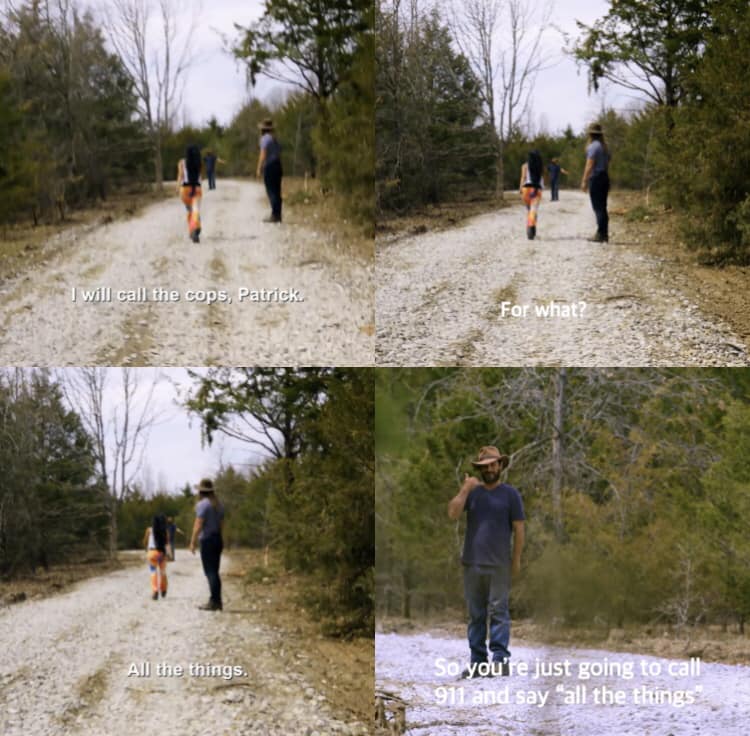
This is a scene from the comedy series "Just One Thing," which is set in a garden setting. The characters mistake their normal walk in the yard for a serious crime, so Patrick immediately calls the police. The text highlights their confusion and eventual realization that they are just going to yell "all the things" to the girl.
simple-description (llama3.2-vision_11b)
This meme is a screenshot from the TV show "The Office" where Michael Scott (played by Steve Carell) is on a phone call with 911. He's trying to explain the situation to the operator, but his explanation is absurd and humorous. The meme is captioned "I will talk to the cops, I will call the cops" and is meant to be a humorous take on the absurdity of Michael's situation.
detailed-analysis (gemma3-27b-vision)
Okay, let's break down this image sequence from what appears to be a dramatic television series (potentially You based on visual cues and dialogue) using the requested theoretical frameworks. It's important to note that with only four panels and limited context, these analyses will be interpretive and focus on potential interpretations, not definitive conclusions.
Visual Description
The image is comprised of four panels arranged in a grid, appearing to be screengrabs from a television show or movie. The setting is a gravel path winding through a sparsely wooded area. The scene is characterized by muted, natural colors – predominantly greens, browns, and grays. A young child in a bright yellow dress is walking ahead on the path, moving away from two adult figures who are engaged in a tense conversation. One figure is a man, apparently named Patrick, dressed in a blue shirt and a baseball cap, and the other figure is a woman, whose face is not fully visible. The framing focuses heavily on the pathway and the distance between the figures, emphasizing separation and conflict. The angle is mostly at eye level, giving a sense of direct observation of the conflict. The lighting is natural, suggesting daytime.
Foucauldian Genealogical Discourse Analysis
This scene lends itself well to a Foucaultian reading, particularly concerning power dynamics and discourse. The statement “I will call the police” and the response “For what?” immediately establishes a power struggle rooted in the discourse of law and control.
- Power/Knowledge: The threat to call the police isn't simply about resolving a conflict; it’s a demonstration of power through invoking the authority of the state and its disciplinary apparatus. The woman is attempting to discipline Patrick through the threat of the police, framing his actions as illegal or problematic.
- Genealogy of Policing: The conversation highlights the historical development of policing as a form of social control. The police aren't neutral arbiters of justice; they are embedded in a network of power relations that often reinforce existing social hierarchies. By referencing the police, the woman is deploying this historical apparatus.
- Disciplinary Power: The "All the things" response is particularly interesting. It suggests a history of problematic behavior, a pattern of actions that the woman is now addressing. The woman's use of "all the things" could mean she is not interested in articulating the specific incidents, and is simply saying she is tired of all the inappropriate acts she’s witnessed. This speaks to a broader disciplinary regime where individual actions are categorized and controlled through surveillance and judgment.
Critical Theory
The scene reveals the hidden power structures beneath seemingly simple interactions. Critical theory, in its focus on dismantling power dynamics, can shed light on this.
- Ideology: The act of threatening to call the police can be seen as reinforcing the dominant ideology that the state is the ultimate authority for resolving conflict. It implicitly assumes the legitimacy of law enforcement as a neutral and just institution, potentially obscuring the ways in which the system may be biased or discriminatory.
- Domination & Resistance: The dialogue suggests a power imbalance between the two adults. The woman is attempting to exert control over Patrick through the threat of external authority. Patrick's response ("All the things.") seems to defy the attempt at control, potentially asserting some degree of resistance.
- Communication and Control: The exchange highlights how language is used as a tool for control and manipulation. The woman isn't engaging in rational dialogue; she's using the threat of the police to silence Patrick and assert her dominance.
Marxist Conflict Theory
While not immediately obvious, Marxist conflict theory can illuminate the underlying tension.
- Power Struggle & Control: The argument, at its core, is a conflict over power and control. The woman is attempting to exert control over Patrick, potentially stemming from differing values, beliefs, or life circumstances.
- Social Hierarchy: The conflict could be a manifestation of broader social inequalities, even if it seems personal. The woman's desire to involve the police might suggest a belief in the existing social order and the need to enforce it.
- Unequal Access to Resources: There is something deeper going on that is unknown to us. The woman could be coming from a socioeconomic class where she believes she is above being questioned and Patrick is a threat to her status.
Postmodernism
The ambiguity of "All the things" offers a space for postmodern interpretation.
- Deconstruction of Meaning: "All the things" is a deliberately vague and open-ended statement. It resists easy interpretation and deconstructs the expectation of a clear, rational explanation. This ambiguity challenges the idea of fixed meaning and highlights the instability of language.
- Subjectivity & Narrative: The scene relies on the viewer to fill in the gaps and construct their own narrative. There is no objective truth presented; only subjective perspectives and interpretations. The meaning of the conflict is contingent on the viewer's own experiences and biases.
- Rejection of Grand Narratives: The conflict doesn't fit neatly into any overarching narrative or ideology. It's a fragmented, localized moment of tension that resists generalization.
Queer Feminist Intersectional Analysis
Intersectional analysis, drawing on queer and feminist theory, requires careful consideration.
- Power Dynamics & Gender: The dynamic between the two adults may reflect broader gendered power imbalances. Is the woman positioning herself as the "responsible" adult and Patrick as the "problematic" one in ways that reinforce patriarchal norms? The unknown context is essential.
- Marginalization & Vulnerability: The presence of the child in the scene complicates the analysis. Is the child vulnerable or being used as a pawn in the conflict? Is the conflict rooted in issues of caregiving, safety, or protection?
- Queer Reading: While not immediately evident, a queer reading could explore whether the conflict is related to issues of identity, sexuality, or social norms. Is the conflict related to a deviation from heteronormative expectations?
Important Note: These analyses are speculative due to the limited context provided by the images. A more thorough interpretation would require knowledge of the full narrative and the characters' motivations.
Let me know if you’d like me to elaborate on any of these theoretical perspectives or explore other potential interpretations.
simple-description (llama3.2-vision)
The meme is a screenshot from the TV show "The Office" featuring Dwight Schrute, where he's responding to a 911 call. The image shows Dwight in the woods, speaking into a phone, with a caption of "911 Operator: 911, what's your emergency?" and Dwight's response is "I am a beet farmer, I am a beet farmer. I will not come out. I will not come out. I will not come out."
tesseract-ocr
"a re Sar i : % m* % ' F 4 4 =| ay . L : Pu a ——-" ‘Ts ont ~ S ee (= i ee ue ase eh \¥i , P ay a =s &é ’ ee 3 ae ee ~ ae Sa ee gue cd a ue ee —s = Phe 2, eS