First Seen
2023-11-13T06:19:31+00:00
simple-description (qwen3.5_2b-q8_0)
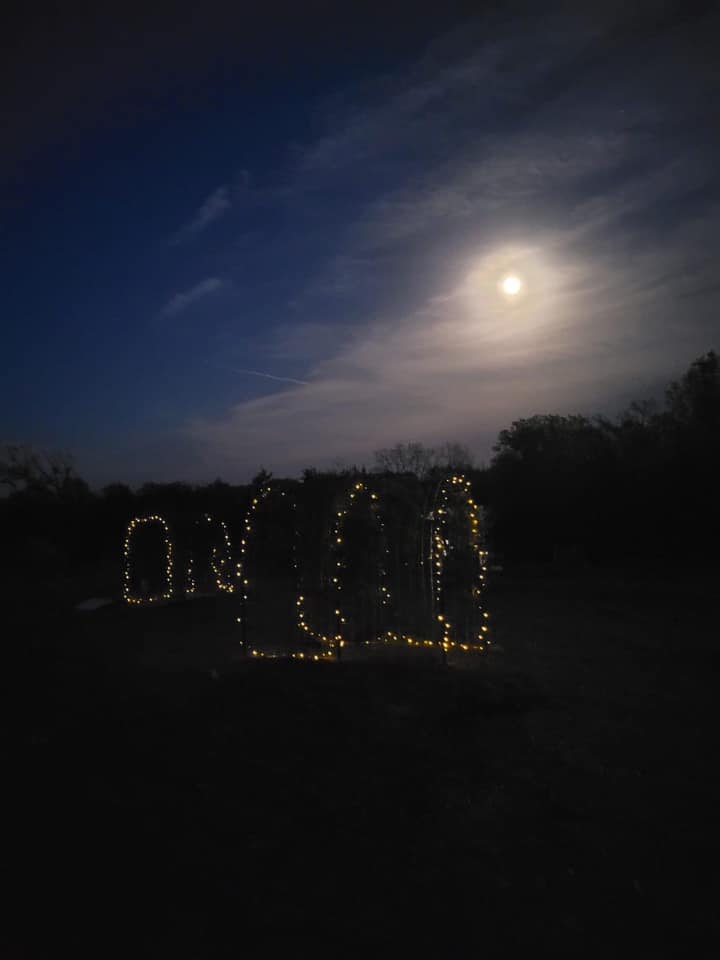
In the context of "The Garden," the meme is displayed literally. Large, glowing wire frames are arranged in the foreground to spell out the text "ON 2024," which appears to be set up as an illuminated garden arch or gate against a dark night sky.
simple-description (llama3.2-vision_11b)
The meme is an image of a garden at night, with a pathway of lights leading to a large tree. The text "Garden of Light" is written in a whimsical font above the tree.
detailed-analysis (gemma3-27b-vision)
Okay, let's break down this image through the lenses you've requested. Given the subject matter and aesthetic, some analyses will be more pronounced than others.
Visual Description
The image depicts a dark night scene. A large, bright full moon dominates the upper portion of the frame, partially obscured by thin clouds. Below, silhouetted against the darkness, is a structure formed by a string of bright, yellow/white lights. The lights trace the outline of a dinosaur, seemingly a brontosaurus or similar long-necked herbivore. The dinosaur shape is somewhat simplified and rendered as a basic line drawing. The surrounding landscape appears to be trees and foliage, creating a dark, indistinct background. The overall mood is serene, slightly mystical, and somewhat nostalgic, evoking a sense of wonder and a connection to the past. There's a strong contrast between the darkness and the light of the moon and dinosaur, creating dramatic effect.
Foucauldian Genealogical Discourse Analysis
This image lends itself to Foucauldian analysis through the ways in which the dinosaur represents a constructed knowledge system.
- Discourse of Paleontology/Natural History: The dinosaur isn't the dinosaur, but rather a representation of a dinosaur constructed through the discourse of paleontology, museum displays, popular science media, and historical reconstruction. The shape itself is not a neutral representation, but is an outcome of historical scientific interpretations and shifts in understanding. The "truth" of the dinosaur is not inherent, but produced by these discourses.
- Power/Knowledge: The very act of creating this illuminated dinosaur shape speaks to the power we ascribe to scientific knowledge. We accept this shape as a reasonable approximation of a creature that existed millions of years ago, exercising power by asserting that a representation can signify the truth.
- Genealogy: We could trace the history of how our understanding of dinosaurs has shifted – from early, monstrous depictions to more scientifically informed reconstructions – showing how power/knowledge regimes have changed over time. The specific shape of this dinosaur (a long-necked herbivore) might reflect a period when this type of dinosaur was particularly emphasized in popular culture.
- Discipline: The creation of this illumination is also a kind of disciplinary practice. It involves surveying and claiming the landscape (through lighting), organizing the world in a way that reflects our understanding, and imposing a visual order on the darkness.
Critical Theory
Applying critical theory, we can examine the image as a cultural product revealing deeper societal anxieties and ideologies.
- Commodification of Wonder: The dinosaur, a symbol of prehistoric power and mystery, is now reduced to a decorative light display. This embodies the commodification of wonder and the tendency to turn experiences into consumer goods. The "magic" of the dinosaur is flattened into a spectacle for enjoyment.
- Nostalgia and Escapism: The image evokes nostalgia for a lost past (the age of dinosaurs) and a desire to escape the present. This can be seen as a symptom of modern alienation and dissatisfaction, where people turn to fantasies and past eras for solace.
- The “Natural” World as Constructed: The image presents the dinosaur as part of the “natural world.” However, it’s important to remember that even our conception of "nature" is a cultural construct, shaped by ideologies, science, and human intervention. This display reinforces a certain (and potentially romanticized) view of the past, ignoring the complex ecological realities of the dinosaur era.
Marxist Conflict Theory
The connection to Marxist conflict theory is weaker in this image, but still present.
- Control of Space and Spectacle: The act of illuminating the landscape with a dinosaur can be seen as a demonstration of power—the ability to control the environment and create a spectacle. This aligns with the Marxist idea that power structures often manifest in the control of resources and spaces. The spectacle serves a function of distraction, entertainment, and potentially reinforcing existing social hierarchies.
- Alienation and Consumption: The dinosaur light display could be interpreted as a form of commodity fetishism, where the “aura” of the past (represented by the dinosaur) is attached to a manufactured object. This can contribute to alienation by emphasizing consumption over genuine connection to history or nature.
Postmodernism
The image is quite fitting for a postmodern interpretation.
- Simulacra and Simulation: The illuminated dinosaur is a simulacrum – a copy without an original. It’s not a real dinosaur, but a representation that exists only as a simulation. The image emphasizes the loss of authenticity and the increasing prevalence of representations over reality.
- Intertextuality: The image draws on multiple cultural texts—dinosaurs as represented in science museums, popular culture (Jurassic Park, etc.), and childhood fantasies. It’s a remix of existing signs and symbols, lacking a singular, original meaning.
- Fragmentation of Meaning: The juxtaposition of a prehistoric creature with modern lighting technology creates a sense of fragmentation and disorientation. It disrupts traditional narratives and challenges the idea of a coherent, unified worldview.
Queer Feminist Intersectional Analysis
This is the most challenging lens to apply, but not entirely absent.
- Challenging Heteronormative Temporal Structures: The dinosaur, as a creature from a “deep time” predating human civilization, can be seen as a disruption of linear, human-centric understandings of history. This can resonate with queer and feminist challenges to dominant temporal frameworks that prioritize patriarchal narratives.
- Reclaiming “Monstrosity”: Dinosaurs are often depicted as "monstrous" creatures. A queer feminist reading could reclaim this label, challenging the binary of "normal" versus "monstrous" and celebrating difference and non-conformity. The light display might be read as an act of queering the landscape, injecting a subversive element into a traditional setting.
- Control of Narrative and Representation: Who decided to illuminate a dinosaur? Who is this display aimed at? The act of choosing this representation is not neutral, and it reflects the power dynamics that shape cultural narratives. Intersectional analysis would ask how race, class, gender, and other factors might influence the creation and reception of this image.
I hope this breakdown is helpful! Let me know if you'd like me to focus on any of these analyses in more detail.
simple-description (llama3.2-vision)
The meme appears to be a dark image with a faint glow in the center. The text "I can see the moon" is likely typed in a bold, white font, but it's not visible due to the dark background. The image is likely a play on words, referencing the phrase "I can see in the dark," but replacing "in" with "the moon" to create a pun.
tesseract-ocr
- = Sia le ‘ig o, Rts os far be) acs a: Sie * See c *, 4 to G ye ie <a s ee ee oe