First Seen
2023-11-29T21:11:08+00:00
simple-description (qwen3.5_2b-q8_0)
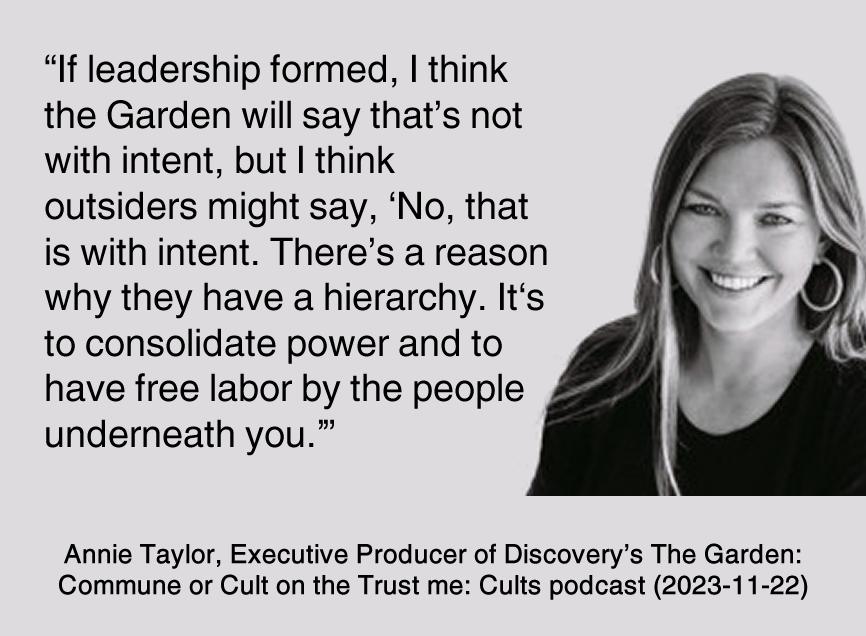
This meme features a black-and-white photo of Annie Taylor, the executive producer of The Garden, alongside a quote from the "cults podcast." The text explains that a group like a cult isn't just a social experiment, but a business formed with a hierarchy to consolidate power and force its members to work for free.
simple-description (llama3.2-vision_11b)
The meme is a screenshot of a quote from the TV show "The Office" where the character Andy Bernard says "I'm a friend first, and a boss second. Probably an entertainer third." This quote is used in a humorous way to describe the character Andy Bernard's personality.
detailed-analysis (gemma3-27b-vision)
Here's an analysis of the image and quote, broken down into relevant theoretical sections.
Visual Description
The image is a headshot of Annie Taylor, identified as the Executive Producer of Discovery’s "The Garden: Commune or Cult" podcast. She appears to be a white woman, smiling and looking directly at the camera. Her hair is blonde, styled in waves, and she is wearing a dark colored shirt, likely black or a very deep navy. The background is a blurry dark grey. The image is professional and presents Annie Taylor as approachable and confident. The overall impression is one of a media professional involved in investigative work.
Foucauldian Genealogical Discourse Analysis
Annie Taylor's statement is rich for Foucauldian analysis. Her comment highlights a discourse around the formation of "The Garden" and specifically, a power dynamic. She points to a divergence between internal explanations (The Garden's framing that hierarchy wasn't intentionally created) and external critiques. This divergence is central to Foucault's work.
- Power/Knowledge: The statement reveals how knowledge is intertwined with power. "The Garden" constructs its own narrative to legitimize its structure. Taylor suggests this narrative is a performance of power—a way to mask the underlying realities. The framing is not about truth, but a tool to control how the group is perceived.
- Genealogy: The mention of an internal vs external viewpoint opens a space for a genealogical approach. A genealogical analysis would trace the historical emergence of the hierarchy and the justifications around it. What historical conditions allowed this structure to arise? How have these justifications shifted over time? What makes the concept of a “commune” or “cult” a discourse that is itself produced within power dynamics?
- Discipline & Control: The phrase “free labor” is crucial. This points to a system where individuals are expected to contribute without fair compensation, which can be seen as a form of subtle discipline and control. By framing it as 'free' it obscures the exploitative nature of the arrangement.
Critical Theory
Taylor's statement lends itself to a Critical Theory analysis, particularly regarding the dynamics of ideology and domination.
- Ideology: "The Garden's" claim that hierarchy "wasn't with intent" is a prime example of ideology at work. It’s a way of presenting a fundamentally unequal structure as natural or accidental, thereby masking its exploitative nature. The narrative is designed to maintain the status quo.
- Domination & Emancipation: The statement inherently positions Taylor as an external critic, challenging the internal logic of the group. Her claim that there is intent behind the hierarchy signals a desire for exposing the power dynamics and potentially freeing individuals from potentially manipulative structures. This is an attempt to unveil what is hidden by the ideological claims of the group.
- The Culture Industry: From a Frankfurt School perspective, "The Garden" itself can be viewed as a ‘culture industry’ product. It offers a constructed narrative, potentially masking its true workings. Taylor, as an investigator, is attempting to “break” the spectacle.
Marxist Conflict Theory
The most striking element of Taylor's statement for a Marxist analysis is the explicit mention of "free labor."
- Exploitation & Surplus Value: "Free labor" is a key indicator of exploitation. In Marxist terms, this refers to the labor performed by individuals that isn't fairly compensated. This labor contributes to the accumulation of "surplus value" – the profit accumulated by those in power. The hierarchy, therefore, is not merely a matter of structure but a material arrangement designed to extract value from its members.
- Class Conflict: The statement implies a class division within "The Garden" – those who benefit from the "free labor" of those below them. The hierarchy serves to perpetuate this unequal power dynamic and maintain the existing class structure.
- False Consciousness: The claim that the hierarchy wasn’t ‘with intent’ could be seen as a form of false consciousness – a way of obscuring the true nature of exploitation and preventing those being exploited from recognizing their own oppression.
Postmodernism
A postmodern reading would emphasize the fluidity of meaning and the constructed nature of truth.
- Deconstruction: Taylor’s statement can be seen as a form of deconstruction. She is challenging the internal narrative of "The Garden" and exposing the contradictions within it.
- Metanarratives: The claim that the group attempts to deny intentionality undermines any claims to a universal ‘truth’ about its structure. It shows how "The Garden" is constructing its own metanarrative to justify its power relations.
- Subjectivity & Power: The statement hints at a power struggle over the construction of meaning. "The Garden" tries to impose its interpretation of events, while Taylor attempts to offer an alternative, external perspective.
Let me know if you'd like any of these analyses expanded, or if you'd like me to apply a different theoretical lens.
simple-description (llama3.2-vision)
This meme is a screenshot of a tweet from the Twitter account of the TV show "Succession" with a quote from the show's character, Logan Roy. The quote reads: "In the end, it's not the years in your life that count. It's the life in your years." However, the meme is actually a quote from the show, but it's in a different font and has a slightly different wording.
tesseract-ocr
“If leadership formed, | think the Garden will say that’s not \ with intent, but | think \ outsiders might say, ‘No, that = iW is with intent. There’s a reason _. f= why they have a hierarchy. It‘s ~" OF to consolidate power and to : have free labor by the people £ underneath you.” | Annie Taylor, Executive Producer of Discovery’s The Garden: Commune or Cult on the Trust me: Cults podcast (2023-11-22)