First Seen
2023-11-29T01:27:00+00:00
simple-description (qwen3.5_2b-q8_0)
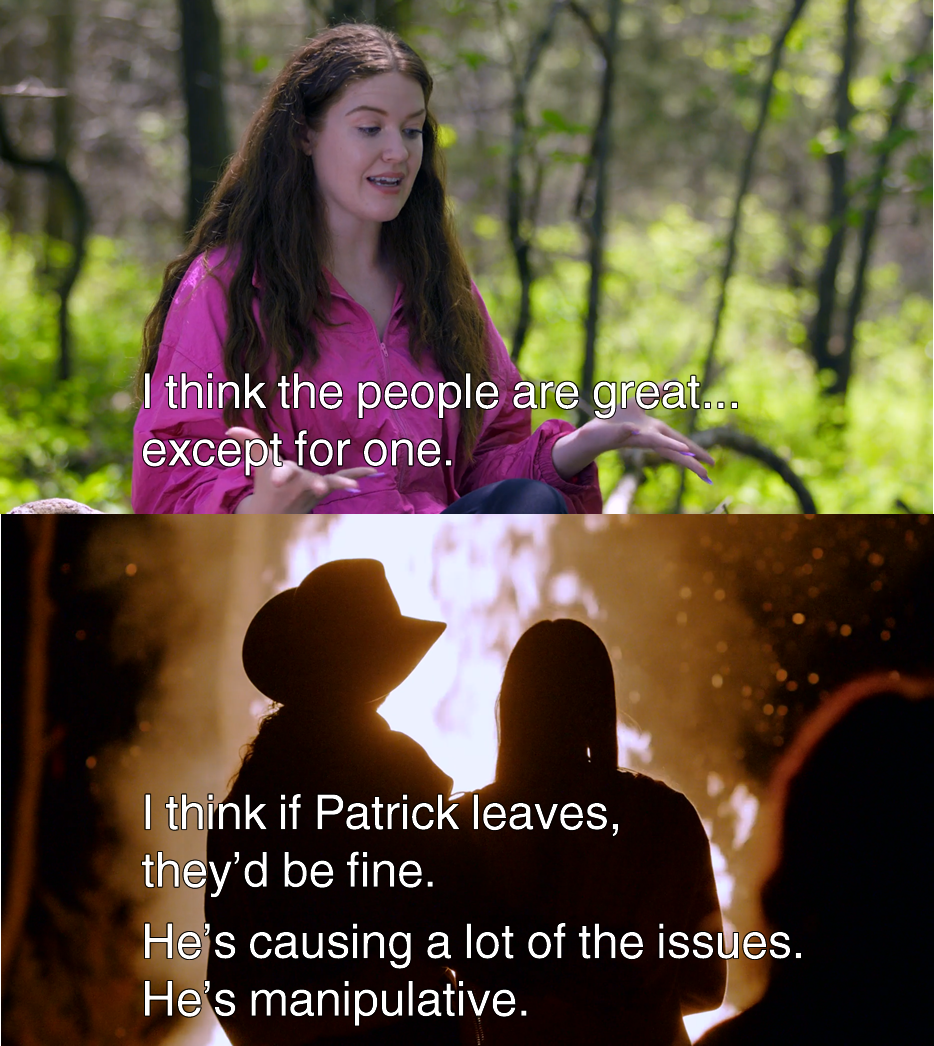
This meme features a woman speaking in a green forest setting while she discusses her opinions on her group members, followed by a transition to a silhouette of two people looking at a fire at night. She claims that while the people are good, "except for one," and specifically blames a person named Patrick for "causing a lot of the issues" and being "manipulative." This joke implies a relationship drama where she is admitting that one specific person is the problem.
simple-description (llama3.2-vision_11b)
The meme is a screenshot from the TV show "The Handmaid's Tale" where June (played by Elisabeth Moss) says "I'd like to say I'm very happy for you, and I'm going to let you get off with it you're so happy and you're so happy you've got to get out for it." The image is captioned "I'd like to say I'm very happy for you, and I'm going to let you get out for it" with the text "I'd like to say I'm very happy for you, and I'm going to let you get out for it" in the context of a garden where a person is saying "I'd like to say I'm very happy for you, and I'm going to let you get out for it"
detailed-analysis (gemma3-27b-vision)
Okay, let's break down this image and its implied context through several theoretical lenses. This seems to be a screenshot from a reality TV show, likely Survivor, given the setting and implied interpersonal drama.
Visual Description
The image consists of two stacked screenshots.
- Top Image: A woman is seated outdoors amidst lush green foliage, presumably a jungle or forested area. She’s wearing a bright pink top. Her facial expression is somewhat pensive or critical. Text superimposed on the image reads: “I think the people are great… except for one.”
- Bottom Image: Depicts a nighttime scene around a campfire. A person wearing a cowboy hat is silhouetted against the fire, only their profile visible. The light and shadows create a sense of mystery and possible antagonism. Text reads: "I think if Patrick leaves, they’d be fine. He’s causing a lot of the issues. He’s manipulative.”
The contrast between the bright, natural light of the first image and the low-light, shadowy second emphasizes a split between observation and perceived problem. The framing suggests a confession or commentary being made.
Foucauldian Genealogical Discourse Analysis
This image can be examined through Foucault’s lens of power/knowledge. The woman’s statement isn't simply an objective observation but a discourse—a system of thought, ideas, and practices—that constructs “Patrick” as a problem.
- Genealogy of “Manipulative”: The term "manipulative" isn’t inherently true or false. Rather, it's a historically and socially constructed category. Foucault would ask how the concept of "manipulation" came to be defined, who benefits from labeling someone as such, and what power dynamics are reinforced by this label. In a game like Survivor, labeling someone "manipulative" can be a strategic move to discredit them and gain allies.
- Power/Knowledge: The woman wields power through her speech. By framing Patrick as the source of conflict, she positions herself as a rational observer and potentially a leader who can resolve the issues. This framing impacts how others perceive Patrick and his actions. The discourse constructs a reality where Patrick is the problem, regardless of objective truth.
- Disciplinary Power: The context of the game, with its rules, alliances, and voting, operates as a form of disciplinary power. Individuals are constantly being evaluated and judged, and the label of "manipulative" is a form of social control.
Critical Theory
Through a Critical Theory lens (drawing on thinkers like the Frankfurt School), we can see how this image reflects broader social dynamics:
- Ideology: The woman’s statement reveals underlying assumptions about how social groups should function. The idea that a single “bad apple” (Patrick) is ruining the group reflects a common ideological belief in individual responsibility, masking the systemic issues that might be at play.
- Domination and Resistance: The dynamic could be seen as a struggle for dominance within the group. The woman’s attempt to define Patrick as “the problem” is a move to consolidate power and control the narrative. Patrick, in turn, might be resisting the established group norms or power structures, leading to his labeling as “manipulative.”
- Hegemony: The ability to successfully label Patrick and gain support from others indicates the operation of hegemony—the dominance of one group’s ideas and values as common sense. If the group accepts the woman's framing of Patrick, it reinforces the power of her worldview.
Marxist Conflict Theory
Applying Marxist principles, we can view the situation as a conflict arising from competition for scarce resources—in this case, power and survival in the game:
- Class Struggle (Analogous): While not a literal class struggle, the competition between players represents a struggle for dominance and access to the ultimate prize. Patrick and the woman are competing for control over the group and its resources (alliances, votes).
- False Consciousness: The other players’ acceptance of the woman’s assessment of Patrick could be seen as a form of false consciousness – they’ve been misled into believing that Patrick is the true obstacle, distracting them from other, more systemic issues within the game.
- Exploitation: Within the game context, players "exploit" each other through alliances, deception, and strategic voting. The label of “manipulative” might be used to justify the exploitation of Patrick, painting him as deserving of being targeted.
Postmodernism
A postmodern reading would focus on the constructed nature of reality and the instability of meaning:
- Deconstruction of Truth: The image challenges the notion of objective truth. The woman’s assessment of Patrick is not a neutral observation but a subjective interpretation, colored by her own biases and strategic goals. There is no inherent “truth” to the claim that Patrick is manipulative; it's simply a constructed narrative.
- Simulacra and Simulation: The entire game context can be seen as a simulation—a hyperreality where authenticity is replaced by fabricated drama and strategic performances. The characters are acting roles, and their interactions are not genuine expressions of their true selves.
- Fragmentation of Identity: The players' identities are fluid and fragmented, shaped by the demands of the game and their attempts to navigate the social landscape.
Queer Feminist Intersectional Analysis
This analysis would require more information about the specific context of the show and the individuals involved. However, we can propose some potential intersections:
- Gender Dynamics: How does gender play a role in how the woman's statement is perceived? Is she positioned as a “caretaker” who is responsible for maintaining group harmony, leading her to frame Patrick as a disruptive force?
- Power and Marginalization: Are there existing power imbalances among the players based on race, class, or other social categories? How might these imbalances affect how Patrick is perceived and targeted? Is he being scapegoated for broader systemic issues?
- Strategic Performance of Gender/Identity: Are the players strategically performing gender or other identity markers to gain an advantage in the game? Does the label of “manipulative” reinforce harmful stereotypes about how certain groups are perceived?
Important Note: This analysis is based on a single image and limited information. A more thorough understanding would require examining the broader context of the show and the individuals involved.
Let me know if you'd like me to elaborate on any of these theoretical lenses or explore other relevant concepts!
simple-description (llama3.2-vision)
This meme is a screenshot from the TV show "The Office" featuring a character named Angela Martin. The image shows Angela looking shocked and upset, with the caption "I think I'm starting to understand why Angela's always so uptight" above a quote from the show.
tesseract-ocr
~— et @w “9 oF oF. oe > 4 Bren '< . . , ? = ’ ; ‘ ; . j 0 An. ' # : ] ; So taligl atatss Lil EWicKOliccie. eS or- 1M (0) 01g moe - “Ee = aw Waa ed | they’d be fine. Hes causing a lot of the isswes. Heis manipulative. -