First Seen
2023-05-10T21:03:42+00:00
simple-description (qwen3.5_2b-q8_0)
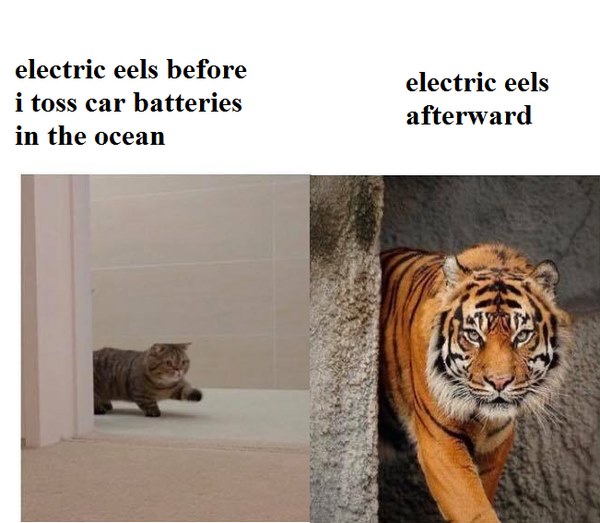
This meme plays on the absurdity of the phrase "throwing car batteries in the ocean." The text "electric eels before" pairs with a picture of a cat, while the text "electric eels afterward" pairs with a picture of a tiger. The caption "i toss car batteries in the ocean" suggests that "electric eels" were spotted before someone tossed car batteries in the water, and then the "electric eels" (or the batteries) turned into a tiger. This connects to the category by referencing the strange activity of tossing batteries in the ocean as a cause for this surreal change.
simple-description (llama3.2-vision_11b)
The meme is a humorous comparison between throwing batteries into the ocean and throwing electric eels into the ocean. The text "electric eels" is paired with the phrase "throwing batteries into the ocean," implying that electric eels are being compared to batteries in terms of their potential to cause harm when thrown into the ocean.
detailed-analysis (gemma3-27b-vision)
Okay, let's break down this bizarre image pairing with the requested theoretical lenses. It's...a lot.
I. Visual Description
The image is a stark diptych. On the left, titled "electric eels before i toss car batteries in the ocean," we see a grey tabby cat standing in a minimalist, brightly lit, almost sterile white room. The cat appears to be looking slightly downwards, its pose suggesting a degree of contemplation or perhaps uncertainty. The composition is simple, with the cat centrally positioned.
On the right, titled "electric eels afterward", is a close-up photograph of a tiger, partially obscured by what appears to be a tree trunk. The tiger is staring intensely at the viewer, its gaze being the focal point. The background is dark and textured, creating a strong contrast with the tiger's orange and black stripes. The lighting is dramatic, emphasizing the animal’s power and intensity.
The visual contrast between the two images is striking: a domestic, muted animal in a clean, artificial environment versus a wild, vibrant predator in a natural, darker setting. The absurdity of the captions adds to the overall surreal quality of the image.
II. Foucauldian Genealogical Discourse Analysis
The pairing, considered through a Foucauldian lens, raises questions of power/knowledge and the construction of subjectivity. The "electric eel" is the central subject, though never visually represented, instead shown by the cat and tiger. The act of tossing car batteries into the ocean (a destructive, environmentally damaging act) is the "discursive event" that supposedly transforms the eels.
- Discourse and Power: The caption establishes a connection (however illogical) between this environmental action and a shift in being ("before" vs. "after"). We’re invited to consider what “electric eels” are defined as by this act. What power dynamics does this imply? Is it a metaphorical assertion of control over nature?
- Genealogy: A genealogical analysis would ask how the idea of the "electric eel" as a changing entity came to be. It's not a biological process represented here, but a constructed narrative. The discourse surrounding environmental impact and animal transformation are being subtly played with.
- Episteme: The very act of juxtaposing the images challenges the established episteme (the underlying order of knowledge) about electricity, ecology, and animal identity. The image doesn’t fit neatly into accepted categories, forcing a re-evaluation of what “transformation” even means.
III. Critical Theory
From a Critical Theory perspective, particularly drawing from the Frankfurt School, the image can be read as a critique of the alienation of modern life and the degradation of the natural world.
- Commodification & Objectification: The "electric eels" are not treated as living beings with intrinsic value, but as objects affected by an external, destructive force (the batteries). This reflects the commodification of nature in capitalist society.
- Instrumental Reason: The act of throwing batteries into the ocean is an example of instrumental reason – prioritizing efficiency and control over ethical considerations and ecological sustainability. The "electric eels" are merely the object of this rational but ultimately harmful action.
- Loss of Authenticity: The sterile environment of the cat's image contrasts with the more "authentic" (though still constructed) wilderness of the tiger image. This could be interpreted as a commentary on the loss of connection to nature in modern, urban life.
IV. Marxist Conflict Theory
Though a stretch, a Marxist reading could frame the image as a metaphor for class struggle and ecological exploitation.
- Exploitation of Nature: The discarded batteries represent the capitalist drive for resource extraction and the subsequent environmental damage inflicted upon the natural world (“electric eels”).
- The "Before" and "After" as Stages of Oppression: The cat, a domesticated animal reliant on human care, represents a subdued or controlled state. The tiger, a wild predator, represents a potential for resistance or liberation – the outcome of rejecting the status quo.
- Alienation: Both images highlight the alienation of living beings – the cat from its natural instincts and the eels from their natural habitat – due to the forces of control and exploitation.
V. Postmodernism
Postmodernism is probably the lens that best fits the absurdity of this image.
- Deconstruction: The image actively deconstructs meaning. The connection between the captions and the images is illogical, challenging traditional notions of coherence and representation.
- Simulation & Hyperreality: The image is a simulation of transformation, a constructed narrative that bears little relation to actual events. It highlights the postmodern condition of living in a world of signs and simulations, where reality is increasingly mediated by representation.
- Irony & Parody: The image is inherently ironic and parodic, poking fun at grand narratives of progress and environmentalism. It suggests that meaning is fluid, subjective, and ultimately arbitrary.
VI. Queer Feminist Intersectional Analysis
This is the most difficult fit, but we can explore it by looking at disruption and challenging binaries.
- Disrupting Categorization: The “electric eel” is never actually shown. Instead, it's represented by other animals, disrupting typical categorization. This can be read as a queer act of challenging rigid definitions of identity.
- Animal Agency: While the animals themselves are not explicitly given agency, the image challenges the anthropocentric viewpoint, forcing us to consider their existence outside of human narratives. This is a core tenet of feminist animal studies.
- Binary opposition and transformation The image sets up a binary of “before” and “after,” but the transformation is illogical and unpredictable. This can be interpreted as a queer disruption of traditional narratives of linearity and progression.
Conclusion
This image pairing is profoundly strange and open to multiple interpretations. Its strength lies in its ability to provoke thought and challenge conventional ways of seeing the world. Through the lens of these various theoretical frameworks, we can see how it functions as a critique of power, alienation, and the constructed nature of reality. The juxtaposition and absurdity create a space for questioning assumptions and exploring alternative possibilities.
Let me know if you'd like me to expand on any of these interpretations or analyze the image through a different lens!
simple-description (llama3.2-vision)
This meme is a visual joke that compares two images side by side. On the left, a picture of a cat is shown with the caption "electric eels before". On the right, a picture of a tiger is shown with the caption "electric eels after". The implication is that the cat, which is known for being lazy and sedentary, has somehow transformed into a powerful and intimidating tiger, much like how electric eels are known for their ability to shock and defend themselves.
tesseract-ocr
ca ac is electric eels A ossieasparteries afterward in the ocean P TYAS? ae Ae, r. ‘ Ly ee