First Seen
2024-05-28T01:09:27.164085+00:00
simple-description (qwen3.5_2b-q8_0)
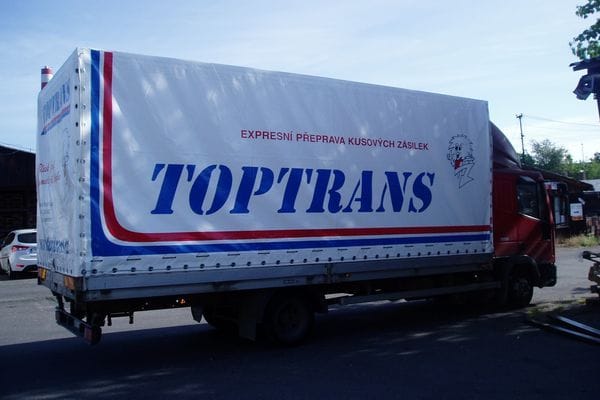
This image is a visual representation of a Trans Portation vehicle, prominently displaying the large blue text TOPTRANS on the side of a large cargo truck. The descriptive text "EXPRESNÍ PŘEPRAVA KUSOVÝCH ZÁSILEK" on the back translates to "Express transport of individual shipments," indicating that this vehicle is used for rapid delivery of packages.
simple-description (llama3.2-vision_11b)
The meme is a photo of a Polish truck with the words "Trans Portation" (a play on words with "transportation") written on the side. The joke is that the truck is named "Trans Portation" and is carrying a load of itself, implying that it's a truck that's transporting itself, which is a clever play on words.
detailed-analysis (gemma3-27b-vision)
Okay, here's an analysis of the image, broken down into sections as you requested. It's important to note that applying all these theoretical lenses to a single image can feel forced, so I've focused on where they provide the most insightful perspective. I will state where a section isn’t applicable.
Visual Description
The image depicts the side of a large, white box truck. The truck appears to be part of a commercial transportation company called "TOPTRANS." The name is prominently displayed in bold, blue lettering with a red outline. Above the name is a smaller phrase in a different font, presumably in Czech (likely, "Expresní přeprava kusových zásilek," meaning "Express Parcel Delivery"). A small logo or graphic (a blue bird?) is located to the right of this phrase.
The truck's body is covered in a pattern of small dots and lines. The undercarriage is dark and appears to be metal. The truck is parked outdoors in a somewhat cluttered environment—the edge of a building and some other vehicles are visible in the background, suggesting a commercial or industrial area. The day is bright and sunny. The truck is angled away from the viewer, showing primarily the side and rear corner.
Foucauldian Genealogical Discourse Analysis
This image can be understood through Foucault's lens of discourse and power/knowledge. The truck itself is a material manifestation of a discourse around logistics, efficiency, and commodity movement.
- The Discourse of Speed & Efficiency: "TOPTRANS" and the phrase "Expresní přeprava" (Express Delivery) embody the contemporary obsession with speed and seamlessness in modern capitalism. This isn't just about getting packages delivered; it constructs a desire for instant gratification and efficiency as desirable values. The very language used shapes our expectations.
- The Surveillance of Movement: While not directly visible, the trucks themselves contribute to a logistical network that tracks and surveils the movement of goods. Each parcel likely has a tracking number, linking it to a data stream. This highlights the increasing "panopticism" of modern life—being constantly monitored even without direct observation.
- Normalization of Global Supply Chains: The truck is a node in a vast network of transportation that masks the often-exploitative and environmentally damaging realities of global supply chains. The smooth, white exterior of the truck presents a clean, efficient image, obscuring the labor and resources required to move goods. The genealogy of this truck could trace the historical development of trucking and logistics, revealing power dynamics and changes in the organization of labor.
- Discipline of Space: Trucks themselves discipline space. They require roads, parking, loading docks, etc., and organize the landscape in particular ways to accommodate them.
Marxist Conflict Theory
This image is highly relevant to Marxist analysis.
- Means of Production & Transportation: The truck represents a crucial part of the means of transportation, a critical element in the capitalist mode of production. It facilitates the movement of goods from production to consumption.
- Exploitation of Labor: The goods being transported are likely the products of exploited labor. The truck itself is driven by a worker, whose labor contributes to the profit of the company. The image doesn’t show the conditions of the workers involved in the chain of transportation.
- Commodification of Space: The truck’s movement represents the commodification of space and time—the turning of distance into a marketable service.
- Capital Accumulation: The very existence of this truck contributes to the ongoing accumulation of capital for the company. The more efficiently they can move goods, the more profit they can generate.
- Class Conflict: The image subtly represents the underlying class conflict inherent in capitalism. The truck represents the interests of the owners of capital (the company), while the labor of those involved in transport (drivers, loaders, etc.) is largely invisible.
Postmodernism
While less directly applicable than the previous lenses, postmodern concepts can be identified.
- The Simulacrum & Hyperreality: The image of the truck is a sign referring to a network of logistics. It’s increasingly removed from the actual work of transport—the truck is a representation of movement rather than the movement itself. It’s a "simulacrum," a copy without an original.
- Fragmentation & Disconnection: The truck, as part of a global logistics network, embodies the fragmentation of production and consumption. It is disconnected from the original source and ultimate destination of the goods it carries.
- Deconstruction of Meaning: The image itself doesn’t have a fixed meaning. It can be interpreted in multiple ways, depending on the viewer's perspective and theoretical framework.
- Emphasis on Surface & Style: The truck’s clean, white exterior and bold lettering emphasize surface appearance and branding over substance. This reflects a broader postmodern emphasis on style and image.
Queer Feminist Intersectional Analysis
This lens requires more extrapolation as the image doesn’t immediately present gender or queer issues.
- Gendered Labor: While not visible, the trucking industry has historically been dominated by men. Understanding the image requires asking who drives this truck, and under what conditions. A feminist analysis would explore the gender dynamics of the profession, and potential experiences of sexism or inequality.
- Precarious Labor & Intersectionality: Workers in the transportation sector, particularly those driving for gig economy companies, often face precarious employment conditions and low wages. An intersectional analysis would consider how factors like race, ethnicity, immigration status, and disability might further exacerbate these vulnerabilities.
- The "Hidden" Labor of Logistics: The truck's clean exterior obscures the often-invisible labor of women and marginalized groups involved in the logistics supply chain—sorting, packaging, loading, etc. These roles are often underpaid and undervalued.
- Spatial Justice & Access: Transportation infrastructure, including trucking routes, can have uneven impacts on different communities. An intersectional approach would consider how transportation policies and infrastructure projects might perpetuate social inequalities based on race, class, and gender.
I hope this provides a comprehensive and nuanced analysis of the image from multiple theoretical perspectives. Let me know if you'd like me to elaborate on any particular aspect.
simple-description (llama3.2-vision)
This meme is a picture of a truck with the logo "DHL" (a global logistics company) on the side, but it's been altered to say "DHL" is now "DHL" and the "L" has been replaced with a picture of a monkey's face. The caption "DHL monkey" is written above the monkey's face.
tesseract-ocr
ae | j 4 j yy : th ial % \ we LOPTRANS