First Seen
2023-10-28T17:47:42+00:00
simple-description (qwen3.5_2b-q8_0)
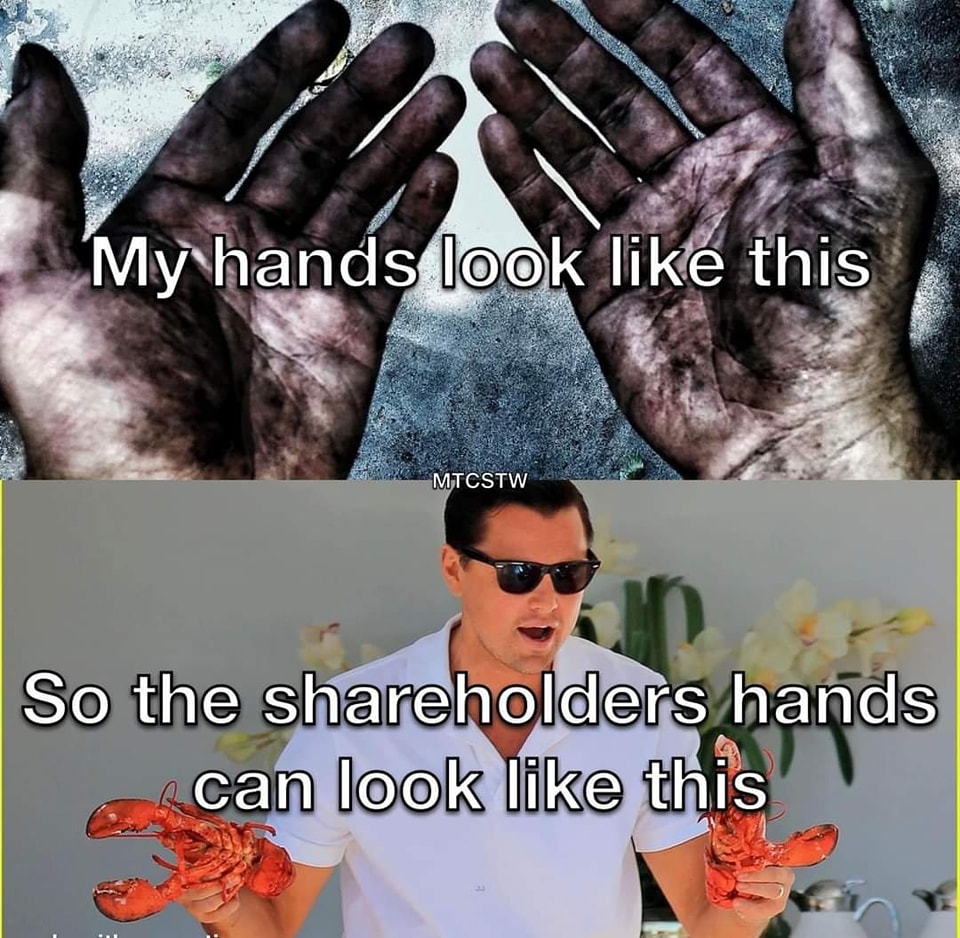
This meme plays on the perceived difference between workers and business owners, a central argument in union discussions. The top image displays grimy, blackened hands held up, accompanied by the text "My hands look like this," representing the physical exhaustion and dirt of manual labor. The bottom image features a man holding two lobsters with the caption "So the shareholders hands can look like this," a play on the previous line that omits the "hand" and the "s." The joke implies that while worker hands are dirty, the owner's ("shareholders") hands are somehow cleaner or better off.
simple-description (llama3.2-vision_11b)
The meme is a play on the phrase "my hands" and "your hands" in the context of a union, implying that the speaker's hands are being used to represent the collective interests of the union, while the employer's hands are being used to represent their own interests. The image is likely a split-screen comparison of the speaker's hands, which are worn and rough, with the employer's hands, which are clean and manicured. The text "My hands" and "Your hands" appears above and below the image, respectively.
detailed-analysis (gemma3-27b-vision)
Okay, let's break down this meme using the requested theoretical frameworks. It’s a pretty rich image for analysis!
Visual Description
The meme is a two-panel image.
- Top Panel: A close-up of two hands covered in black grime. The hands appear work-worn, suggesting manual labor. The background is a nondescript blue. A small watermark "MTCSTW" is visible. The text overlaid on this image reads “My hands look like this”.
- Bottom Panel: A man wearing sunglasses, a crisp white button-down shirt, and a blazer stands casually, holding a cluster of lobsters. The background is a blurred, upscale interior (possibly a restaurant/kitchen). The text reads “So the shareholders hands can look like this”.
The juxtaposition of the grimy hands and the luxurious display of lobster immediately signals a contrast between labor and wealth.
Marxist Conflict Theory
This meme is almost a textbook example of Marxist conflict theory in visual form. The central theme is the exploitation inherent in a capitalist system.
- Bourgeoisie vs. Proletariat: The grimy hands represent the proletariat – the working class whose labor produces value. The man and the lobster symbolize the bourgeoisie – the owners of capital who benefit from that labor. The lobster, a luxury item, is presented as a product made possible by the worker's toil.
- Exploitation of Surplus Value: The meme suggests that the worker's labor produces more value than they receive in wages. This surplus value, in this case, manifests as the ability for shareholders (represented by the man) to indulge in luxuries like lobster.
- Class Consciousness: The meme could be interpreted as an attempt to raise class consciousness – to make viewers aware of the power dynamics and inequalities inherent in the capitalist system. The direct comparison provokes a feeling of unfairness. The image points to the inherent contradictions within capitalism – it relies on the exploitation of labor to generate wealth, but this exploitation is often hidden or normalized.
Critical Theory
From a Critical Theory perspective, the meme is a form of social critique. It questions the status quo and exposes the power structures that maintain inequality.
- Dominant Ideology: The meme challenges the dominant ideology that justifies wealth inequality. The assumption is that wealth and luxury are earned through merit or hard work, while labor is often devalued or unseen. The meme exposes the structural forces that benefit some at the expense of others.
- Power Dynamics: The meme highlights the asymmetrical power dynamics between labor and capital. The man/shareholder has the power to enjoy luxuries, while the worker is reduced to the physical toll of their labor. This imbalance is not presented as natural or inevitable but as a result of systemic exploitation.
- Critique of Consumerism: The lobster itself can be seen as a symbol of conspicuous consumption. It represents a lifestyle made possible by the exploitation of others.
Foucauldian Genealogical Discourse Analysis
A Foucauldian analysis wouldn’t focus on a ‘truth’ about exploitation, but rather on the discourse that surrounds labor and wealth.
- Power/Knowledge: Michel Foucault would argue that power operates not just through repression but through the production of knowledge. The meme disrupts the accepted narrative of "hard work leading to success," exposing the power relations that define labor and wealth.
- Disciplinary Power: While not explicitly about discipline, the contrast evokes a sense of how labor is normalized and often invisible. The worker’s hands are literally marked by their labor, making it visible, while the “shareholder’s” hands are clean and untouched – suggesting a system that allows certain individuals to remain distanced from the work that sustains them.
- Genealogy of the Image: A genealogical approach would trace the historical development of images depicting labor and wealth. How have images of work and leisure been used to justify social hierarchies and power imbalances? The meme draws on a long tradition of visual rhetoric that contrasts the exploited and the exploiting.
Note: The other categories (Postmodernism, Queer Feminist Intersectional Analysis) don’t have as strong a presence in this particular meme, though interpretations are possible. A postmodern reading might focus on the meme's self-referentiality or deconstruction of established narratives, and a queer/feminist reading could examine how gender and sexuality intersect with class exploitation. However, the primary thrust of the meme is clearly rooted in Marxist and Critical Theory.
Let me know if you'd like a deeper dive into any of these theoretical frameworks as they apply to this image!
simple-description (llama3.2-vision)
This meme is a humorous comparison between the cleanliness of one's hands and the state of their palms after using a computer keyboard for an extended period. The image juxtaposes two contrasting hand states: one with clean, well-manicured hands and the other with grimy, stained hands. The text reads: "My hands / My hands after a day of typing".
tesseract-ocr
4 a é f oy. j A (ges : PA Naietaels lool pS aS P wr & LS wn Piinetilere els xcan look like thi 1 & = = h s = iy ~