First Seen
2023-06-20T21:38:09+00:00
simple-description (qwen3.5_2b-q8_0)
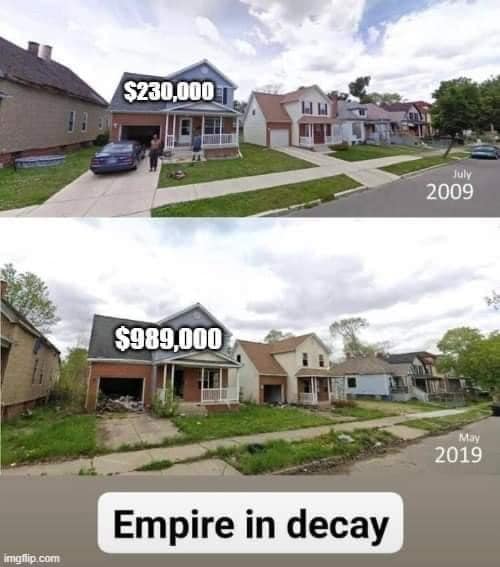
This meme illustrates the rapid urban decay of a specific neighborhood. In 2009, a large, pristine suburban home was valued at $230,000 before the image was taken. By 2019, the same property has crumbled into disrepair, revealing a massive hole in the driveway and overgrown grass where the garage once stood. The property's value has plummeted to just $989,000, perfectly capturing the caption "Empire in decay."
simple-description (llama3.2-vision_11b)
The meme is a before-and-after comparison of two photographs of a house, with the first showing a well-maintained property and the second depicting a dilapidated, abandoned house. The text "From 2008 to 2019" appears below the images, and the caption "When your investment strategy doesn't pay off" is overlaid on the second image.
detailed-analysis (gemma3-27b-vision)
Okay, here's an analysis of the image, broken down into sections based on the theoretical lenses you requested. I'll include sections only where the theoretical framework is relevant to the image. Given the image content, certain frameworks will be more prominent than others.
I. Visual Description
The image presents a side-by-side comparison of two street views, presumably of the same neighborhood, taken ten years apart.
- 2009 Image: Shows a well-maintained, traditionally styled suburban neighborhood. The houses appear moderately priced ($230,000) and are surrounded by neatly kept lawns. A blue car is parked in one driveway. It's a sunny day.
- 2019 Image: The same houses are visible, but the overall condition appears considerably degraded. Lawns are overgrown, some houses show signs of disrepair (e.g., peeling paint), and the general appearance is less cared-for. The price point is significantly higher ($989,000). The sky is cloudy.
- Overall Impression: The image strongly suggests a change in the neighborhood—a transition from an average, comfortable suburban setting to one that is either gentrifying and inaccessible, or simply deteriorating through abandonment, or a combination of the two. The caption "Empire in decay" adds a critical framing.
II. Marxist Conflict Theory
This image is powerfully interpretable through a Marxist lens.
- Class Struggle and Capital: The drastic increase in housing prices ($230,000 to $989,000) is a prime example of capital accumulation. It indicates that a neighborhood once accessible to a broader range of people has become economically exclusive. This highlights the inherent conflict between capital (those who own and control wealth) and labor (those who must work for wages). As capital accumulates, it can push out lower and middle-class residents.
- Gentrification and Displacement: The image strongly suggests gentrification. While deterioration is visible, the price increase indicates speculative investment and/or influx of higher-income residents. This often leads to the displacement of original residents, as they can no longer afford to live in the area. This displacement is a direct consequence of the conflict between capital and those who cannot compete in a rapidly inflating housing market.
- The "Decay" Narrative: The caption "Empire in decay" is particularly telling. It frames the economic changes as a broader systemic failure—a critique of capitalist structures that prioritize profit over the well-being of communities. The "decay" is not necessarily physical but refers to the erosion of affordable housing and social cohesion.
III. Critical Theory
Critical Theory, focusing on power structures and social critique, provides another layer of analysis.
- Ideology and Representation: The image itself can be seen as a challenge to dominant ideologies about progress and prosperity. The implied story of gentrification contradicts the narrative of "equal opportunity" or a "meritocratic" system. It suggests that economic forces are shaping communities in ways that exacerbate inequality.
- Commodification of Housing: Critical Theory highlights how housing is not simply a "need" but has become a commodity—an object of financial speculation. The skyrocketing prices demonstrate that housing is increasingly treated as an investment, rather than a fundamental human right.
- Power Dynamics: The image implicitly points to the power of developers, investors, and the wealthy to reshape neighborhoods according to their interests, often at the expense of long-term residents. It's a visual representation of the imbalance of power within the housing system.
IV. Postmodernism
While not the strongest fit, elements of Postmodern thought can be applied:
- Deconstruction of the "American Dream": The image undermines the traditional notion of the "American Dream"—the idea that anyone can achieve homeownership and upward mobility through hard work. The inflated prices and potential displacement suggest that this dream is increasingly unattainable for many.
- The "Hyperreality" of Speculation: The huge price increase, even with visible deterioration, could be seen as a step into a hyperreality, where the value of a property is divorced from its actual physical condition and based purely on financial speculation. This aligns with Baudrillard's ideas about the simulation of reality.
- Loss of grand narratives: The idea of a "decaying empire" is a break from traditional grand narratives of progress and stability, reflecting the postmodern emphasis on fragmentation and contingency.
Why other frameworks aren't prominent:
- Foucauldian Genealogical Discourse Analysis: This primarily focuses on the historical development of power relations through discourse. While power is evident in the image, there isn't enough textual data in the image itself to do a deep genealogical analysis.
- Queer Feminist Intersectional Analysis: This framework centers on the interconnectedness of social categorizations such as race, class, and gender. While gentrification often disproportionately affects marginalized communities, the image itself doesn't directly highlight these intersections. An additional text explaining the demographics would be needed for this lens to be fully relevant.
In summary, the image is a potent visual statement about economic inequality, gentrification, and the erosion of affordable housing. Marxist and Critical Theory offer the most compelling frameworks for interpreting its meaning, while Postmodernism offers a complementary perspective on the breakdown of traditional narratives.
simple-description (llama3.2-vision)
The meme is a before-and-after comparison of two photos of a house. The top photo shows a house with a well-manicured lawn and a tidy exterior, with a caption "In 2008". The bottom photo shows the same house, but it's now overgrown with weeds, has broken windows, and a "For Sale by Owner" sign is in the front yard, with a caption "In 2023". The meme is captioned "Inflation".
tesseract-ocr
ge ae Tea Wee yl a, mes ~ me Pa) “ | passes WO — if iv 7 —— ee Empire in decay