First Seen
2023-05-10T20:59:59+00:00
simple-description (llama3.2-vision_11b)
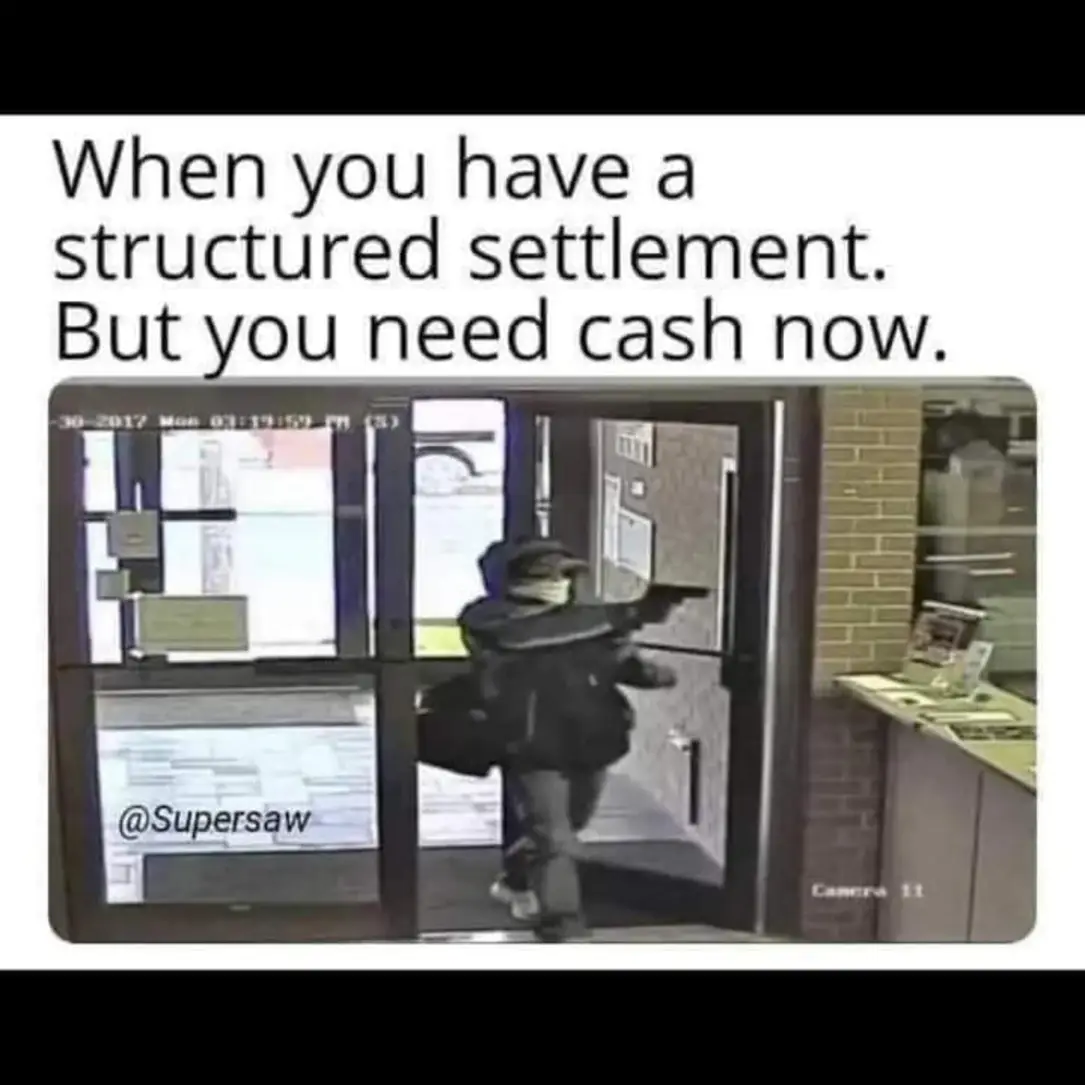
This meme is from the category of Urbanism - Decay, which explores the decline of urban areas. The image shows a person breaking into a bank, implying that they're desperate for cash due to a lack of financial stability. The text "When you have a structured settlement but you need cash now" is a humorous commentary on the challenges of managing finances.
detailed-analysis (gemma3-27b-vision)
Okay, let's break down this image and its accompanying text through several critical lenses. Given the content, some of these analyses will be more prominent than others.
1. Visual Description
The image is a screen capture of CCTV (Closed-Circuit Television) footage, appearing to be from a bank robbery. The time and date ("30-2017 Mon 03:11:17:17" - potentially a misread or coded date) are visible at the top. A person, obscured with a black hat and dark clothing, is visible through the glass doors of the bank, pointing what appears to be a gun. They are holding a bag, presumably for money. The composition centers on the act of potential threat and immediate action. The overall visual tone is grainy and low-resolution, creating a sense of immediacy and 'raw' capture. A watermark "@supersaw" appears at the bottom left, suggesting someone is taking credit for the image.
2. Foucauldian Genealogical Discourse Analysis
This image is fertile ground for a Foucauldian analysis. The bank itself becomes a site of disciplinary power. Banks are not simply places for money exchange; they are intricately linked to systems of surveillance, control, and the normalization of financial behavior. The CCTV footage is a clear manifestation of this power, functioning as a mechanism of panoptic control. The potential robber is both subject to the surveillance and attempting to disrupt it.
The act of robbery, while illegal, can be viewed as a challenge to the discourse of legitimate financial accumulation. It exposes the inherent violence underpinning the systems that concentrate wealth. The fact that this is captured on camera and possibly circulated as a meme re-inscribes the act within a new discourse – a digital, circulated spectacle.
Furthermore, the 'structured settlement' mentioned in the text speaks to the very construction of 'financial subjecthood'. These settlements are complex legal and financial constructs designed to manage the flow of capital over time. The act of robbing the bank can be seen as a rejection of this managed system, a desperate attempt to access capital immediately, outside of its regulated channels.
3. Marxist Conflict Theory
From a Marxist perspective, this image embodies the inherent contradictions of capitalism. The robbery is a direct result of class struggle and economic inequality. The person robbing the bank is likely driven by material necessity, a desperate attempt to obtain resources in a system that systematically denies access to them.
The bank represents the concentration of capital and the power of the bourgeois class. The robber is, in a way, attempting to redistribute wealth, albeit through illegal means. It highlights the fact that the system is inherently reliant on inequality – someone must be deprived for others to accumulate.
The text – "When you have a structured settlement, but need cash now" – further emphasizes this contradiction. A ‘structured settlement’ is a promise of future wealth, while the robbery represents a need for immediate access to resources. This highlights the temporal disconnect between wealth accumulation and basic needs.
4. Postmodernism
The image, particularly in its meme format, embodies a postmodern sensibility. The fragmentation of the image (grainy CCTV footage) and the detached, ironic text contribute to a sense of hyperreality. The image doesn't present a clear narrative or moral message; it’s a fragmented, decontextualized event.
The meme format also suggests a shift away from grand narratives and towards localized, individualized interpretations. The text isn't offering a justification for the robbery; it’s a playful, ironic observation about the absurdity of the situation. This emphasis on surface and irony is characteristic of postmodern aesthetics.
Furthermore, the appropriation of the image for entertainment (meme culture) can be seen as a form of pastiche – a playful imitation of a serious event. This blurs the boundaries between reality and representation, further eroding the possibility of objective truth.
5. Critical Theory
Critical Theory sees the image as a symptom of a larger societal problem – the alienation and dispossession that result from advanced capitalism. The robbery is not simply a criminal act; it’s a manifestation of the structural violence that underlies the system. The person robbing the bank is likely a product of forces beyond their control – poverty, lack of opportunity, systemic oppression.
The image, therefore, serves as a critique of the dominant ideology that justifies inequality and obscures the true costs of capitalism. It forces us to question the legitimacy of the financial system and the moral implications of wealth accumulation.
The ironic text adds a layer of complexity, suggesting a cynical acceptance of the absurdity of the situation. It highlights the ways in which individuals are forced to navigate a system that is inherently unjust.
6. Queer Feminist Intersectional Analysis
While not immediately apparent, an intersectional lens can reveal further layers of meaning. It’s important to acknowledge that systemic oppression intersects in complex ways. The person robbing the bank may also be facing marginalization based on gender, race, sexuality, or other factors. These intersecting oppressions likely contribute to their economic desperation.
The act of robbing the bank could be seen as a form of resistance against a system that is designed to exclude and marginalize certain groups. It’s a desperate attempt to reclaim agency and power in a world that denies them.
Furthermore, the image can be seen as challenging traditional notions of masculinity and criminality. The robber may not fit the stereotypical image of a criminal, and their actions may be motivated by factors that are not traditionally associated with criminal behavior.
Important Note: These analyses are interpretations based on the available information. It's crucial to avoid making assumptions about the person robbing the bank and to acknowledge the complexity of the situation. The image and text are open to multiple interpretations, and the above analyses are just a few possibilities.
simple-description (llama3.2-vision)
This meme is a humorous take on the concept of a "structured settlement," which is a financial arrangement where a person receives a series of payments over time rather than a lump sum. The image shows a person trying to break into a bank vault, with a caption that reads "When you have a structured settlement but you need cash now." The joke is that the person is desperate to access their money, even if it's structured to be paid out over time, and is willing to take extreme measures to get it.
tesseract-ocr
When you have a structured settlement. But you need cash now. a 9157 ri i my bee SE ei