First Seen
2023-07-10T06:03:38+00:00
simple-description (qwen3.5_2b-q8_0)
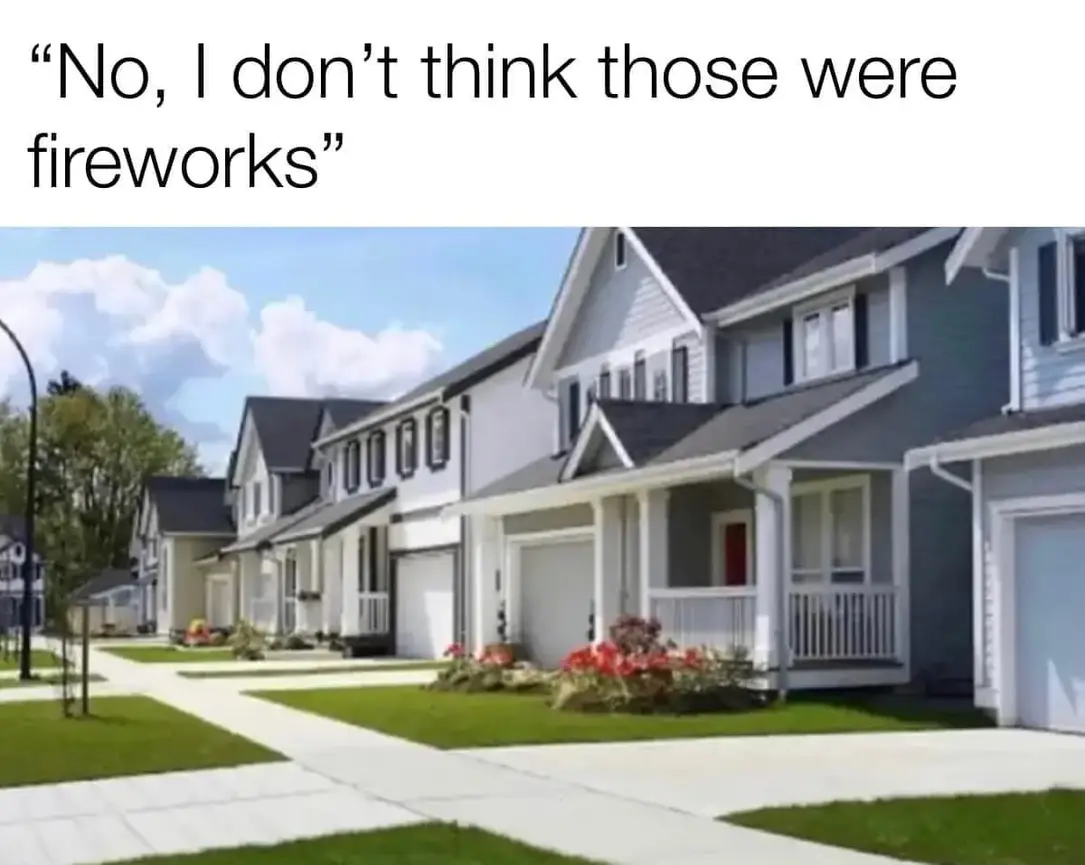
The image depicts a pristine, perfectly manicured suburban street lined with uniform, high-end homes, which serves as a visual metaphor for gentrification—a process where a community is renovated and upgraded to attract a wealthier, more affluent population.
The text "No, I don't think those were fireworks" adds a layer of irony, suggesting that despite the quiet, orderly nature of the neighborhood, residents are resistant to the noise of commercial nighttime entertainment. They are refusing to watch fireworks because they feel the loud, commercialized environment is too disruptive to the peaceful, safe suburban life they have been displaced from.
simple-description (llama3.2-vision_11b)
The meme is a humorous commentary on gentrification, where a neighborhood is transformed from a working-class or low-income area to a more affluent and upscale one. The image is likely a photo of a suburban neighborhood with a caption that reads "I don't think they're gonna start a fireworks factory here." This implies that the area is not suited for industrial activities like fireworks manufacturing, which is often associated with noise and disruption. The humor lies in the understatement of the situation, implying that the neighborhood is not suitable for anything but quiet, middle-class living.
detailed-analysis (gemma3-27b-vision)
Okay, let's break down this image and its tagline ("No, I don't think those were fireworks") through several theoretical lenses. I will address each section only if it's applicable and yields meaningful analysis.
1. Visual Description
The image depicts a row of nearly identical, two-story single-family homes in a suburban development. They are painted in neutral colors (whites, greys, light blues) with dark shutters and similar landscaping (manicured lawns, small flower beds). The homes are closely spaced and emphasize a sense of uniformity and order. The lighting appears flat, contributing to a somewhat sterile, artificial feel. The sky is overcast, further emphasizing the lack of vibrancy. The overall aesthetic is one of perfectly curated, middle-class American suburban life.
2. Critical Theory
This image, paired with the tagline, lends itself powerfully to a critical theoretical analysis, particularly drawing on the Frankfurt School. The perfect uniformity of the houses points to the "culture industry" described by Adorno and Horkheimer. The houses are not built for habitation, but produced as standardized commodities. They’re meant to signify a certain lifestyle (success, stability, normalcy) rather than fulfill genuine housing needs.
The tagline "No, I don't think those were fireworks" disrupts this facade. "Fireworks" represent spectacle, celebration, individuality, a momentary break from the mundane. To deny the fireworks suggests a denial of joy, a suppression of difference, and an insistence on a constant state of predictable order. The tagline could indicate a deep-seated, unspoken anxiety about anything that deviates from the norm, or a repressive environment where even small displays of joy are policed. It evokes a sense of surveillance and control. The seemingly benign image thus becomes a critique of the stifling effect of consumer culture and its emphasis on conformity.
3. Postmodernism
From a postmodern perspective, the image and tagline offer a commentary on the loss of authenticity and the proliferation of simulacra. The houses are hyperreal – they look like houses, but they are ultimately constructed representations of an idealized lifestyle. They are signs pointing to other signs, divorced from any genuine grounding in lived experience.
The tagline further reinforces this. The denial of fireworks is a denial of the “real” in favor of a manufactured reality. It implies that anything exciting or unpredictable is seen as a threat to the carefully constructed order. It's a commentary on the simulated nature of modern life, where even our experiences are curated and controlled. The unsettling implication is that what appears to be celebration (fireworks) could be something else entirely—perhaps a disruption, a disturbance, or simply something unapproved.
4. Queer Feminist Intersectional Analysis
This image and phrase resonate powerfully through a queer feminist intersectional lens. The suburb, historically, has been a site of enforced heteronormativity and traditional gender roles. The uniformity of the houses and the curated lawns symbolize a pressure to conform to a narrow definition of "family" and "success."
The phrase "No, I don't think those were fireworks" can be interpreted as a silencing of queer desire or any expression of non-normative experience. "Fireworks" represent vibrancy, excitement, and difference. To deny them is to enforce a homogenous vision of reality, actively suppressing anything that deviates from the prescribed norm.
An intersectional reading expands on this. The suburb often marginalizes people of color, the working class, and those with disabilities. The pressure to conform isn’t just about sexual or gender identity, but also about race, class, and ability. The suppression of “fireworks” becomes a metaphor for the silencing of all marginalized voices. The seemingly idyllic setting masks a deeply oppressive system.
Let me know if you'd like me to elaborate on any of these analyses or explore other theoretical perspectives.
simple-description (llama3.2-vision)
The meme is a picture of a suburban neighborhood with a row of houses. Above the image, the text "I just realized that the house I grew up in is now a firework explosion zone" appears, followed by the phrase "No, I didn't. I just meant that the neighborhood is now a firework explosion zone because of all the kids in the neighborhood."
tesseract-ocr
“No, | don’t think those were fireworks” perial Pie NE Ja a. : ie —_ - rae | ll (ion a peel ‘ A ba i a ~<a