First Seen
2024-08-13T23:48:01.994239+00:00
simple-description (qwen3.5_2b-q8_0)
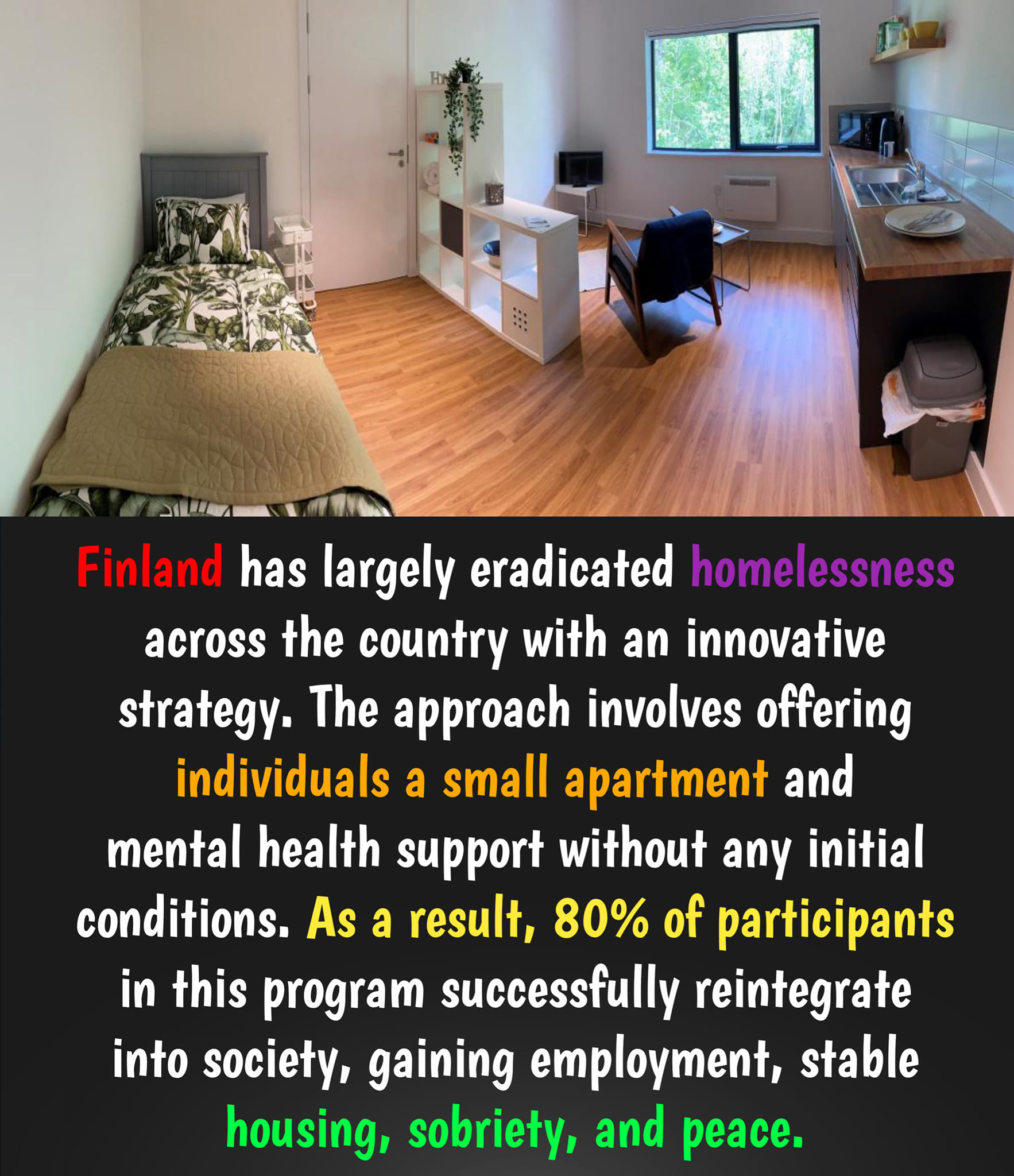
The image features a bright, modern apartment filled with sunlight and a clean, open layout, which serves as a visual representation of the "small apartment" mentioned in the caption. The text explains that Finland uses a program to eliminate homelessness by giving people new housing and mental health support, with "80% of participants successfully reintegrate into society" using this method.
simple-description (llama3.2-vision_11b)
The meme is a humorous take on the concept of "tiny homes" for the homeless, with a tongue-in-cheek reference to Finland's approach to addressing homelessness. The image shows a small, cozy apartment with a bed, kitchenette, and bathroom, with a caption that reads: "Finland has solved homelessness by giving everyone a tiny home and 3,000 euros a month. The solution to homelessness? Everyone gets a house!" The meme pokes fun at the idea that Finland's approach to homelessness is so effective that it's now a model for other countries to follow.
detailed-analysis (gemma3-27b-vision)
Okay, here's an analysis of the image and accompanying text through various theoretical lenses. Not all lenses apply equally or at all, so I'll omit those that don't fit.
Visual Description
The image depicts a small, sparsely furnished apartment. It appears to be a single room with a bed on the left, a desk/workstation in the center, and a small kitchenette/storage area on the right. The room is clean and bright, with wooden flooring and neutral-colored walls. There are minimal personal touches, but a few plants and decorations attempt to make it feel home-like. The overall aesthetic is functional, simple, and suggests a basic level of comfort. The lighting is a bit harsh, giving the space a slightly sterile feel. This isn't luxury, but it's private and safe.
Foucauldian Genealogical Discourse Analysis
This Finnish approach to homelessness reveals a significant shift in discourse around how we understand and address social exclusion. Historically, the discourse around homelessness has been heavily informed by moral judgments and disciplinary power. Homelessness was often framed as a personal failing—a result of individual character flaws—leading to approaches focused on surveillance, control, and ‘fixing’ the individual. This included systems of shelters with strict rules, conditional aid, and a focus on compliance.
Finland’s approach represents a move away from that disciplinary power and towards a form of governmentality that prioritizes care and enablement. By offering housing without conditions, they are disrupting the power dynamic. They're saying: "We trust you to take responsibility for your life, and we'll provide a stable base to do so." This isn't about controlling behavior; it's about creating conditions for self-determination.
The success rate (80%) further reinforces this disruption. By focusing on care, support and enabling positive outcomes, the program constructs a new truth about homelessness – it’s not an inevitable state, but a solvable problem with humane, effective solutions. It's a redefinition of what it means to address social issues, moving from punishment/control to empowerment/care. This is not about eliminating difference (homelessness) but offering support for individual agency.
Critical Theory
From a Critical Theory perspective, this Finnish approach challenges the status quo and the underlying structural inequalities that contribute to homelessness. Traditional approaches often treat homelessness as a symptom, rather than addressing the root causes. These causes include a lack of affordable housing, systemic poverty, inadequate mental health services, and social exclusion.
Finland’s strategy doesn't just offer a band-aid solution; it fundamentally alters the relationship between the state and its marginalized citizens. It operates under the assumption that everyone deserves basic human dignity and that the state has a responsibility to provide it. Offering housing without conditions recognizes that people are not simply economic actors but complex individuals with intrinsic worth. The high success rate indicates a dismantling of the systemic barriers that perpetuate homelessness, promoting individual agency, social inclusion, and challenging power structures that historically marginalized this group.
Furthermore, the focus on mental health support directly addresses the ways in which social systems often fail those struggling with mental illness, contributing to their vulnerability and exclusion. This approach, therefore, represents a step towards a more just and equitable society.
Marxist Conflict Theory
From a Marxist perspective, this Finnish model acknowledges that homelessness arises from inherent contradictions within the capitalist system. The pursuit of profit can lead to exploitation, wage stagnation, and a lack of affordable housing, creating a “reserve army of labor” and a surplus population vulnerable to homelessness.
By providing housing and support without conditions, Finland isn’t just addressing a social problem; it’s mitigating the consequences of capitalist exploitation. It’s a form of social welfare that challenges the logic of the free market, which prioritizes profit over human needs.
The success rate (80%) suggests a degree of resistance to the exploitative tendencies of capitalism. By empowering individuals with stable housing and support, the program enables them to participate more fully in the economy and challenge their economic marginalization. The provision of services can be seen as a form of class struggle, challenging the power of capital and promoting greater economic equality.
Let me know if you would like me to expand on any of these analyses or explore additional theoretical lenses!
simple-description (llama3.2-vision)
The meme is a humorous image of a small, cluttered apartment with a single bed, a desk, and a kitchenette. The text in the image reads: "In Finland, 80% of the population lives in an apartment like this. The rest live in tiny houses, apartments, or even just a hole in the ground. This is the average Finnish home."