First Seen
2023-05-10T21:03:42+00:00
simple-description (qwen3.5_2b-q8_0)
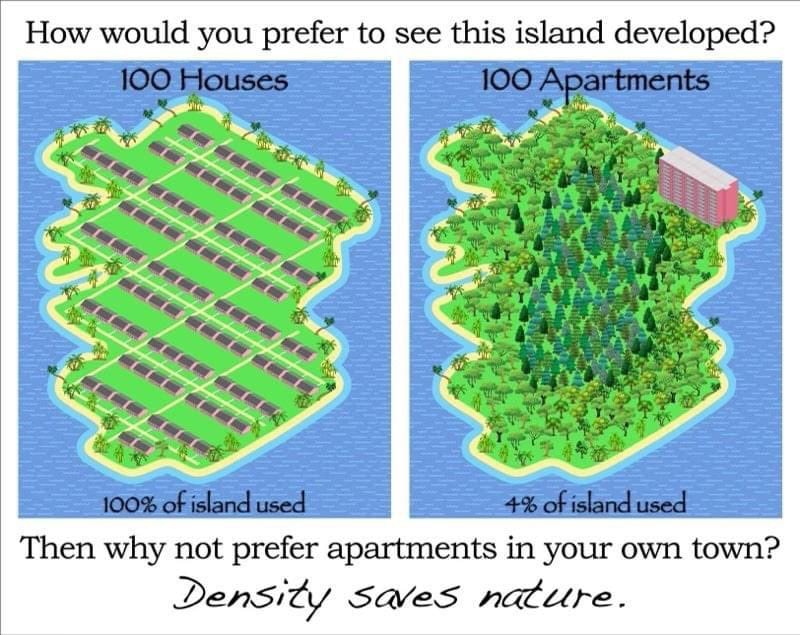
This meme uses an island to demonstrate the efficiency of high-density housing. On the left, 100 single-family homes spread out across the entire island, effectively blocking 100% of the land. In contrast, 100 apartments are packed tightly together, filling only 4% of the island and preserving the surrounding forest. The joke relies on the concept that building in dense clusters is a smarter way to use land, allowing more housing while leaving the natural environment alone.
simple-description (llama3.2-vision_11b)
The meme is a humorous comparison between a city with a high population density (100 apartments) and a city with a low population density (100 houses). The meme pokes fun at the idea that a city with 100 apartments is more environmentally friendly than a city with 100 houses, implying that the former is more sustainable. The text at the bottom of the meme reads: "Then why not live in a city?"
detailed-analysis (gemma3-27b-vision)
Okay, here's a breakdown of the image, incorporating the requested theoretical frameworks where applicable. It’s worth noting that this image strongly leans into a specific argument and therefore lends itself to certain theoretical analyses more easily than others.
Visual Description
The image is a comparison of two development proposals for a small, roughly kidney-shaped island. The top half shows the island completely covered with individual, single-family houses, arranged in a grid pattern. The bottom half shows the same island with a single, relatively large apartment building occupying a tiny fraction of the land.
Text labels are present: “100 Houses” and “100 Apartments”, and corresponding percentages of land used ("100% of island used" vs. "4% of island used"). A tagline reads: "Then why not prefer apartments in your own town?" and "Density saves nature.” The overall aesthetic is somewhat simplistic and illustrative. The water surrounding the island is a uniform blue. The contrast between the two scenarios is stark and meant to visually emphasize the difference in land use.
Foucauldian Genealogical Discourse Analysis
This image functions as a discursive intervention attempting to establish a specific way of understanding urban development and environmentalism.
- Power/Knowledge: The image doesn’t simply present information; it constructs a narrative about “good” vs. “bad” development. The juxtaposition implicitly frames single-family housing as inherently destructive to the environment, while high-density housing is positioned as a force for preservation. This is not an objective truth but a particular way of knowing and valuing land use.
- Genealogy: A genealogical analysis would trace the historical development of planning discourses around land use, suburbanization, and environmentalism. This image is engaging with pre-existing anxieties about suburban sprawl and the ecological cost of the "American Dream". It leverages and reshapes these established anxieties in order to establish a new narrative.
- Discipline: The image subtly disciplines by presenting a very clear, binary choice. It implies that if you don't prefer the apartment building scenario, you are implicitly contributing to environmental destruction.
- Subject Formation: The "you" addressed in the question, "Then why not prefer apartments?" is constructed as a subject capable of making a "rational" environmental choice. The image appeals to a particular type of modern, environmentally conscious subject.
Critical Theory
From a critical theory perspective (drawing from the Frankfurt School and figures like Adorno and Horkheimer), the image can be seen as engaging with the tensions of instrumental reason.
- Domination of Nature: The image frames the problem as one of how to develop land, implicitly accepting the premise that development will happen. Critical theorists would ask if the fundamental issue is the human desire to dominate and control nature in the first place.
- The Culture Industry: While not directly about culture, the image is a form of persuasive communication, strategically framing a certain viewpoint. It could be argued that it functions similarly to advertising – simplifying complex issues and presenting a specific solution as desirable.
- Rationality and Control: The stark contrast between the two images suggests a form of technocratic rationality – a belief that problems can be solved through efficient, data-driven solutions (in this case, maximizing land use efficiency). Critical theorists would question whether this approach is truly sustainable or simply a new form of control.
Marxist Conflict Theory
The image hints at underlying class dynamics and resource control.
- Land as a Commodity: The image assumes land is something to be developed for profit (even if the profit motive isn’t explicitly stated). From a Marxist perspective, land is a crucial means of production, and the question of who controls land and how it’s used is central to understanding power relations. Single-family housing, in many contexts, is associated with wealth and privilege, while apartments can provide more affordable housing options.
- The Bourgeoisie vs. The Proletariat: While not directly represented, the image subtly speaks to the desires and needs of different social classes. The “American Dream” of owning a detached house with a yard is often inaccessible to those with lower incomes. The apartment building could be seen as a potential solution to housing shortages, but it also raises questions about control and ownership.
- Capital Accumulation: The argument that “density saves nature” implicitly suggests that reducing land use is a more efficient way to accumulate capital. The image frames environmental protection not as an altruistic goal, but as a matter of economic efficiency.
Postmodernism
A postmodern reading might focus on the image’s deconstruction of binary oppositions (nature vs. development, rural vs. urban) and its embrace of relativism.
- Rejection of Grand Narratives: The image challenges the “grand narrative” of suburbanization and the inherent value of single-family home ownership. It suggests that there is no single “right” way to develop land.
- Simulacra and Simulation: The image is a simulation of a potential development scenario. It’s a simplified representation of a complex issue, and it doesn’t necessarily reflect the full range of environmental or social consequences.
- Subjectivity of Truth: Postmodernism emphasizes the subjectivity of truth. The image doesn’t prove that density saves nature; it asserts it, relying on persuasion and visual rhetoric.
Queer Feminist Intersectional Analysis
This is the least directly applicable framework, but a queer feminist intersectional lens can still offer some insights.
- Spatial Politics: How spaces are designed and allocated has profound implications for marginalized communities. Single-family housing zoning has historically been used to exclude people of color and low-income residents. The image could be interpreted as a critique of this exclusionary practice, advocating for more inclusive and equitable housing options.
- Care & Sustainability: The image's argument for density could be linked to queer feminist concepts of care – caring for the planet and caring for one another. Sustainable practices can be seen as a form of care, while unsustainable practices can perpetuate harm.
- Challenging Normative Assumptions: The image challenges the normative assumption that single-family home ownership is the ideal form of housing. It implicitly questions the patriarchal and heteronormative values that underpin this ideal.
I hope this detailed breakdown is helpful! Let me know if you would like me to elaborate on any specific aspect or theoretical framework.
simple-description (llama3.2-vision)
This meme is a humorous comparison between two possible scenarios for a small island. The first image shows a dense, urbanized island with 100 houses, implying a high population density and a focus on development. The second image shows a wild, natural island with 100 trees, implying a focus on conservation and preservation. The meme is captioned "In 100 years..." with a hint of irony, suggesting that the natural island would be more desirable in the long run.
tesseract-ocr
How would you prefer to see this island developed? tie . Ss oF pote at Yat | ae s se Meg ee Fe ts, : os ae ey ey Mab ra 3 ee eee | ue Rey agree |S s aaa? a ae “Pay” gq. estas Then why not prefer apartments in your own town? Density Saves nature.