First Seen
2023-05-10T21:03:42+00:00
simple-description (qwen3.5_2b-q8_0)
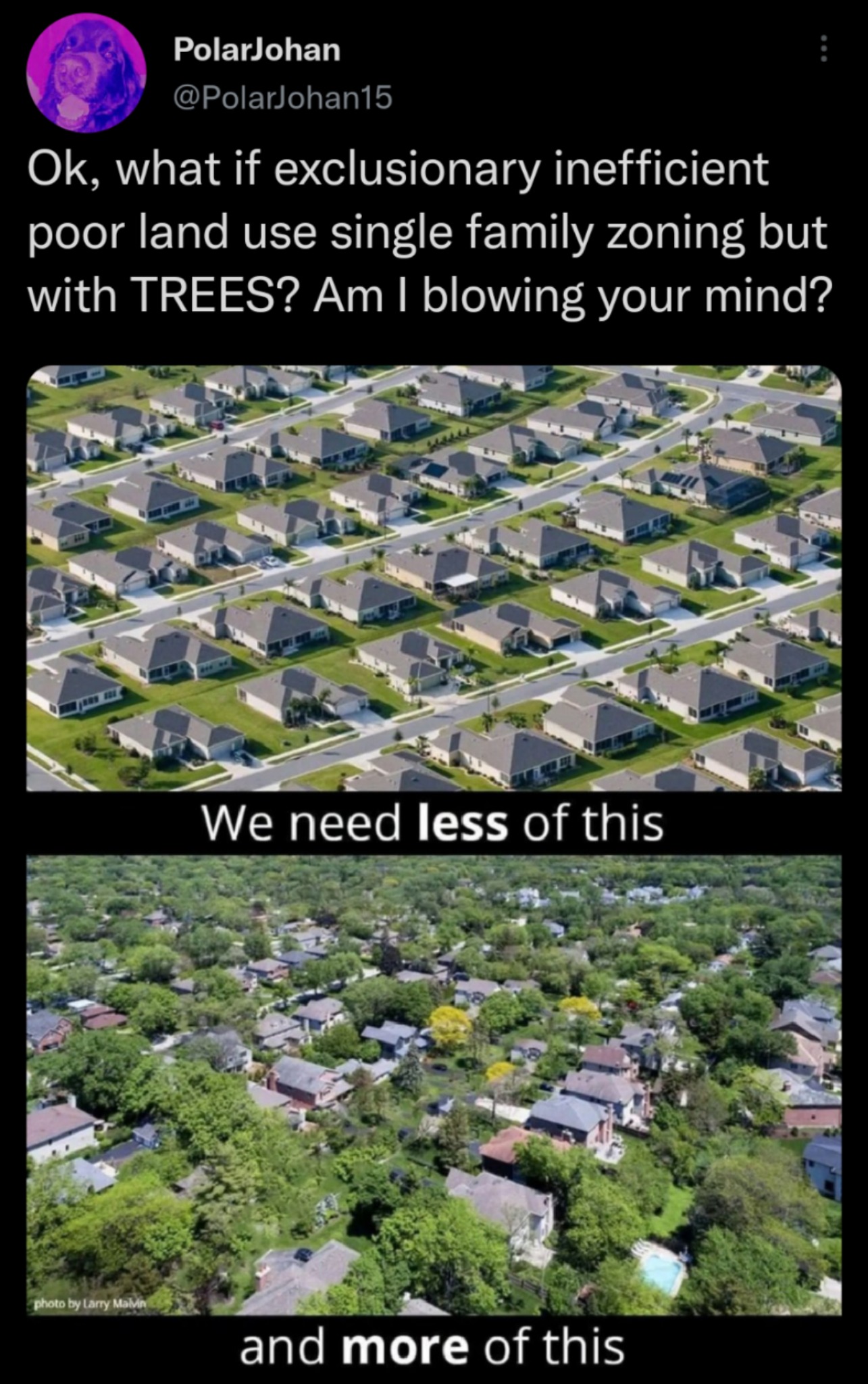
This meme critiques traditional suburban zoning laws by contrasting two different landscape designs. It suggests a new model called "green suburbs" (or "dead zone housing") that uses dense trees and lawns as buffers between homes. The humor lies in the idea that this new version is actually more efficient and environmentally friendly, despite the top image's text claiming it is "less" exclusive and "poor" land use.
simple-description (llama3.2-vision_11b)
The meme is a humorous commentary on urban planning and housing. It presents a split-screen image of a city with a dense, crowded neighborhood on the top and a sprawling, suburban area with large lots and trees on the bottom. The text above the top image reads "We need to build more housing" and the text below the bottom image reads "We need to build less housing". The meme is poking fun at the idea that there's a perpetual debate about whether to build more housing in cities or preserve green spaces, and that both perspectives are equally valid.
detailed-analysis (gemma3-27b-vision)
Okay, let's break down this image and the accompanying text through several theoretical lenses. This is a rich image that lends itself well to complex analysis.
Visual Description
The image is a diptych – a side-by-side comparison.
- Top Image: An aerial view of a sprawling suburban development. Houses are tightly packed together in a grid-like pattern, with neatly trimmed green lawns. The overall impression is one of uniformity and repetition. Roofs are predominantly light-colored. There is little variation in house style or landscaping. The image has an almost “toy-like” quality due to the repetition and symmetry.
- Bottom Image: Another aerial view of a residential area. This one is characterized by a far more organic and varied landscape. Houses are spaced further apart, with larger yards containing mature trees and diverse vegetation. The street patterns are winding and less rigid than those in the top image. It appears more established and natural.
- Text: The text accompanying the images is “Ok, what if exclusionary inefficient poor use land zoning with TREES? Am I blowing your mind?” and “We need less of this and more of this.” This framing invites the viewer to question the logic and effects of traditional zoning practices.
Foucauldian Genealogical Discourse Analysis
This image and text provide a powerful illustration of how power operates through discourse and the shaping of space.
- Genealogy of Suburban Zoning: A Foucauldian analysis would trace the historical development of single-family zoning, looking at how it emerged as a system of control connected to anxieties about class, race, and social order in the early 20th century. Zoning wasn't a neutral, technical solution to city planning, but a way to construct certain ideal (and exclusionary) communities.
- Disciplinary Power: The grid-like arrangement in the first image represents a panoptic form of control, with houses aligned for surveillance and normalization. The uniformity enforces certain social and aesthetic norms. The spacing of trees is minimal.
- The “Efficient” Myth: The text points to the “inefficiency” of such zoning, challenging the idea that it’s a logically sound or beneficial system. Foucault would argue this “efficiency” is a productive power – meaning it creates (and excludes) through normalization. The comparison to the image with trees highlights the constructed nature of the first image as the alternative emphasizes nature, space, and variation.
- The Power of the Question: The phrasing "Am I blowing your mind?" is deliberately provocative. It’s meant to disrupt the taken-for-granted assumptions about how we build and organize our communities.
Critical Theory
This image speaks directly to central tenets of Critical Theory, particularly those relating to the built environment and social critique.
- The Built Environment as Ideology: The standardized suburban landscape in the first image embodies a specific ideology – a preference for private property, individualism, and social segregation. Critical theorists like Herbert Marcuse would argue this built environment reproduces existing power structures.
- Critique of Rationality: The emphasis on “efficiency” is a key target of critical theory. The claim that this type of zoning is “efficient” often masks the social and environmental costs – the loss of green space, increased reliance on automobiles, and the exclusion of diverse housing types.
- Alienation: The uniformity of the suburban landscape can be seen as contributing to a sense of alienation and disconnection from nature and community. The second image offers a counter-example, emphasizing organic growth and greater integration with the natural environment.
- Critique of Progress: This image challenges the idea that suburban development represents progress. Critical theorists would ask: Progress for whom? At what cost? The image suggests that a different kind of development – one that prioritizes ecological sustainability, social equity, and community building – is possible.
Marxist Conflict Theory
From a Marxist perspective, this image reveals the inherent conflicts within capitalist systems of land development.
- Land as a Commodity: The suburban landscape exemplifies the commodification of land – its treatment as a source of profit and speculation. The tightly packed houses and manicured lawns maximize land value, but at the expense of social and environmental well-being.
- Class Conflict: Zoning regulations, historically, have been used to maintain class segregation and protect property values. Single-family zoning, in particular, has excluded lower-income individuals and families from accessing desirable neighborhoods.
- The Reserve Army of Labor: The car-dependent nature of suburbia supports an entire economic system based on automobile manufacturing, highway construction, and related industries. This system, while profitable for some, contributes to environmental degradation and social inequality.
- Contradictions of Capital: The image exposes the contradictions inherent in capitalist development – the pursuit of profit often leads to unsustainable and unjust outcomes. The second image suggests an alternative model that prioritizes social and ecological needs over profit maximization.
Postmodernism
A postmodern reading of the image emphasizes the breakdown of grand narratives and the embrace of difference.
- Rejection of Universal Truths: The image challenges the idea that there’s a single “right” way to build a community. It suggests that different models are possible and that suburban uniformity is not necessarily superior to more organic and diverse forms of development.
- Deconstruction of Ideology: The image deconstructs the ideology of suburban perfection – the idea that suburban life represents the “American Dream.” It exposes the underlying assumptions and power relations that shape this narrative.
- Emphasis on Fragmentation and Hybridity: The second image embodies a postmodern aesthetic – a celebration of fragmentation, diversity, and the mixing of styles and forms.
- Simulacra and Simulation: One could argue that the first image represents a simulacrum of community – a manufactured and artificial environment that lacks genuine social connection.
Queer Feminist Intersectional Analysis
This image and text can also be explored through a queer feminist intersectional lens.
- Spatial Exclusion & Marginalization: Traditional zoning has historically been used to enforce social norms and exclude marginalized groups. Single-family zoning, coupled with discriminatory housing practices, has created segregated communities based on race, class, and sexual orientation. The image highlights the spatial manifestation of these inequalities.
- The Private Sphere as a Site of Control: The emphasis on private property and individual homeownership reinforces patriarchal norms and reinforces the separation of public and private spheres. This separation can limit access to community resources and create barriers to social inclusion.
- Ecofeminism: The comparison between the two images resonates with ecofeminist principles. The second image, with its emphasis on natural landscapes and ecological sustainability, can be seen as a rejection of patriarchal control over nature and a celebration of interconnectedness.
- Intersectional Exclusion: Zoning laws do not exist in a vacuum. They intersect with other forms of discrimination (race, gender, sexuality, disability) to create complex and overlapping forms of exclusion. A queer feminist analysis would focus on how zoning policies disproportionately affect marginalized communities.
I have attempted to provide a detailed analysis of this image from various theoretical perspectives. Let me know if you'd like me to expand on any particular aspect or explore additional lenses.
simple-description (llama3.2-vision)
This meme is a play on the idea of a utopian society, where people are given the option to live in a world with no poverty or scarcity. The text "In a world where..." sets up a hypothetical scenario, and the punchline "we'd all just live in trees" is a humorous commentary on the idea that even in a perfect world, humans would still find ways to be lazy and indulge in comforts.
tesseract-ocr
PolarJohan : @Polarjohani5 Ok, what if exclusionary inefficient poor land use single family zoning but with TREES? Am | blowing your mind? oy ey a ~ cat al ah 7 oe _ ‘ae n i 4 aie <—_ eS”, Ss Se Pe. es: oe ne >. Ain = “Bes on — i —. & i = “< ae ste SS Ae B | Se . Be at —ai ak > 1g - ; Te We need less of this Se a a is cane a ae aes ae yA Pha Neate: a 7 a 4 oie ae ee aS lca at a a: = ee FAO i Sine SOE me a a Se CESS eit she, a : As aed ase ? Pe eS. ie Bo Re ee” EE a, a Pes Came ee. EN > ge Ce Tens i | 2S a. a | and more of this