First Seen
2023-05-10T21:03:42+00:00
simple-description (qwen3.5_2b-q8_0)
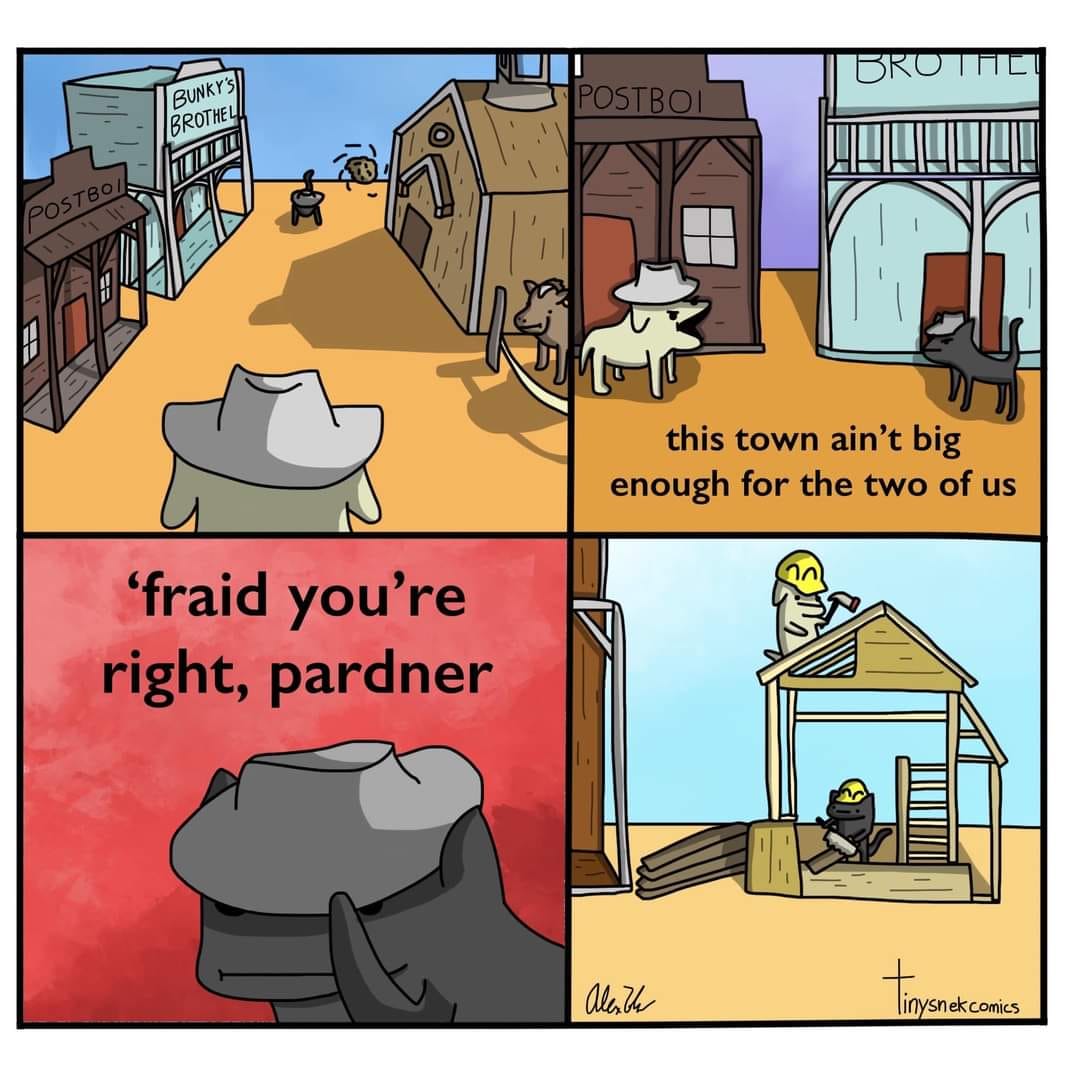
This meme satirizes urban housing by depicting a small "western" town with crumbling buildings labeled "Brotherhood" and "Postboi." A dog and a cat complain that the town isn't big enough for them, which ironically forces them to build a tiny, dilapidated house on a very small lot of land. The final panel reinforces this housing insecurity by showing the characters actively constructing a shack, while the caption confirms the residents' frustration with the town's size.
simple-description (llama3.2-vision_11b)
The meme is a humorous commentary on the challenges of urban living, specifically the struggle to find affordable housing in cities. It features a character standing in front of a small, cramped apartment, with a caption that reads "I can barely afford this 1-bedroom studio, but I can afford 2 Teslas" - a tongue-in-cheek reference to the luxury car brand. The meme pokes fun at the absurdity of prioritizing material possessions over basic needs like housing.
detailed-analysis (gemma3-27b-vision)
Okay, let's break down this comic panel with the requested analytical lenses. It’s a rich little piece!
Visual Description
The comic is divided into four panels, presented in a grid layout. It evokes a stylized Western aesthetic, with simplified building designs and a limited color palette. The main colors are reddish-brown, beige, and yellow. The backgrounds are flat, and the figures are minimalist.
- Panel 1: Depicts a small Wild West town with buildings labeled "Bunky's Brothel", "Post Office", and other unnamed structures. A large, dark figure wearing a cowboy hat dominates the foreground.
- Panel 2: The dark figure and a lighter, much smaller figure in a cowboy hat are walking towards each other.
- Panel 3: A close-up of the dark figure's face, shadowed and obscured, with the text "’fraid you’re right, pardner."
- Panel 4: Shows a small, dilapidated wooden structure with a ladder leading to a second level, with the text "this town ain’t big enough for the two of us.”
The art style is cartoonish and reminiscent of early 20th-century comic strips. The artist's signature, "ala.b6," and the TinySnekComics watermark are in the lower right corner.
Foucauldian Genealogical Discourse Analysis
This comic lends itself strongly to a Foucauldian reading. The Wild West setting itself is a constructed "discourse" – a system of power/knowledge that has been built up through narratives and representations.
- Power/Knowledge: The comic reveals how power operates through the very structure of the Western myth. The idea of a town "not being big enough" is not a literal issue of space, but a symbolic declaration of dominance. The larger figure holds the power, and the statement is a claim to control and exclusion.
- Genealogy: The phrase "this town ain’t big enough for the two of us” is a trope deeply embedded in the Western genre. Analyzing its history shows how it functions to justify violence and the assertion of power. It's a pre-existing 'statement' that carries weight because of its repetition and association with certain actions (usually a duel or confrontation).
- Discipline & Biopower: While not overt, the comic touches on biopower. The larger figure's assertion implies the right to determine who belongs in the community, exerting control over the "life" of the town. The smaller figure is positioned as an "other" and an impediment to the larger figure’s perceived order.
Critical Theory
A critical theory reading highlights the ways in which seemingly simple narratives can reinforce dominant ideologies and power structures.
- Deconstruction: The comic subtly deconstructs the romanticized image of the Wild West. The seemingly straightforward confrontation isn’t about justice or conflict resolution, but a declaration of dominance. The minimalist style removes the "naturalness" of the setting, forcing us to see its construction.
- Ideology: The comic operates within the ideology of individualism and competition. The idea that only one figure can "fit" in the town reinforces the notion that resources and space are limited, and that conflict is inevitable.
- Subjectivity: The comic forces us to question the perspective of the large figure. We only see his reaction, and we are positioned to empathize with his assertion, despite not knowing the cause of the conflict.
Marxist Conflict Theory
Applying a Marxist lens, we can analyze the comic as a representation of class struggle and the assertion of dominance.
- Power Dynamics: The stark difference in size between the two figures immediately establishes a power imbalance. The larger figure can be read as representing the ruling class, possessing greater resources and control.
- Competition for Resources: The phrase “this town ain’t big enough” can be interpreted as a struggle for limited resources – land, wealth, or social standing. The larger figure seeks to eliminate the smaller figure as a competitor.
- Hegemony: The larger figure's assertion operates as a form of hegemony. By framing the conflict as a matter of necessity (the town being "too small"), he seeks to legitimize his actions and maintain control.
Queer Feminist Intersectional Analysis
This analysis delves into how intersecting systems of power operate within the comic, specifically focusing on gender, sexuality, and the marginalization of the smaller figure.
- The "Other": The smaller figure is immediately positioned as "other" through their size and potentially, representation (though we lack clear visual cues about gender or sexuality). This "otherness" makes them vulnerable to the larger figure's assertion of dominance.
- Spatial Control: The statement about the town not being big enough represents a form of spatial control – the larger figure seeks to dictate who belongs and who is excluded. This echoes real-world experiences of marginalized groups facing exclusion from spaces and resources.
- Subtext of Violence: The language implies impending violence, particularly if we consider the historical context of the Wild West. This hints at the ways in which power imbalances often lead to acts of aggression and harm against marginalized individuals. While not explicitly gendered or sexualized, the dynamics of power and exclusion can resonate with experiences of oppression.
Overall: This seemingly simple comic panel is remarkably layered. It functions as a potent allegory for power dynamics, social exclusion, and the perpetuation of harmful ideologies. By applying different analytical lenses, we can uncover the complex meanings embedded within its minimalist design and evocative language.
simple-description (llama3.2-vision)
This meme is a humorous image that depicts a person standing in a Western-style town, with a sign that reads "This town ain't big enough for the two of us." The image is likely referencing a famous line from a movie or TV show, and is being used to imply that the person is about to engage in a confrontation or fight with someone else in the town. The text "This town ain't big enough for the two of us" is a nod to a classic line from the 1987 movie "The Untouchables," in which a character says this to a rival.
tesseract-ocr
' ial afe\ Muu a eng A nl pn ’ F We N | + ‘ef Y a p _ f= Oy i { a ’ TS this town ain’t big Jie enough for the two of us 6 e > \ Gn\ fraid you're -- CSP right, ey | i Sa - cara Abie Ties