First Seen
2023-07-18T20:58:04+00:00
simple-description (qwen3.5_2b-q8_0)
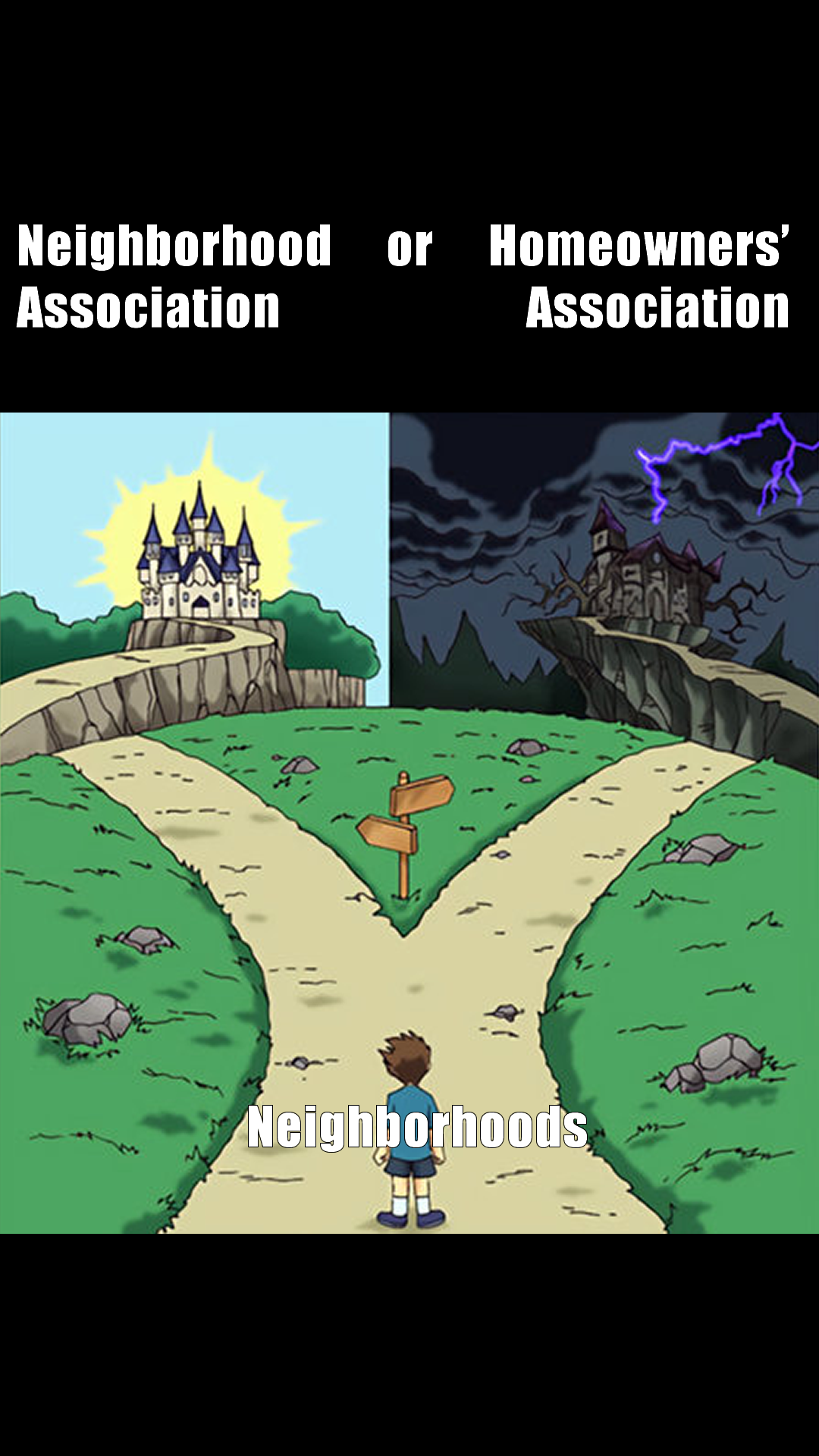
This Urbanism meme illustrates a binary choice for a resident in the housing category: a desirable neighborhood versus a restrictive Homeowners Association. On the left, the sunlit path leads to a castle representing a peaceful, walkable community or a well-managed HOA, while the path on the right leads to a dark stormy castle representing a chaotic or problematic neighborhood. The word "Neighborhoods" at the bottom plays on the phrase "Neighbors," humorously equating the two concepts.
simple-description (llama3.2-vision_11b)
The meme compares the contrast between living in a neighborhood ( Neighborhood ) versus living in a city ( Homeowners' Association ). The image depicts a child looking at two paths, one leading to a castle ( Neighborhood ) and the other to a dark, ominous castle ( Homeowners' Association ). The text "Neighborhood" and "Homeowners' Association" are written above each path, highlighting the differences between living in a community with rules ( Neighborhood ) and living in a community with strict regulations ( Homeowners' Association ).
detailed-analysis (gemma3-27b-vision)
Okay, here's an analysis of the image, broken down into the requested sections, addressing relevant theories where applicable. I'll try to be thorough and nuanced.
Image Description
The image depicts a cartoonish scene of a fork in a path, suggesting a choice or decision. A small silhouetted figure stands at the junction. The paths lead to drastically different landscapes. One path leads towards a bright, idyllic castle-like structure, bathed in sunlight and suggesting order, tradition, and perhaps conformity. The other path leads to a dark, stormy, and imposing structure, resembling a haunted mansion or fortress, with lightning flashing around it. The text above the image reads "Neighborhood or Homeowners Association" and the text below reads "Neighborhoods". The overall visual theme is one of binary opposition – the choice between a seemingly perfect, controlled environment and a more chaotic, potentially dangerous one. The cartoon style adds a layer of simplification, potentially undercutting the seriousness of the implied choice.
Foucauldian Genealogical Discourse Analysis
This image is highly amenable to a Foucauldian reading. The "Neighborhood or Homeowners Association" framework constructs a discourse around the very idea of community and dwelling. The two pathways represent differing deployments of power/knowledge.
- Discipline & Normalization: The path leading to the idyllic castle represents a form of social control through discipline. The castle symbolizes a space where norms are enforced, and deviations are discouraged. The visual cleanliness and order suggest the surveillance and self-regulation inherent in well-managed communities (think of architectural restrictions, lawn maintenance rules, etc.). The aim is normalization – to ensure conformity to established standards.
- Panopticism: The "perfect" castle evokes the panoptic structure, even if not directly visible. The idea is that the expectation of surveillance (by the HOA, by neighbors) leads to self-discipline. Residents internalize the rules, policing their own behavior to avoid conflict or sanctions.
- The Dark Path as Counter-Discourse: The darker path isn’t simply “bad”; it represents a counter-discourse. It's a space where rules might be less rigid, individuality more valued, and perhaps, even rebellion against the dominant norms. This path is stigmatized, framed as dangerous, yet it also holds the potential for alternative ways of living.
- Genealogical Approach: A genealogical examination would ask how these discourses (of control, of conformity, of alternative living) emerged historically. How did HOAs come to be seen as necessary or desirable? What historical anxieties or desires drove the need to control communities? The image implicitly invites us to uncover the power dynamics that have shaped our understanding of “good” neighborhoods.
Critical Theory (Frankfurt School)
This image can be interpreted through a Critical Theory lens, particularly considering the Frankfurt School's concerns with the “culture industry” and the colonization of everyday life.
- Rationalization & Control: The perfectly manicured castle is a symbol of rationalization – the tendency in modern society to organize everything according to efficiency, predictability, and control. This path represents a move towards a “totally administered society,” where even personal choices are shaped by bureaucratic systems.
- False Consciousness: The image might suggest that residents who embrace the HOA’s control are experiencing false consciousness. They believe they are improving their community, but they are actually contributing to a system that reinforces social control and suppresses individuality.
- The Loss of Authentic Experience: The idyllic castle, while aesthetically pleasing, lacks authenticity. It's a curated, artificial environment that obscures the messy, complex realities of life. This aligns with the Frankfurt School’s critique of the culture industry, which produces standardized, commodified experiences that replace genuine expression.
- The Dark Path as Resistance: The darker path, while chaotic, represents a potential space for reclaiming agency and resisting the homogenizing forces of modern society. It suggests that embracing imperfection and ambiguity might be a more authentic way of living.
Marxist Conflict Theory
From a Marxist perspective, the image can be seen as representing a conflict between different classes or interests within the neighborhood.
- HOA as Bourgeois Control: The HOA, symbolized by the castle, can be interpreted as an instrument of the bourgeoisie (the property-owning class). The rules and regulations are designed to protect property values and maintain the social order that benefits those who own property. It’s a means of controlling space and maintaining existing power structures.
- The Dark Path as Working-Class Resistance (Potentially): The darker path, while not explicitly representing a class, could symbolize a space where non-conformity and resistance to the dominant power structure are allowed. Perhaps a space for those who can't afford or don't want to participate in the carefully curated lifestyle of the HOA-controlled neighborhood.
- Commodification of Community: The HOA's emphasis on maintaining property values reflects the commodification of community. The focus is not on building genuine social connections but on maximizing the economic value of the neighborhood.
- Alienation: Residents who feel constrained by the HOA's rules might experience alienation – a sense of disconnect from their community and from their own authentic selves.
Postmodernism
A postmodern reading of the image would focus on the deconstruction of binary oppositions and the instability of meaning.
- Deconstructing the Binary: The image sets up a clear binary (idyllic/chaotic, order/disorder), but a postmodern reading would question the validity of this opposition. Is "order" necessarily good? Is "chaos" necessarily bad? Are these categories stable and fixed?
- Simulacra & Simulation: The castle might be seen as a simulacrum – a copy without an original. It’s a representation of a “perfect” community that doesn’t actually exist. The focus on appearances and maintaining a certain image suggests a world increasingly dominated by simulation.
- Loss of Grand Narratives: The image subtly implies a rejection of traditional “grand narratives” about community and the good life. There is no single, correct way to live. Both paths have their drawbacks and advantages.
- Fragmentation & Fluidity: The fork in the road represents the fragmentation and fluidity of modern experience. There is no clear, predetermined path to follow. Individuals are left to navigate a complex and uncertain world, making choices that are contingent and contextual.
Queer Feminist Intersectional Analysis
This is where it becomes a bit more speculative, but still relevant.
- HOA as Enforcing Normative Standards: HOAs are frequently notorious for enforcing normative standards of appearance and behavior. This can disproportionately impact those who deviate from those norms, including LGBTQ+ individuals, people of color, and those with disabilities. The "perfect" castle symbolizes a pressure to conform to a narrow definition of the "ideal" resident.
- The Dark Path as Space for Difference: The darker path could represent a space where difference is tolerated or even celebrated. It could be a space where marginalized groups can express themselves authentically without fear of judgment or sanction. However, it’s also important to acknowledge that “chaos” can be dangerous for marginalized groups as well.
- Intersectionality: The image highlights the intersection of different forms of oppression. The pressure to conform to HOA standards might be particularly acute for individuals who are simultaneously marginalized based on their race, gender, sexuality, and/or disability.
- Control of the Body and Space: The HOA, as a system of control, also exerts control over bodies and spaces. Requirements for lawn maintenance, exterior appearances, and acceptable decorations can be seen as attempts to regulate bodies and the spaces they inhabit, reinforcing dominant social norms.
I hope this detailed analysis provides a comprehensive understanding of the image through multiple theoretical lenses. Let me know if you'd like me to elaborate on any of these points or explore other interpretations.
simple-description (llama3.2-vision)
This meme is a visual representation of a common dilemma. The image shows a person standing at a crossroads, with a signpost that reads "Neighborhood" on one side and "Homeowners' Association" on the other. The text "Neighborhood" is written in a playful, cursive font, while "Homeowners' Association" is written in a more formal, block font.
tesseract-ocr
Neighborhood or Homeowners’ Association Association at pli f aN , iz) ze LA im. ~ —> iy ~ a Vr a mw - 2 | = ie go TO TOOUE ss