First Seen
2023-07-18T20:58:28+00:00
simple-description (qwen3.5_2b-q8_0)
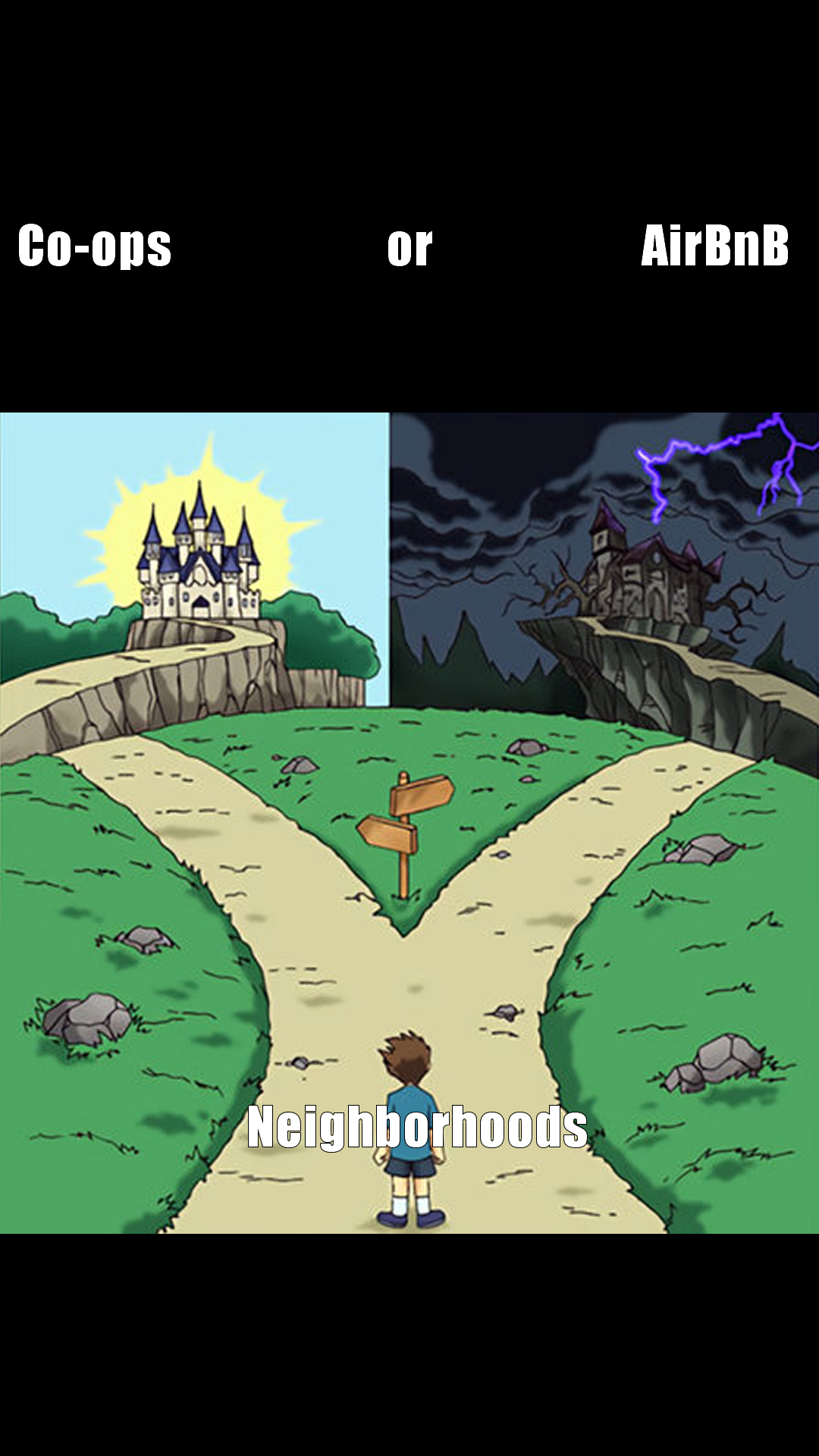
From the perspective of urban housing, this meme illustrates the trade-off between high-quality community living versus a potentially unsafe and isolated single room. The boy faces a choice between a bright, sunny castle on one side and a dark, stormy mansion on the other, representing the two distinct types of housing options. The text "Co-ops or AirBnB" implies that the quality of your neighborhood and lifestyle is entirely dependent on which specific building you end up renting or buying.
simple-description (llama3.2-vision_11b)
The meme is a humorous comparison between two housing options, "Communes" (co-ops) and "AirBnB" (short-term rentals), with the caption "Choose your own adventure". It presents a split path with a fork in the road, where one path leads to a castle (commune) and the other to a haunted house (AirBnB).
detailed-analysis (gemma3-27b-vision)
Okay, let's break down the image with the requested theoretical lenses. It's a compelling visual with potent subtext, so there's quite a bit to unpack.
Visual Description
The image presents a stylized, almost cartoonish illustration of a fork in a road, visually representing a choice between "Co-ops" and "Airbnb" neighborhoods. A solitary figure stands at the intersection, facing the decision.
- Composition: The composition is divided into two halves. The left side, labeled "Co-ops," depicts a bright, idealized landscape featuring a whimsical castle, vibrant green hills, and a clear, sunny sky. The right side, labeled "Airbnb," is a stark contrast – a shadowy, storm-ridden landscape with a dilapidated, gothic-style house, dark hills, and a lightning-filled, ominous sky.
- Symbolism: The contrast is strong and deliberate. The "Co-op" side evokes a sense of community, stability, and idealism. The "Airbnb" side suggests precariousness, commodification, and potentially, a darker undercurrent. The castle on the left implies a long-term, fortified community, while the dilapidated house implies impermanence.
- The Figure: The solitary figure, seemingly gender-neutral, embodies the individual facing the choice. Their stance is somewhat ambiguous – are they contemplating the decision, hesitant, or resigned? The figure is positioned at the 'fork', embodying the dilemma and agency within it.
Critical Theory
This image readily lends itself to analysis through a critical theory lens, particularly relating to urban development, housing, and the societal impacts of market forces.
- Commodification of Housing: The image subtly critiques the increasing commodification of housing. "Co-ops" suggest housing as a social good, a collective responsibility, and a means of building community. “Airbnb” symbolizes the conversion of homes into commodities for profit, eroding community ties and driving up housing costs.
- The Illusion of Choice: While appearing to present a choice, the highly stylized and symbolic representations suggest a deeper, more problematic situation. The bright/dark contrast isn’t merely aesthetic; it implies that the "choice" isn't equal. One path (Co-ops) represents a more sustainable, equitable vision, while the other (Airbnb) is a potentially destructive one presented as equally viable.
- Neoliberal Ideology: The image subtly critiques neoliberal ideology. Neoliberalism promotes privatization, deregulation, and market-driven solutions. Airbnb, as a platform facilitating the commodification of housing, can be seen as a direct manifestation of these principles. The idyllic "Co-op" side represents a rejection of this ideology.
Marxist Conflict Theory
From a Marxist perspective, the image highlights the class conflict inherent in housing.
- Bourgeoisie vs. Proletariat: The "Airbnb" side can be interpreted as representing the interests of the bourgeoisie – those who profit from owning and renting out property. The "Co-op" side symbolizes the collective interests of the proletariat – those who seek affordable, stable housing and community.
- Exploitation: The commodification of housing through Airbnb can be viewed as a form of exploitation. Property owners profit from the scarcity of affordable housing, while renters and communities bear the costs.
- Alienation: The breakdown of community ties resulting from the proliferation of short-term rentals can lead to alienation, a key concept in Marxist thought. The "Airbnb" side, with its dark and stormy imagery, evokes a sense of isolation and disconnection.
Foucauldian Genealogical Discourse Analysis
A Foucauldian lens allows us to examine the discourses that shape our understanding of housing and community.
- Discipline and Control: The image implies that the discourse around housing has shifted from one of collective responsibility and social welfare (represented by the Co-op side) to one of individual profit and market efficiency (represented by the Airbnb side). This shift represents a move towards greater discipline and control over resources.
- Power/Knowledge: The image suggests that the discourse of Airbnb (as a "disruptive innovation" or "sharing economy" platform) has gained power. This power isn’t simply economic; it’s also epistemic – it shapes how we understand housing, community, and the role of the market.
- Genealogy of Community: A genealogical analysis could trace the historical evolution of the concept of “community.” The idealized castle on the left suggests a historically rooted, long-term collective. The fragmented, market-driven landscape on the right suggests a more recent and precarious form of social organization.
Postmodernism
While not a dominant theme, postmodern elements are present.
- Deconstruction of "Community": The image challenges the traditional, monolithic concept of "community." The contrast between the idealized Co-op and the fractured Airbnb landscape suggests that "community" is not a fixed entity but a socially constructed and contested concept.
- Simulation and Hyperreality: The highly stylized nature of the image could be interpreted as a reflection of the simulation and hyperreality characteristic of postmodern culture. The “Co-op” side is almost too perfect, while the “Airbnb” side is a caricature of decay.
- Loss of Grand Narratives: The image subtly critiques the decline of grand narratives. The traditional idea of community as a source of stability and belonging has been replaced by the fragmented, market-driven realities of the “Airbnb” age.
Queer Feminist Intersectional Analysis
This lens adds a layer of complexity by considering how housing issues disproportionately impact marginalized groups.
- Displacement and Gentrification: Airbnb's impact is particularly acute for queer and trans communities who already face discrimination in housing. Increased rents and displacement driven by short-term rentals exacerbate existing inequalities.
- The "Ideal" Home and Exclusion: The idyllic “Co-op” side, while appearing inclusive, might reflect dominant societal norms around family and homeownership that exclude queer families or those with non-traditional living arrangements. Whose ideal of "community" is represented?
- Intersection of Housing and Identity: For marginalized communities, housing isn't just about shelter; it's deeply intertwined with identity, belonging, and safety. The precariousness of Airbnb rentals can be especially harmful for those who already experience discrimination and vulnerability.
I hope this detailed breakdown provides a thorough and nuanced analysis of the image through various theoretical lenses. Let me know if you’d like me to elaborate on any particular point or explore a different angle!
simple-description (llama3.2-vision)
The meme is a visual representation of the age-old debate between Co-ops (Cooperative) and AirBnB (Air B- N- B- N- B) (a popular online platform for booking accommodations) in a fantasy-like setting. The image shows a young boy standing at a fork in the road, with a castle to the left and a dark, abandoned castle to the right. The text "Co-ops or AirBnB" is written above the image, and the text "Neighborhoods" is written below it, indicating that the debate is about where to stay.
tesseract-ocr
Co-ops or YT iL] at pli i Ans , (iia ~) RG vf Ai im. ~ | SS 3 Vr a OD . re cS mw - 2 | = ie go | (AIOI TOOLS AT es