First Seen
2023-05-10T21:03:42+00:00
simple-description (qwen3.5_2b-q8_0)
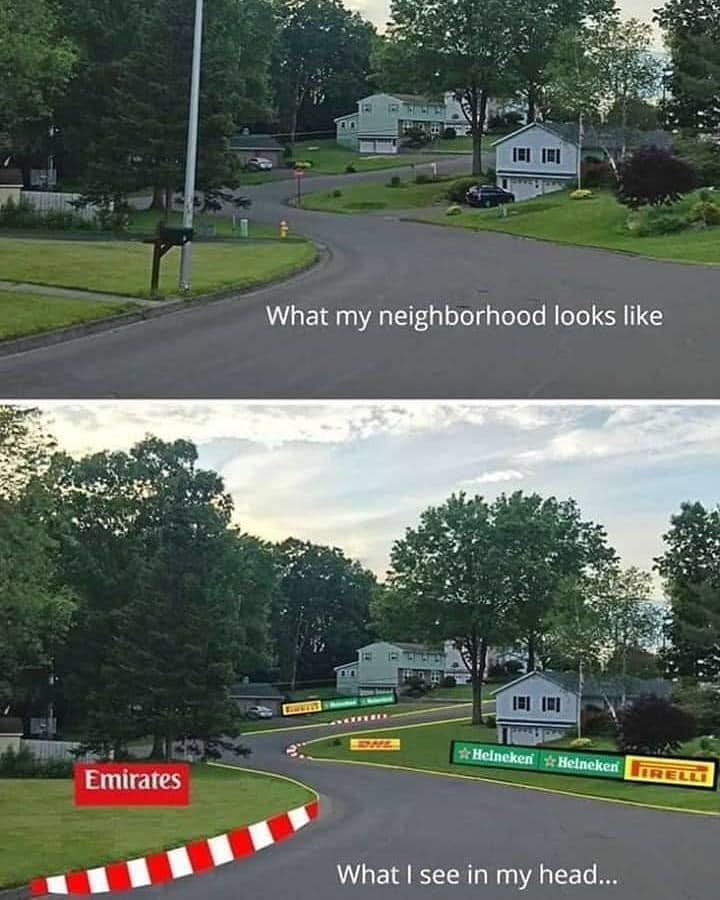
The meme humorously illustrates a dramatic shift from a standard residential street to a professional race track, highlighting the specific infrastructure of urban road design that accommodates different modes of traffic and events. The top image shows a quiet, familiar neighborhood, while the bottom image reveals the same area transformed with green barriers, race cars, and massive sponsor banners like Emirates, DHL, Heineken, and Pirelli. This contrast emphasizes how the same geographic space can undergo massive physical and conceptual changes depending on the primary purpose of the road.
simple-description (llama3.2-vision_11b)
This meme is a humorous commentary on the design of roads in urban areas. The image shows a typical suburban street with a road that suddenly turns into a Formula 1-style racing track, complete with barriers, signs, and a pit lane. The caption "What my neighborhood looks like" is a tongue-in-cheek reference to the absurdity of a normal suburban street being transformed into a high-speed racing track.
detailed-analysis (gemma3-27b-vision)
Okay, here's a breakdown of the image based on your requested theoretical frameworks. It's a bit of a complex meme and lends itself to several interpretations. I’ll provide sections for those frameworks where it seems most applicable, with caveats where the connection is weaker.
Visual Description
The image presents a before-and-after comparison. The top image shows a standard suburban neighborhood street. It's a slightly winding road flanked by grass and trees, with a house visible in the background. It’s a typical, unremarkable American suburban scene.
The bottom image digitally alters the same scene, transforming it into a Formula 1 race track. Advertising banners for sponsors like Emirates, Pirelli, and Heineken line the "track," and the road markings have been replaced with race track paint. The transformation is visually jarring, highlighting the contrast between mundane reality and imagined speed, excitement, and spectacle. The visual humor relies on the incongruity of applying high-speed racing aesthetics to a quiet residential area.
Foucauldian Genealogical Discourse Analysis
This image powerfully evokes how discourse constructs reality. The "before" image is perceived as normal because we've been socialized to view suburban life in a certain way. This view is not inherent to the scene itself, but produced through discourses about the "American Dream," "homeownership," and suburban lifestyles. The image begs the question: what discourses construct our experience of space, and how are those discourses power-laden?
The "after" image disrupts this accepted discourse. By inserting the aesthetics of Formula 1 racing, it posits an alternative way of experiencing the same space: as a site of speed, competition, and spectacle. This isn't simply a "change" of scenery, it's a shift in regime of truth.
A genealogical analysis could trace the historical development of both suburban ideology and the aesthetics of Formula 1 racing. How did the ideal of the suburban home emerge as a dominant cultural force? How did F1 racing become linked to notions of luxury, technological prowess, and even masculinity? This image exposes the constructed nature of both these seemingly natural phenomena.
Critical Theory (Specifically, the Culture Industry)
The image strongly resonates with Adorno and Horkheimer’s concept of the "Culture Industry." The imposition of F1 aesthetics onto the mundane suburban street suggests a process of commodification and standardization. The street is no longer simply a residential space, but a potential site of consumption. The presence of sponsor logos (Emirates, Heineken, Pirelli) reinforces this.
The image implies that even in our "private" lives, we are constantly bombarded with the symbols and values of the market. The F1 transformation isn’t about enhancing the street itself; it’s about turning it into a spectacle for consumption, where value is derived not from use but from its symbolic associations with wealth, speed, and excitement.
The contrast between the drab reality and the hyper-stimulated "inner life" suggested by the altered image also highlights the alienation characteristic of modern consumer culture.
Marxist Conflict Theory
From a Marxist perspective, the image exposes underlying class tensions and the alienation of labor. The suburban street, in many ways, represents the achievement of the “American Dream,” but it’s a dream often built on economic inequality and exploitation. The imposition of the F1 aesthetic, with its overt displays of wealth and sponsorship, exacerbates this tension.
The F1 imagery represents a world of extreme capital and concentrated power—a world inaccessible to most residents of the depicted suburban street. It's a visual metaphor for the widening gap between the haves and the have-nots. The "inner life" of the individual, filled with the excitement of racing, can be interpreted as a form of escapism—a distraction from the realities of economic precarity and social injustice.
Postmodernism
The image is inherently postmodern. It's a playful deconstruction of reality, blurring the lines between the “real” and the “simulated.” The juxtaposition of the mundane and the fantastical embodies the postmodern rejection of grand narratives and the embrace of pastiche, irony, and fragmentation.
The image challenges our assumptions about what constitutes “normal” or “authentic” experience. It suggests that our perceptions are shaped by a constant flow of media images and cultural references. The meme format itself is a postmodern device—a self-aware commentary on culture that relies on irony and intertextuality.
Queer Feminist Intersectional Analysis
This is where the interpretation becomes more nuanced. While not immediately obvious, a queer feminist lens can be applied. The hyper-masculine world of Formula 1 racing is traditionally very gendered. The image can be seen as a fantasy that replaces the often restrictive and normative expectations associated with suburban domesticity—especially for women.
The "inner life" of imagining a race track could be interpreted as a subversive escape from the pressures of conforming to traditional gender roles and societal expectations. It's a space for desire, fantasy, and agency, even if it's purely internal. Furthermore, the image challenges the notion of a "static" or "fixed" identity. The individual is not simply defined by their location in a suburban neighborhood, but by their capacity for imagination and fantasy.
However, it's important to note that the world of Formula 1, even in a fantastical re-imagining, remains heavily dominated by patriarchal structures. Therefore, a fully developed queer feminist analysis would need to consider how this image both reinforces and potentially subverts these power dynamics.
Let me know if you’d like me to elaborate on any of these interpretations or explore other theoretical frameworks!
simple-description (llama3.2-vision)
The meme is a humorous comparison between how a neighborhood appears to the general public and how it appears to the person who lives there. The top image shows a typical suburban neighborhood with a few houses and trees. The bottom image shows the same neighborhood but with a racing track and numerous advertisements from companies like Heineken, Pirelli, and Emirates. The text above the images reads, "What my neighborhood looks like" and "What I see in my head." The meme is meant to be humorous and satirical, implying that the person's imagination is so vivid that they can see a full-fledged racing track in their own neighborhood.
tesseract-ocr
a, Nee ae 3 ee cask re ioe = a it H esas What my neighborhood looks like : a. oa cae Oe ae Pot Bia, Sees on ae ie nA Gees BF eo ans = per Boe —- ae rors ; F . z Tea ee ee What | see in my head...