First Seen
2023-05-10T20:59:58+00:00
simple-description (llama3.2-vision_11b)
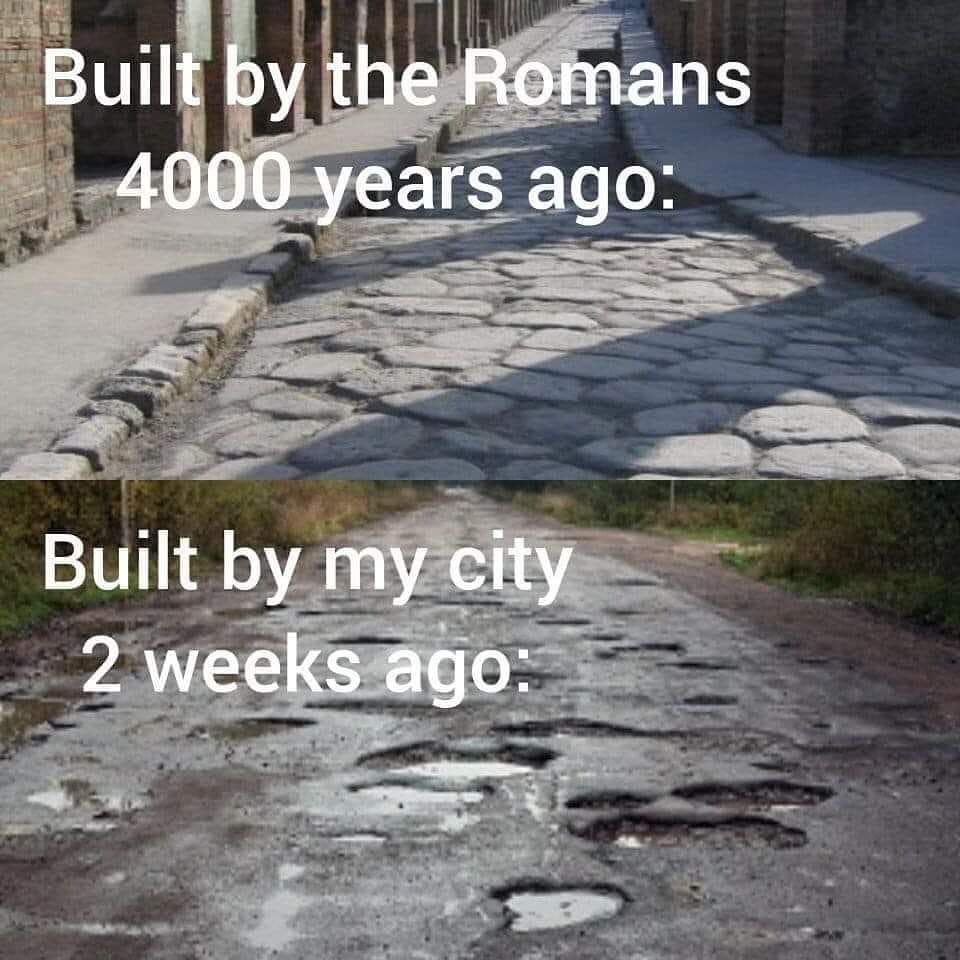
The meme is a humorous comparison between ancient Roman road construction and modern urban infrastructure. The top image shows a well-maintained Roman road, while the bottom image depicts a modern road with potholes and cracks. The text reads: "Built by the Romans 2000 years ago: / Built by my city 2 weeks ago: "
detailed-analysis (gemma3-27b-vision)
Okay, here's a breakdown of the image using the requested theoretical lenses. I'll note when a lens doesn't strongly apply, and why.
Visual Description
The image presents a stark juxtaposition of pavement. The upper portion, labeled "Built by the Romans 4000 years ago," shows a relatively intact, though aged, stone pavement. It's composed of large, roughly-hewn polygonal stones, showing signs of wear (some erosion, moss/algae growth) but still generally level and in place. The stones have a pale, greyish hue.
The lower portion, labeled "Built by my city 2 weeks ago," shows a freshly paved surface of what appears to be asphalt or concrete. However, it is deeply rutted, broken, and water-filled, exhibiting severe damage almost immediately after construction. The color is dark grey/black, and the water within the ruts creates stark, dark reflections. The damage includes deep tire tracks and crumbling sections.
The overall composition emphasizes the dramatic contrast between the longevity and apparent quality of Roman construction and the immediate failure of modern work. The framing, labeling and stark contrast serve to create a statement.
Foucauldian Genealogical Discourse Analysis
This image lends itself very well to a Foucauldian analysis. It can be seen as a visual argument about the changing discourses of construction, skill, and civic responsibility.
- Power/Knowledge: The Roman pavement represents a discourse built upon mastery of materials, long-term planning, and a perceived authority to create lasting infrastructure. This authority was built upon a social structure, and the knowledge was linked to the power of the Roman state. The modern pavement represents a discourse centered on speed, efficiency, and potentially, cost-cutting. The power here resides in different economic and political structures.
- Genealogy: A genealogical tracing would explore how this shift happened. What historical changes in labor practices, material science, economic priorities, and political accountability led to a situation where a road built millennia ago is in better condition than one built two weeks ago? The genealogy wouldn't be a simple linear progression but would highlight the contingent and often unpredictable intersections of various forces.
- Disciplinary Power: We can see a form of disciplinary power at play. The Roman road implicitly establishes a standard of quality. The new road, by failing to meet that standard, subtly disciplines (or critiques) contemporary construction practices. It exposes the weaknesses in current systems.
- Archaeology of Knowledge: The image literally is an archaeological exploration of knowledge – a visual comparison of different “layers” of knowledge surrounding construction techniques and their outcomes.
Critical Theory
This image is a strong case study for a Critical Theory reading. It highlights a systemic problem that isn't merely a technical one (poor paving).
- Domination & Control: The contrast between the Roman and modern road suggests a broader pattern of decay in civic responsibility and a prioritization of short-term profits over long-term quality. It can be interpreted as a symptom of a wider system of domination, where the needs of capital outweigh the well-being of citizens.
- Ideology: The image challenges the dominant ideology that equates “progress” with rapid construction and economic efficiency. It demonstrates that simply doing something faster doesn’t necessarily mean it’s better. It exposes the hidden costs of prioritizing speed and efficiency above quality.
- Emancipation: By highlighting this systemic failure, the image potentially invites reflection and encourages a re-evaluation of priorities. It subtly asks: What kind of society do we want to build, and what values should guide our construction (both literally and figuratively)?
Marxist Conflict Theory
The image has definite relevance to Marxist thought.
- Class Struggle: The image can be seen as a manifestation of class struggle. The longevity of the Roman road represents a system where skilled labor was valued and produced lasting results. The failure of the modern road points to a system where labor is devalued, corners are cut to maximize profit, and the quality of work suffers.
- Exploitation: A Marxist analysis might highlight the exploitation of labor in the modern construction process. The rapid construction and low quality suggest that workers may be pressured to complete work quickly, even at the expense of quality, for the benefit of those who profit from the project.
- Contradiction: The image embodies a contradiction within the capitalist system: the pursuit of short-term profit undermines long-term sustainability and quality of life.
Postmodernism
The image engages with postmodern themes, but in a somewhat ironic way.
- Deconstruction: The image "deconstructs" the myth of progress. It challenges the linear narrative of history by demonstrating that the past sometimes produced superior results to the present.
- Simulacra & Simulation: It could be argued that the new road is a simulacrum of a road – it looks like a road, but doesn’t function effectively. The image is more about appearance than substance.
- Irony & Parody: The comparison between the ancient and modern road is inherently ironic. It parodies the notion that contemporary technology and construction methods are automatically superior to those of the past.
Queer Feminist Intersectional Analysis
This lens is the weakest fit, but still has some potential.
- Systems of Oppression: The failure of the modern road can be seen as a metaphor for broader systemic failures that disproportionately affect marginalized communities. Poor infrastructure often impacts low-income areas and communities of color.
- Devaluation of Labor: Historically, labor performed by women and marginalized groups has been devalued. The image could be read as a symbolic representation of that devaluation, where the quality of work is sacrificed for profit.
- Intersectionality: A fully nuanced reading could explore how different forms of oppression (class, race, gender) intersect to create conditions that lead to poor infrastructure and systemic failures. However, the image is primarily focused on material conditions and does not explicitly address social justice issues.
I hope this detailed breakdown using these different theoretical frameworks is helpful! Let me know if you'd like me to elaborate on any particular lens.
simple-description (llama3.2-vision)
This meme is a humorous comparison between the quality of roads built by the Romans and those built by modern cities. The top image shows a well-paved and well-maintained Roman road, with the caption "Built by the Romans 4000 years ago." The bottom image shows a pothole-ridden and crumbling modern road, with the caption "Built by my city 2 weeks ago." The meme pokes fun at the idea that modern cities can't even build a decent road, let alone a long-lasting one like the Romans.
tesseract-ocr
” - Bem aris ee em PB GHoue - etn | 9 1ewRomans te ‘4 t. =e 7. =| oe CIEE Telok - 4 ae SR =: A — : ee iP 3 a u sree Severo. oe : nt = = er rath seatiticon a ¥y eine AYw) Ci oe POF 4 — — ee ee Be Ah en ian ta we . ie en 8 <a eee ao a og |e ee eee a! ene si Sg: ere ieee. as. Ae ee sepa» tee pl Sore