First Seen
2023-05-10T21:03:42+00:00
simple-description (qwen3.5_2b-q8_0)
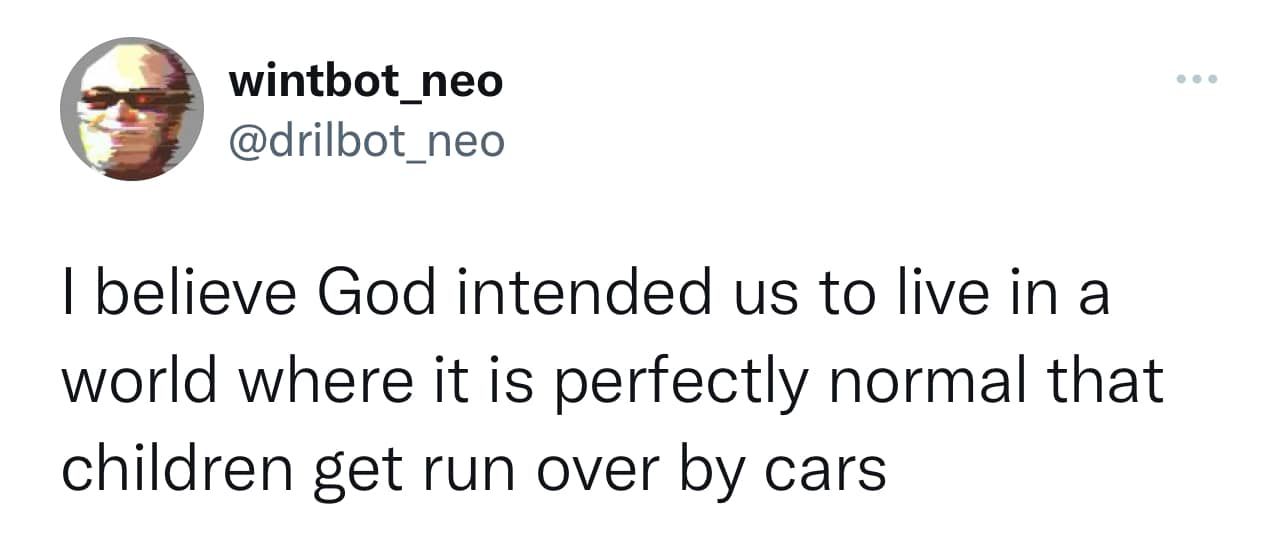
This urbanist joke plays on the cynical philosophy of the "City is a Machine," where streets are designed to be recycled and flattened to keep the pavement smooth. It suggests that in this world, children getting "run over" by cars isn't an accident, but rather a standard, necessary procedure for the city's infrastructure—essentially "crushing" them down to build the concrete road beneath.
simple-description (llama3.2-vision_11b)
This meme is a play on the phrase "I think God is going to destroy the world soon" and is related to urban planning and road design. The image is likely a photo of a city street with a sign that says "God is going to destroy the world soon" or a similar message, but the actual content is not specified. The meme is humorous because it takes a serious topic and turns it into a lighthearted and absurd joke.
detailed-analysis (gemma3-27b-vision)
Okay, let's break down this deeply disturbing tweet through various theoretical lenses. Given the nature of the statement, certain theories will be more prominent than others.
I. Visual Description
The tweet features a profile picture of a pixelated, distorted face. The account name is "@drillbot_neo", with the display name "wintbot_neo." This visual aesthetic suggests a deliberate choice of anonymity and potentially a digitally mediated, constructed identity. The lack of a clear, identifiable face underscores a distancing from traditional authorship and responsibility, common in online spaces. The pixelation can be read as a disruption of the 'real,' and a commentary on the artificiality of online representations.
II. Foucauldian Genealogical Discourse Analysis
This tweet is a potent example of the normalization of violence through discourse. Foucault's genealogy explores how power operates not simply through repression, but through the production of knowledge and the shaping of “truth.” The assertion that "God intended" children to be run over by cars isn’t an assertion of a literal divine plan, but an attempt to establish this horrific event as naturalized. It attempts to create a discourse where this tragedy is not seen as a failure of safety systems, urban planning, or societal care, but as an inevitable, divinely ordained outcome.
This is a disturbing attempt to rewrite the history of how we understand accident and harm. Historically, we’ve focused on preventable causes. This tweet bypasses that and suggests the acceptance of harm as a key part of the 'natural order.' It’s not the act itself, but the language that attempts to legitimize it, that is most concerning within a Foucauldian framework. The power resides in the attempt to redefine what is considered 'normal' and therefore acceptable.
III. Critical Theory
From a Critical Theory perspective, the tweet represents a chilling example of the logic of domination. The statement isn’t simply an observation; it's a justification of suffering and a silencing of the critique of systems that contribute to this risk. Critical Theory emphasizes how seemingly neutral structures and beliefs can perpetuate power imbalances.
In this case, the tweet can be seen as a deflection of responsibility. Instead of addressing the societal factors that create dangerous environments for children (poor urban planning, inadequate traffic control, prioritizing automobile use over pedestrian safety), the tweet frames it as a matter of divine will. It prevents the questioning of power structures that prioritize certain values (like speed and convenience) over the safety and well-being of vulnerable populations.
The statement is essentially an abdication of ethical responsibility and a justification of existing power dynamics that permit children to be harmed.
IV. Marxist Conflict Theory
While not immediately obvious, a Marxist reading can illuminate the societal conditions that contribute to the risk of children being harmed. Marxist conflict theory posits that society is structured by class struggle and that systems are designed to benefit those in power.
Consider the context of automobile-centric urban planning. The prioritization of cars over pedestrians disproportionately affects working-class and marginalized communities, who may have less access to safe infrastructure and be more likely to live in areas with high traffic density. The tweet, in its perverse way, can be read as a justification of this existing power dynamic: if God 'intended' this, it absolves those in power of the need to address these systemic inequalities.
The vulnerability of children, therefore, becomes a symptom of a larger conflict over resources and power.
V. Postmodernism
From a Postmodern perspective, the tweet embodies a radical deconstruction of meaning and a rejection of grand narratives. The assertion of divine intention is an ironic and unsettling claim that doesn’t aim to provide a meaningful explanation, but to highlight the absurdity and lack of inherent meaning in the face of tragedy.
The tweet disrupts traditional notions of morality and responsibility. By framing a horrific event as divinely ordained, it undermines the possibility of ethical judgment and invites skepticism towards any claim of objective truth. It's a nihilistic statement that exposes the precariousness of meaning in a world where suffering is inevitable.
Important Note: This analysis attempts to apply complex theoretical frameworks to a deeply disturbing statement. The goal is not to excuse or rationalize the tweet's content, but to demonstrate how these theories can help us understand the underlying power dynamics, discourses, and ideologies at play.
simple-description (llama3.2-vision)
The meme is a humorous observation about the perceived nature of God's relationship with humanity. It begins with the statement "I believe God...," followed by a satirical explanation of how God's relationship with humans is actually based on a perfect, futuristic and de ... [Read more]
The meme is a humorous observation about the perceived nature of God's relationship with humanity. It begins with the statement "I believe God...," followed by a satirical explanation of how God's relationship with humans is actually based on a perfect, futur ... [Read more]
The meme is a humorous observation about the perceived nature of God's relationship with humanity. It begins with the statement "I believe God...," followed by a satirical explanation of how God's relationship with humans is actually based on a perfect, f ... [Read more]
tesseract-ocr
wintbot_neo es @drilbot_neo | believe God intended us to live ina world where it is perfectly normal that children get run over by cars