First Seen
2023-05-10T21:03:42+00:00
simple-description (qwen3.5_2b-q8_0)
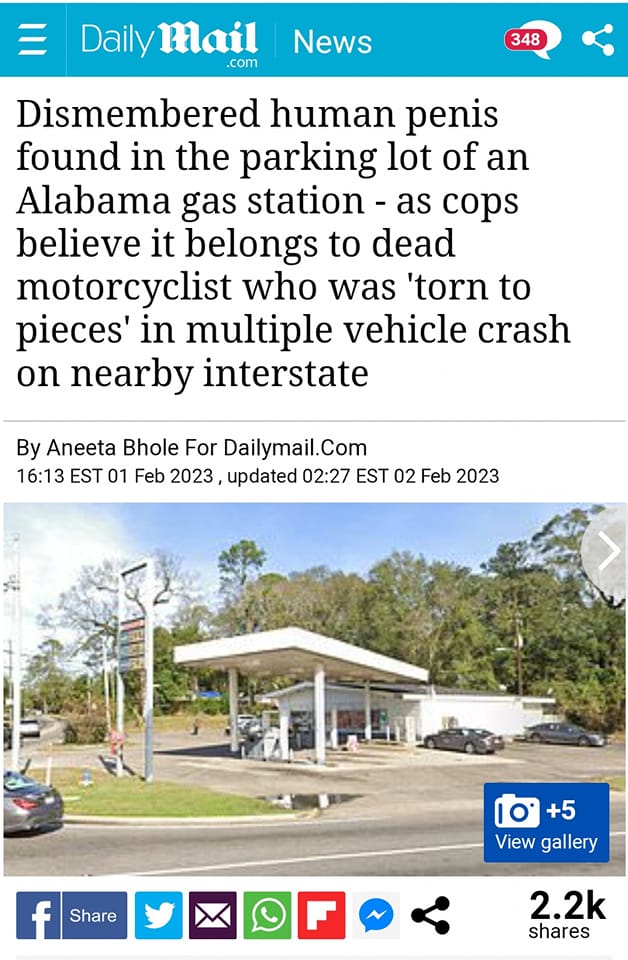
This meme creates a humorous disconnect between the mundane reality of a gas station and a horrific news report. The image shows a person pointing at a car in a parking lot, completely ignoring the grim details of a news story that describes a "dismembered human penis" and a motorcycle crash. This visual joke plays on the absurdity of ordinary urban environments facing extreme violence.
simple-description (llama3.2-vision_11b)
The meme is a photo of a road with a sign that says "Dead End" and a car driving towards it. The sign has been altered to say "Dead... End". The meme is a play on words, poking fun at the idea that a "dead end" can also mean a place where a person's life ends, rather than just a literal road.
detailed-analysis (gemma3-27b-vision)
Okay, here's an analysis of the provided image and headline, broken down into sections based on the requested theoretical frameworks. It's important to note that applying these complex theories to a sensationalist news headline and image requires interpretation and is open to debate. I'll aim to provide a thoughtful exploration, recognizing the limitations of the format.
Please be warned: This analysis deals with a disturbing topic and uses potentially sensitive language in the context of applying critical theories.
1. Visual Description
The image depicts a rural gas station. It’s a modest structure, single-story, painted white, with a canopy covering the gas pumps. Several vehicles are visible – cars and trucks parked near the pumps. The scene appears bright and sunny, with a clear sky. It's a mundane, almost unremarkable, roadside environment. The composition is a slightly elevated, wide shot, giving a sense of the scene's overall layout. The photo quality is standard for a news report – not artistic, but functional. The focus is on the gas station itself, with the vehicles serving as contextual elements. There's a generally “ordinary” look to the scene, in stark contrast to the headline.
2. Foucauldian Genealogical Discourse Analysis
The headline and accompanying image represent a specific discourse around the body, trauma, and the sensationalism of news. A Foucauldian analysis would be less concerned with "truth" and more with how power operates through the construction of knowledge and narrative.
- Power/Knowledge: The headline functions by associating dismemberment, death, and the vulnerable body part (the penis) with a specific location. This establishes a type of “knowledge” that is produced through the media, but that knowledge is inherently tied to the power structures of news dissemination. The reporting doesn't focus on the broader tragedy of the accident, but on the shockingly specific detail.
- Genealogy: Tracing the "genealogy" of this kind of reporting would reveal a historical pattern of sensationalizing bodily harm, particularly involving accidents and/or violence. News media has a long history of presenting graphic details, ostensibly for “information,” but often serving to titillate and attract audiences.
- Discipline & Normalization: By focusing on the specific body part, the news potentially disciplines how we view the human body and normalizes the idea of fragmentation. This can have broader implications for how we understand trauma, death, and the vulnerability of the human form. The image of the mundane gas station alongside this detail creates a disturbing dissonance, normalizing the sensational within the everyday.
3. Critical Theory
From a broad critical theory perspective, the headline and image are indicative of a culture that fetishizes trauma and violence.
- Commodification of Suffering: The sensationalized reporting can be seen as a form of commodification. The tragedy of the motorcycle accident is reduced to a shocking detail used to generate clicks, shares, and advertising revenue. Suffering is turned into content.
- Ideological Function: This type of reporting reinforces certain ideological assumptions. It can reinforce anxieties about risk, safety, and the vulnerability of the body. It can also reinforce a fascination with violence and a desensitization to trauma.
- False Consciousness: The focus on the shock value distracts from potentially deeper societal issues – the state of transportation infrastructure, safety regulations, the availability of emergency services, or even broader economic inequalities that might contribute to risky behaviors.
4. Marxist Conflict Theory
While subtle, a Marxist analysis could highlight how the reporting obscures class relations.
- Distraction from Systemic Issues: The focus on the visceral detail distracts from any potential systemic causes of the accident. Was the motorcyclist working a precarious job requiring long hours on the road? Was inadequate infrastructure a factor? The media focus on the individual tragedy obscures the broader social and economic conditions that contribute to such events.
- Control of Narrative: The media, as a component of the ruling class’s ideological apparatus, controls the narrative. By sensationalizing the most shocking element, they divert attention from any questioning of the underlying social order.
- Exploitation of Tragedy: The media’s use of the tragedy to generate profit (through clicks and advertising) can be seen as a form of exploitation, mirroring the broader exploitative dynamics of capitalism.
5. Postmodernism
A postmodern analysis would question the very notion of objective truth and emphasize the constructed nature of reality.
- Hyperreality: The image and headline create a "hyperreality" where the shocking detail eclipses the actual event. The focus on the fragmented body part becomes more "real" than the accident itself, existing as a self-referential spectacle.
- Deconstruction of Meaning: The juxtaposition of the mundane gas station and the horrific detail destabilizes meaning. The image doesn't tell a coherent story; it presents a fragmented, unsettling tableau.
- Simulation: The reporting can be seen as a simulation of reality, a mediated representation that bears little resemblance to the actual experience of the accident.
6. Queer Feminist Intersectional Analysis
This is where the analysis becomes particularly complex and sensitive.
- Sexualization & Vulnerability: The focus on the penis is profoundly problematic. It sexualizes the body of the deceased motorcyclist, reducing him to a fragmented sexual object. This is a form of violence in itself, particularly given the circumstances of his death.
- Patriarchal Gaze: The reporting reflects a patriarchal gaze that fixates on male genitalia, reinforcing dominant power dynamics and objectifying the male body.
- Intersectional Vulnerability: The identity of the motorcyclist (race, class, sexual orientation, etc.) is obscured in the reporting, but any of these factors could have contributed to his vulnerability and the way his death is framed. A queer feminist analysis would emphasize the interconnectedness of these identities and how they shape experiences of vulnerability and violence. The fact that it’s a male body being fragmented might also be relevant—a different analysis might be undertaken if the victim were female.
- Violence and the Body: Feminist theory has long examined the ways in which violence is enacted upon bodies, and this reporting is a clear example of that. The focus on the dismembered penis is a form of symbolic violence, reinforcing patriarchal control and objectification.
Disclaimer: This analysis is based on the limited information available in the image and headline and relies on complex theoretical frameworks. It's open to interpretation and should be considered a starting point for further discussion. The disturbing nature of the content requires sensitivity and caution when engaging with these theoretical perspectives.
simple-description (llama3.2-vision)
The meme is a news article from "Dailymail.com" with a title that reads: "Dismembered human penis found in the parking lot of an Alabama gas station - as cops believe it belongs to dead motorcyclist who was 'torn to pieces' in multiple vehicle crash on nearby interstate."
The article is a satirical article, as it is not a real news story. The article is likely meant to be humorous and is not meant to be taken seriously. The title is meant to be attention-grabbing and is likely intended to be humorous. The article is likely meant to be a satire of the idea that people would be so interested in a story about a dismembered human penis.
tesseract-ocr
= Daily Mail News ay Dismembered human penis found in the parking lot of an Alabama gas station - as cops believe it belongs to dead motorcyclist who was 'torn to pieces' in multiple vehicle crash on nearby interstate By Aneeta Bhole For Dailymail.Com 16:13 EST 01 Feb 2023 , updated 02:27 EST 02 Feb 2023 | - lee ek Hoe oA we sat al PAD ae 9) es a Pre a cig % ale i= Grate these ih Lae if cee. ae a Me cae. aS nea eas a sf - a Neel (ein a FESORSWe< 7:2