First Seen
2023-06-08T02:44:26+00:00
simple-description (qwen3.5_2b-q8_0)
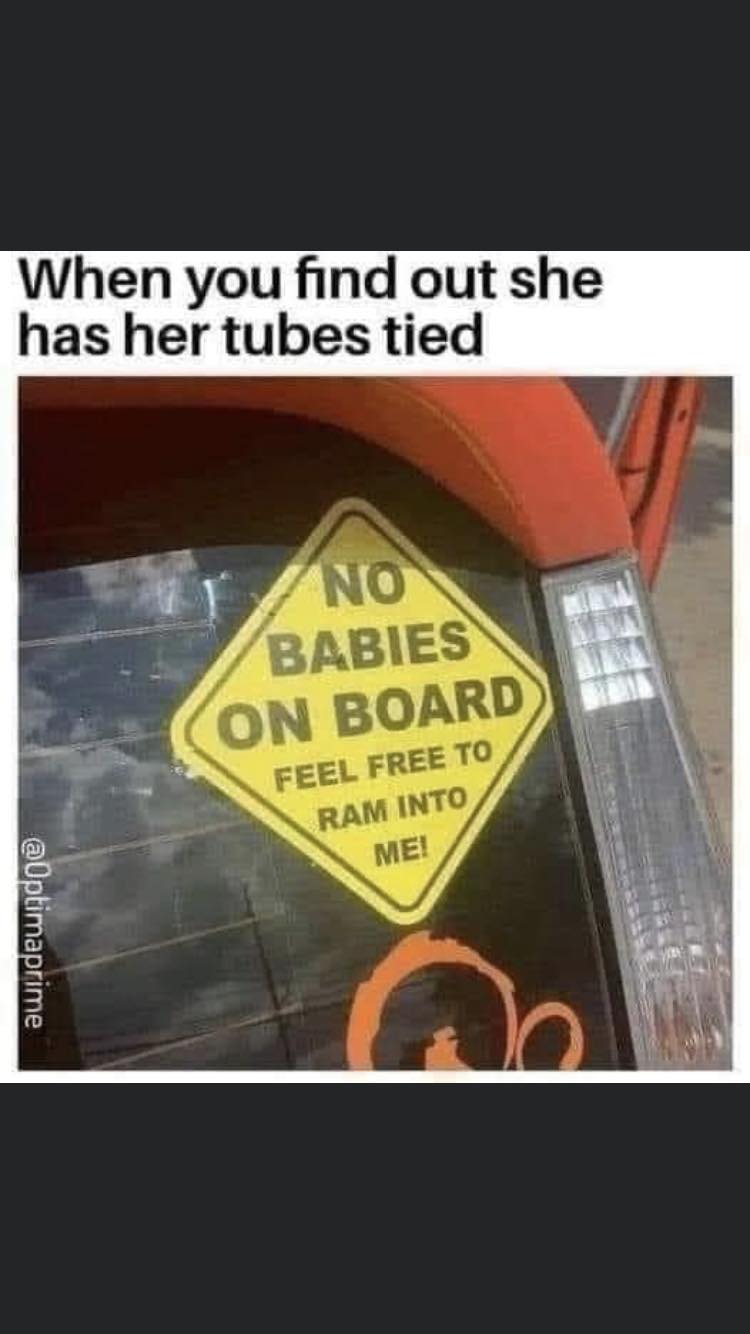
This meme uses road signage as a visual metaphor for urban regulation, creating a humorous barrier against pregnancy on public transport. A yellow diamond-shaped warning sign acts as a standard traffic rule, explicitly stating "NO BABIES ON BOARD" to imply the vehicle is currently occupied. However, the text twists this into a satirical message by reading, "FEEL FREE TO RAM INTO ME!" which mocks the idea of conceiving while hiding inside a car to drive.
simple-description (llama3.2-vision_11b)
This meme is a play on a common warning sign, but with a humorous twist. The image shows a typical "No Babies on Board" sign, but with a phrase "No Babies on Board" replaced with "No Babies on Board... unless you're a baby, in which case you're on board".
detailed-analysis (gemma3-27b-vision)
Okay, let's break down this image/meme using the requested theoretical frameworks. It's a provocative image, and several frameworks apply, though to different degrees.
Visual Description
The image depicts a sticker on the rear window of a red vehicle. The sticker is designed to mimic the yellow diamond-shaped "Baby On Board" warning signs common on cars. However, the text has been altered to read "NO BABIES ON BOARD. FEEL FREE TO RAM INTO ME!". The image is presented as a meme, with the text at the top reading "When you find out she has her tubes tied." The background is a blurred view of a parking lot. The sticker is the central and dominant visual element. The overall aesthetic is deliberately crude and intentionally provocative.
Foucauldian Genealogical Discourse Analysis
This meme presents an interesting case for Foucauldian analysis. The "Baby On Board" sticker itself is a form of discourse. It's not merely a warning sign, but a statement about societal expectations around motherhood, reproduction, and the value of potential life. It implies a certain moral imperative – that protecting potential babies is a good and natural thing.
The meme subverts this discourse. It challenges the assumed naturalness and goodness of reproduction. The alteration to the sign is a direct challenge to the normalisation of procreation.
The meme's implication (that the person having their tubes tied welcomes/even desires a potential accident) can be seen as a transgressive discourse, operating outside the accepted norms. It speaks to a frustration with societal pressure around motherhood and reproductive control.
A genealogical approach would examine how the "Baby On Board" sign came to be a societal norm. When did these stickers appear? What anxieties did they address? How did they contribute to the construction of the ‘good mother’ archetype? The altered sign, then, can be seen as a disruption to this established genealogy, revealing the power dynamics embedded within the seemingly innocuous original.
Critical Theory
This meme aligns with core tenets of Critical Theory, specifically concerning the critique of patriarchal structures and the social construction of gender roles.
The sticker, in its original form, reinforces the idea that a woman's primary role is as a mother. The meme pushes back against this expectation. The phrase "tubes tied" signifies a deliberate act of reclaiming reproductive control. This control is seen as an act of resistance against societal expectations and the potential for being reduced to a reproductive vessel.
The provocative nature of the message (inviting ramming) is a hyperbole meant to illustrate the depth of frustration felt by those who are pressured to have children against their will. It's a statement about bodily autonomy and the right to determine one’s own life path.
This aligns with the Frankfurt School’s emphasis on challenging dominant ideologies and exposing the power dynamics that underpin social norms.
Queer Feminist Intersectional Analysis
This meme is rich for Queer Feminist Intersectional analysis. It is an articulation of reproductive freedom, bodily autonomy and resistance to societal expectations about women’s bodies.
-
Feminist Perspective: The meme directly addresses the societal pressure on women to reproduce. It challenges the idea that a woman's value is tied to her ability to bear children. It is a reclamation of control over one's own body and reproductive destiny.
-
Queer Perspective: While not explicitly ‘queer’ in subject matter, the act of intentionally disrupting reproductive norms can be seen as a rejection of heteronormative assumptions about family and reproduction. It’s a statement that not everyone desires or is suited for parenthood, and that is a valid choice. The rejection of the expectation to procreate aligns with queer critiques of normative life structures.
-
Intersectional Perspective: This meme acknowledges that the pressure to reproduce is not experienced equally by all women. Factors such as race, class, and disability can significantly impact access to reproductive healthcare and the choices women make. The meme can be interpreted as a broader statement about bodily autonomy for all individuals, recognizing the complexities of reproductive justice.
Marxist Conflict Theory
While less prominent than the other analyses, a Marxist lens can still be applied. The issue of reproductive rights often intersects with economic inequalities.
The meme can be seen as a rejection of the capitalist expectation that individuals reproduce to maintain the workforce. It challenges the idea that women’s bodies are simply a resource for producing future laborers.
The frustration expressed in the meme can also be interpreted as a response to the economic challenges of raising children in a capitalist society, where the costs of childcare, education, and healthcare can be prohibitive.
Postmodernism
The meme embodies some Postmodern characteristics. The alteration of the "Baby On Board" sign is a deconstruction of the original meaning. It challenges the notion of a fixed, stable meaning and highlights the ways in which language and signs are always open to interpretation.
The meme's provocative and ironic tone aligns with the Postmodern emphasis on challenging grand narratives and questioning authority. It is a playful but pointed critique of societal norms.
The image also relies on pastiche and intertextuality – it takes a familiar sign and remixs it to create a new, subversive meaning.
Important Note: The meme is deliberately provocative and some may find its imagery disturbing or offensive. It is important to approach it with sensitivity and recognize that its message is intended to challenge and disrupt conventional thinking.
Let me know if you would like me to expand on any of these analyses or explore other theoretical frameworks.
simple-description (llama3.2-vision)
The meme is a photo of a car's rear window with a yellow diamond-shaped sticker that reads: "NO BABIES ON BOARD. FEEL FREE TO RAM INTO ME!" The text above the image says: "When you find out she has her tubes tied." The meme is a humorous way to express the idea that someone's partner has been or is about to be sterilized, and they're now free to live their life without the burden of having to deal with a partner's or their own child's needs.
tesseract-ocr
When you find out she has her tubes tied - Ps re ~ ene i | ay SON eee BABIES NO Ue = ON BOARD iam eS ceel FREE T° / Me i oo) » Ral INTO yt hb 4 ee - 2 Me! iy iy) = ha y a j ah ‘ { Pl la Wo