First Seen
2024-03-20T05:44:46.092112+00:00
simple-description (qwen3.5_2b-q8_0)
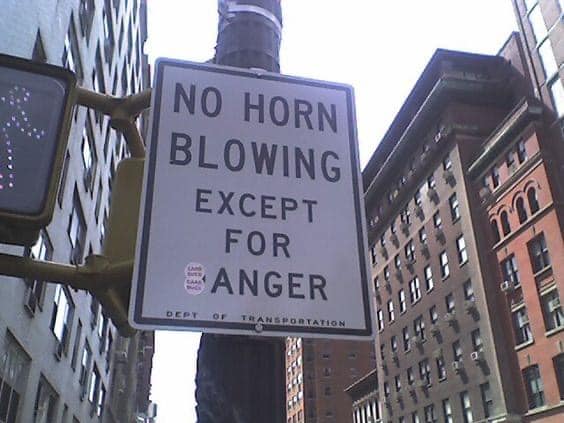
This image features a street sign in a city setting that reads "NO HORN BLOWING EXCEPT FOR ANGER." This meme satirizes the aggressive nature of urban traffic, implying that honking is such an annoying and aggressive act that it is only warranted when you are truly furious. The sign adds to the irony by noting the constant presence of driving and honking in the street, highlighting how city centers often prioritize traffic flow over peaceful commuting.
simple-description (llama3.2-vision_11b)
This meme is a play on the idea that urban design and road safety are often at odds with the needs of drivers, pedestrians, and cyclists. The image shows a "no horn" sign, but with a humorous twist, replacing "no horn" with "no horn blowing except for anger". The text is a clever commentary on the frustration that drivers often feel when navigating busy city streets, and the absurdity of a sign that seems to be addressing a non-existent problem.
detailed-analysis (gemma3-27b-vision)
Okay, let's break down this image of the "No Horn Blowing Except For Anger" sign, utilizing the frameworks you requested.
1. Visual Description
The image shows a white, rectangular traffic sign attached to a metal pole at a street intersection. The sign reads "NO HORN BLOWING EXCEPT FOR ANGER" in bold, black lettering. Beneath this is a smaller, stylized seal with the words “Loud Rights Dept” and then the phrase “Dept of Transportation”. The background consists of dense urban architecture – high-rise brick buildings, partially visible traffic lights and poles, suggesting a city street scene. The image seems to have been taken looking slightly upwards, emphasizing the buildings and the sign's position within the urban landscape. The overall aesthetic is slightly grainy and feels like a candid street photograph.
2. Foucauldian Genealogical Discourse Analysis
Michel Foucault's genealogical approach involves tracing the historical emergence of power relations embedded in discourse. This sign is a fascinating example.
- Discipline & Normalization: The sign attempts to discipline the behavior of drivers. It doesn't simply prohibit horn-blowing, but conditionalizes it. This suggests that horn-blowing is seen as disruptive, potentially 'abnormal,' except when aligned with the socially acceptable emotion of anger. This normalizes anger as a justifiable reason for sonic disruption.
- Power/Knowledge: The very placement of the sign implies authority (the Dept. of Transportation) defining acceptable behavior. The knowledge that anger justifies horn-blowing is not inherent, but constructed by this authority. The sign creates a discourse where drivers are subtly encouraged to perform anger to legitimize a normally prohibited act.
- Genealogy of 'Anger': A deeper genealogical inquiry might investigate how 'anger' itself is constructed as a legitimate, even expected, emotional response in urban environments. Does the infrastructure of the city (congestion, noise, pace of life) produce anger, making the sign a self-fulfilling prophecy?
- Panoptic Effect: While not a direct example of the panopticon, the sign operates similarly. It’s a constant reminder of potential surveillance and expectation of conformity, even when it appears to allow for exception.
3. Critical Theory
From a broader critical theory perspective, the sign can be read as a symptom of the alienation and repressed emotions inherent in modern urban life.
- Commodification of Emotion: The sign implicitly acknowledges that the city creates conditions that elicit anger. Yet, it doesn’t address the underlying causes (congestion, stress, etc.). Instead, it allows for the expression of anger (via horn-blowing) within pre-defined boundaries, potentially diverting attention from the systemic issues causing the anger in the first place.
- Instrumental Reason: The sign represents a rationalizing, bureaucratic approach to managing the symptoms of social problems rather than addressing the root causes. It seeks to 'control' behavior, rather than foster a more harmonious or empathetic urban environment.
- One-Dimensional Man: (Herbert Marcuse) The sign potentially contributes to a society where even emotional expression is channeled and controlled, preventing genuine critical thinking or dissent. The allowance of anger as an exception could be seen as a controlled release valve, preventing a broader questioning of urban conditions.
4. Marxist Conflict Theory
From a Marxist lens, the sign illuminates power dynamics and class tensions.
- Ideology and False Consciousness: The sign can be seen as a form of ideological control. It normalizes a situation where disruptive behavior (horn-blowing) is acceptable when rooted in an “authentic” (but socially sanctioned) emotion like anger. This can distract from the real sources of social conflict.
- Alienation: The prevalence of anger in urban life might be seen as a product of alienation stemming from exploitative labor practices, inequality, and the dehumanizing aspects of capitalist society. The sign does not address these underlying conditions, but allows for a symbolic expression of frustration.
- Class and Space: The urban landscape (high-rise buildings, traffic congestion) often reflects and reinforces class divisions. The sign, placed within this landscape, can be interpreted as a mechanism for managing the tensions arising from these divisions.
5. Postmodernism
The sign resonates with several postmodern themes:
- Deconstruction of Meaning: The sign undermines the straightforward prohibition implied by the phrase "No Horn Blowing." It introduces a conditional exception, challenging the stability of the meaning and inviting interpretation.
- Hyperreality & Simulation: The “Loud Rights Dept” seal is an odd element. Is it real? Is it satire? It creates a layer of ambiguity, blurring the lines between reality and simulation. It’s a performative gesture that draws attention to the constructed nature of authority.
- Fragmentation & Playfulness: The combination of serious (traffic regulations) and absurd (conditional permission for anger) creates a fragmented, playful effect. This reflects the postmodern tendency to challenge grand narratives and embrace ambiguity.
6. Queer Feminist Intersectional Analysis
While subtle, an intersectional lens can offer some insights:
- Emotional Labor & Gender: The expectation that anger is an acceptable justification for breaking a rule could be particularly relevant for marginalized groups who are often socialized to suppress their anger. The sign could be seen as subtly reinforcing the idea that some expressions of anger are acceptable, while others are not (based on race, gender, class, etc.)
- Public Space & Control: Public spaces (like streets) are often sites of power imbalances and control. The sign reflects an attempt to regulate behavior and maintain order, potentially disproportionately affecting marginalized communities who are already subject to heightened surveillance and scrutiny.
- Reclaiming Anger: However, the sign could also be read as a subversive gesture, a way of reclaiming anger as a legitimate emotion and challenging oppressive systems. By acknowledging the existence of anger, it implicitly recognizes the validity of the grievances that fuel it.
Let me know if you'd like me to delve deeper into any of these frameworks or aspects of the image.
simple-description (llama3.2-vision)
This meme features a photo of a traffic sign that says "No horn blowing except for anger" with a red "No" symbol in a circle. The sign is displayed in a city setting, likely in a busy area with many people and vehicles. The sign's unusual message and use of a red "No" symbol, typically used to indicate a rule or warning, are likely meant to be humorous and satirical.
tesseract-ocr
‘ ; ‘ RN | bf : ie NG (Ay Ih i | | A it ct 5 es