First Seen
2023-05-26T00:10:54+00:00
simple-description (qwen3.5_2b-q8_0)
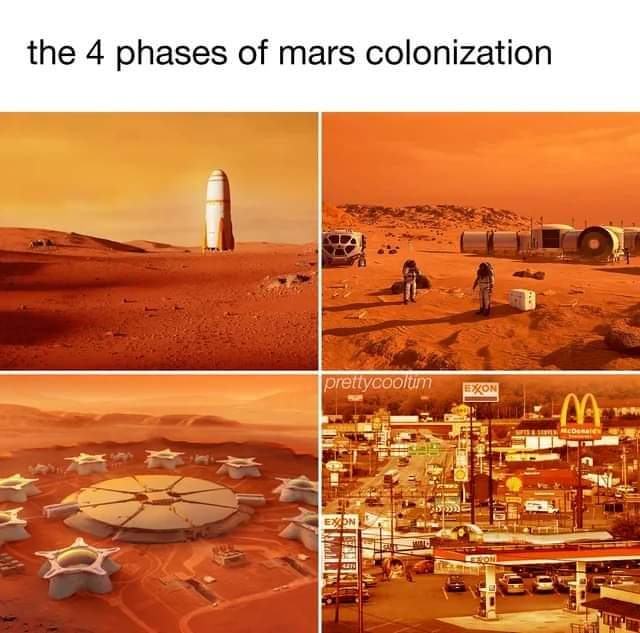
The meme satirizes urban planning by imagining a Martian city that evolves like Earth's, eventually becoming a chaotic highway sprawl. It suggests that Mars colonization will follow the same urban trajectory as our planet, ending in a massive settlement featuring a "mcdonald's" complex, "EXON" gas station, and winding road networks. "the 4 phases of mars colonization" humorously outlines this progression from isolation to a bustling metropolis.
simple-description (llama3.2-vision_11b)
The meme is a humorous commentary on the challenges of urban planning in a futuristic, sprawling city on Mars. The image shows a sprawling metropolis with towering skyscrapers and a grid-like street pattern, but with a Martian landscape backdrop. The text "the 4 phases of mars colonization" is overlaid on the image, implying that the city's development is not yet complete, and there are still many challenges to overcome.
detailed-analysis (gemma3-27b-vision)
Okay, let's break down this image—titled "The 4 Phases of Mars Colonization"—through the lenses you've requested. It's a visually striking and conceptually loaded piece, so there's a lot to unpack.
Visual Description
The image is a quadriptych (four-panel image) showing a progression, seemingly depicting stages of colonization on Mars.
- Panel 1: A minimalist, isolated landscape of red sand with a single, sleek, white rocket or launch vehicle in the background. It's a scene of stark, early exploration and potential.
- Panel 2: A small, utilitarian, and somewhat ramshackle settlement. There's a collection of what appear to be prefabricated structures, a rover, and figures in spacesuits inspecting the environment. It speaks to a basic foothold and establishment of infrastructure.
- Panel 3: A more complex, though still relatively sparse, Martian landscape populated with uniquely designed, geodesic dome-like structures. There's a sense of expanding architecture and a longer-term establishment.
- Panel 4: A shockingly normal, yet incredibly jarring, image of a busy American gas station/convenience store intersection, complete with Exxon, McDonald's, and other corporate chains. This is set against the red Martian background.
The progression is meant to be satirical, demonstrating a shift from exploration and settlement towards complete capitalist absorption.
Foucauldian Genealogical Discourse Analysis
Michel Foucault’s genealogical method traces the history of ideas and concepts to understand how power operates through them. In this image:
- The Discourse of Exploration/Progress: The initial panels (1 & 2) represent the early discourse of space exploration, framed as a quest for knowledge, progress, and expansion. This is the foundational narrative—the justification for the undertaking.
- The Shift to Discipline & Control: As the colony expands (Panel 3), we see the emergence of structures and organization. This isn't merely building, but also constructing systems of control – boundaries, architecture that shapes movement, a developing social order.
- The Normalization of Capital: The final panel is the key Foucauldian moment. The image displays how capitalist structures (Exxon, McDonald’s) aren’t external to colonization, but become normalized and integrated. The "red planet" becomes indistinguishable from the very systems of power and consumption it was theoretically meant to escape. Colonization isn’t about a new beginning but a replication of existing power structures.
- Power/Knowledge: The image powerfully demonstrates how knowledge isn't neutral. The "knowledge" of how to build, organize, and sustain a colony is inextricably linked to the power of corporations to exploit resources and impose their systems.
Critical Theory
From a critical theory perspective (drawing on the Frankfurt School and others), this image is a scathing commentary on the inherent logic of capitalism:
- Instrumental Reason: The image illustrates how reason and technology (the ability to colonize another planet) are used instrumentally – not for liberation or enlightenment, but to serve the ends of capital accumulation. The question isn't "can we?" but "how can we profit?"
- Commodification of Space: The final panel shows the ultimate commodification – the colonization of a planet becomes just another market. Space itself, the "final frontier," is subject to capitalist logic.
- Reification: The image suggests that even the dream of escaping Earth's problems is reified – turned into a commodity that can be bought and sold. The red planet is no longer a symbol of hope but simply another extension of the existing capitalist system.
- Alienation: The image evokes a sense of alienation. Even on another planet, human needs are mediated through the market. The authentic experience of being on Mars is overshadowed by the omnipresence of commercialism.
Marxist Conflict Theory
From a Marxist perspective, this image highlights the inherent class conflict that drives colonization:
- Means of Production & Control: The corporations in the final panel represent the bourgeoisie – the ruling class that controls the means of production. They have the capital and resources to colonize Mars and, inevitably, exploit its resources for profit.
- Proletarianization of Space: The image implies that the colonists themselves (even if initially idealized as pioneers) will eventually become a proletariat – a working class subject to the demands of capital.
- Imperialism & Resource Extraction: Colonization, in this context, is a form of imperialism – the extension of capitalist domination to a new frontier. The goal is not simply to establish a colony but to extract resources and create new markets.
- Alienation of Labor: The final panel implies that even on Mars, labor will be alienated – workers will be disconnected from the fruits of their labor and subjected to the control of capital.
Postmodernism
A postmodern reading of the image would focus on:
- Simulation & Hyperreality: The image suggests that the Mars colony isn't a genuine "new world" but a simulation – a copy of Earth, specifically a hyper-commercialized American landscape. The reality of Mars is overshadowed by the manufactured reality of corporate branding.
- Loss of Grand Narratives: The image deconstructs the grand narratives of space exploration and progress. It reveals that colonization isn’t about creating a better future but simply replicating the problems of the present.
- Irony & Parody: The image is deeply ironic and parodic. It mocks the naive optimism of space exploration and exposes the cynical reality of capitalist expansion.
- Deconstruction of Boundaries: The image collapses the boundaries between Earth and Mars, between exploration and exploitation, between progress and profit.
Queer Feminist Intersectional Analysis
This lens highlights how the colonization of Mars, as depicted, would likely exacerbate existing inequalities and create new forms of oppression:
- Reproduction of Patriarchal Structures: The image hints at a patriarchal colonial project. Historically, colonization often involved imposing patriarchal social norms on colonized populations, and this image suggests that pattern would continue on Mars.
- Exclusion & Marginalization: The final image, with its focus on mainstream American consumerism, likely signifies the exclusion of marginalized communities from the benefits (if any) of Martian colonization. Whose vision of the future is being realized?
- Intersectional Oppression: The intersection of gender, race, class, and other social categories would likely shape the experiences of colonists on Mars. Those already marginalized on Earth would likely face even greater challenges in a new, hostile environment.
- Commodification of Bodies & Labor: The image suggests that bodies and labor would be commodified on Mars, with colonists treated as expendable resources for corporate profit. This commodification would likely disproportionately affect marginalized groups.
- Rejection of Radical Alternatives: The final image’s prioritization of mainstream consumerism rejects any possibility of radical, queer, feminist, or anti-capitalist alternatives for the Martian colony. It reinforces the dominant, oppressive social order.
I've tried to provide a thorough analysis through each of the lenses you requested. It's a very potent image, and each perspective offers a unique and valuable interpretation. Let me know if you’d like me to elaborate on any particular aspect!
simple-description (llama3.2-vision)
The meme is a humorous comparison of the four phases of Mars colonization, which are: 1) Arrival, 2) Exploration, 3) Settlement, and 4) Over-Commercialization. The text "the 4 phases of mars colonization" is at the top, and the four images below show a desolate Mars landscape, a person in a spacesuit, a small settlement, and a bustling, over- commercialized city with many cars, buildings, and billboards.
tesseract-ocr
the 4 phases of mars colonization ny | A aa = Si sa t r os ee peoamen|.) > cy 3 r sie. «= bit a << eas en Ta a - = > = i t