First Seen
2024-02-07T22:30:36.074608+00:00
simple-description (qwen3.5_2b-q8_0)
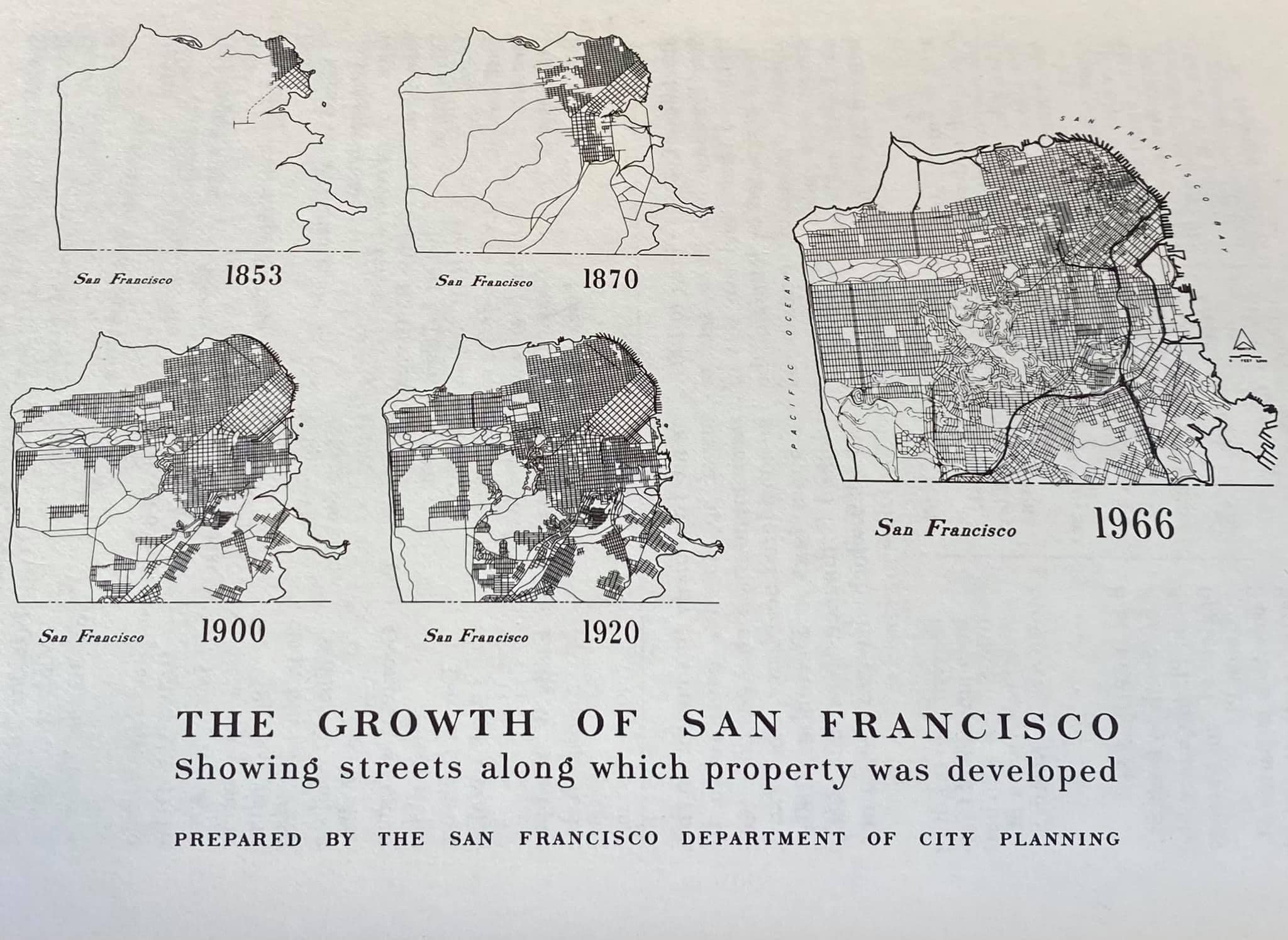
This "meme" is a humorous visual history of San Francisco's urban sprawl, presented as a comic strip of five maps. It uses the text "The Growth of San Francisco Showing streets along which property was developed" to illustrate how the city expanded from 1853 to 1966. The images, prepared by the San Francisco Department of City Planning, track the increasing density and physical growth of the grid over two centuries.
simple-description (llama3.2-vision_11b)
The meme is a comparison of San Francisco's city maps from 1853 to 1968, showcasing the city's rapid growth and urbanization. The image displays a series of maps, with the first one showing a small, rural area with few buildings, and the last one showing a densely populated city with many buildings and streets. The text "The Growth of San Francisco" appears above the maps, with the subtitle "Showing streets along which property was developed" below.
detailed-analysis (gemma3-27b-vision)
Okay, here's a breakdown of the image, focusing on the requested analytical lenses where applicable. It's important to remember this is an interpretation based on a static image, and a full analysis would require broader historical context.
Visual Description
The image presents a series of five maps depicting the growth of San Francisco at different points in time: 1853, 1870, 1900, 1920, and 1966. Each map visually illustrates the development of streets and presumably, property, within the city.
- Format: The maps are black and white line drawings, with the city limits delineated by a clear border.
- Imagery: The developed areas are indicated by a dense grid pattern, representing streets. Undeveloped areas remain blank. The density of the grid increases dramatically over time, charting the growth and expansion of the city.
- Progression: The maps show a clear progression. 1853 shows a very limited area of development clustered around the bay. By 1966, the grid extends across nearly the entire peninsula, illustrating extensive urban sprawl.
- Text: The title, “The Growth of San Francisco – Showing streets along which property was developed," and the source "Prepared by the San Francisco Department of City Planning” contextualize the image.
Foucauldian Genealogical Discourse Analysis
This image is highly relevant to a Foucauldian reading. Michel Foucault’s genealogy examines how power operates through discourse and historical formations. This image isn’t just a neutral depiction of growth, but a production of San Francisco as a site of property ownership and development.
- Discourse of Progress: The image reinforces a discourse of “growth” and “development” as inherently positive, and it’s presented as an objective, factual account. It implicitly positions property development as a natural and inevitable process.
- Power/Knowledge: The fact that this map was produced by the Department of City Planning is crucial. It demonstrates the intertwining of power and knowledge. The department defines what constitutes "growth," and this definition shapes urban policy, which in turn, governs land use, property value, and social organization.
- Historical Contingency: A genealogical approach emphasizes that the current form of San Francisco isn’t natural or predetermined. It’s the result of a series of historical power dynamics. The map hints at these – the early concentration of development suggests specific patterns of land ownership and access. Tracing the expansion requires investigating the policies and conditions (e.g., land grabs, transportation infrastructure, economic incentives) that facilitated it.
- Discipline and Control: The grid itself can be seen as a form of spatial discipline, organizing and controlling space, facilitating surveillance, and regulating movement.
Critical Theory
Framed through Critical Theory (drawing on the Frankfurt School), the image represents a visualization of rationalization and the logic of capital.
- Commodification of Space: The map's emphasis on "property development" highlights the commodification of space – the transformation of land into a tradable commodity. The grid lines signify the division of land into discrete units of ownership.
- Instrumental Reason: The neat grid pattern embodies instrumental reason – a focus on efficiency and control, reducing space to its utilitarian function as a site for economic activity. This pursuit of efficiency often comes at the expense of other values, such as community, ecology, or aesthetics.
- Alienation: The map can be interpreted as contributing to a sense of alienation. The abstraction of space into a grid emphasizes its exchange value over its use value, reducing it to an object of calculation and profit. This can lead to a disconnect between people and their environment.
- One-Dimensional Society: Herbert Marcuse might argue that this image reflects a “one-dimensional society,” where the logic of capitalism has permeated all aspects of life, including urban planning. The relentless pursuit of growth suppresses alternative visions of the city.
Marxist Conflict Theory
From a Marxist perspective, this map visualizes the historical struggles over land and resources.
- Class Relations: The expansion of the grid represents the victory of capital and the property-owning class. The map doesn’t show who benefited from this development, but it implicitly highlights the unequal distribution of wealth and power.
- Means of Production: Land is a primary means of production, and the map illustrates the accumulation of land control. The expansion of the grid shows how capital expanded its control over space, dispossessing others in the process (e.g., indigenous populations, working-class communities).
- Contradictions of Capitalism: The relentless growth depicted in the map also embodies the contradictions of capitalism – the inherent tendency towards expansion, overaccumulation, and crisis.
- Exploitation of Labor: The development shown on the map required the labor of countless workers, often under exploitative conditions. This labor isn't visible on the map, but it is foundational to the urban landscape.
Queer Feminist Intersectional Analysis
While the map itself doesn't directly depict marginalized groups, a queer feminist intersectional analysis can reveal how the processes of urban development depicted have disproportionately impacted certain communities.
- Spatial Exclusion: The expansion of the grid likely led to the displacement of marginalized communities (e.g., communities of color, low-income residents, LGBTQ+ individuals) from desirable locations. The map doesn’t show where these communities were located, but it can be used as a starting point for investigating patterns of spatial exclusion.
- Gendered Spaces: Historically, urban planning has often been shaped by patriarchal norms, creating spaces that are unwelcoming or unsafe for women and gender non-conforming individuals. The map doesn't reveal these dynamics, but it can be used to examine how urban spaces have been designed to reinforce gender inequality.
- Intersectionality: The experiences of marginalized groups are shaped by the intersection of multiple identities (e.g., race, class, gender, sexuality). A queer feminist analysis would investigate how these intersecting identities have influenced access to resources, housing, and safety in San Francisco.
- Racialized Property Ownership: Historical patterns of redlining and discriminatory housing practices have prevented communities of color from accumulating wealth through property ownership. The map doesn't show these patterns, but they are crucial for understanding the unequal distribution of land ownership in San Francisco.
Postmodernism
A postmodern reading might focus on the representation of growth itself.
- Simulacra and Simulation: The map isn't the reality of San Francisco's growth, but a representation of it – a "simulacrum." This representation shapes our understanding of the city, potentially obscuring the complexities and contradictions of its development.
- Deconstruction of Grand Narratives: The image supports a grand narrative of progress and economic growth. A postmodern critique would deconstruct this narrative, challenging the idea that growth is inherently positive or inevitable.
- Fragmented Subjectivity: The map emphasizes the spatial organization of the city, but it doesn’t address the lived experiences of individuals within that space. It presents a fragmented and abstract view of the city, obscuring the subjective experiences of its residents.
I hope this detailed breakdown is helpful! Let me know if you'd like me to elaborate on any particular aspect or apply a different theoretical lens.
simple-description (llama3.2-vision)
The meme is a series of maps of San Francisco's growth from 1853 to 1966. The text at the bottom of the image reads, "The growth of San Francisco: Showing streets along which property was developed." The maps show how the city's development and urbanization have changed over time, with the 1966 map showing a much larger and more developed city compared to the earlier maps.
tesseract-ocr
Seat im , SAL ae Hal tin} KS eS 2 SAT TT A OI = iin ‘a HTT Peet LOA SRO = —— pnt Se eee OR ROS Crwe= eros: Seek | San Francisco 1853 San Francisco 1870 . \ ent ee \) TH MSA es tes es Se ia aa Aue Se \ oie = oO Et ES ea Pe eet rae eeat eeeeee eee eeeseratet ete WT rarer LUE LZ Ny A eee BRS SES gf aE s ih Ea eae eee a PT Pes TE SRY REY a ee eee » WAS “Hite [eee SS i aT Oy MN & a Oe XS es = hice Wit f Gone St Str AS fie — Eee a ae Weare y\ REAP ERS S3 ti Ht Cae Eee merit fis Hy SERRE e SR ‘4 SES Les aA Se) A) a ae ae aye He = a yee Spee oat i a ne > hs. 19 HH epee Re baat Hin gs Ae "WR eS Pa ea hae ee San Francisco 19 0 0 San Francisco 1920 THE GROWTH OF SAN FRANCISCO i ] hich Showing streets along which property was developed PREPARED BY THE SAN FRANCISCO DEPARTMENT OF CITY PLANNING