First Seen
2023-05-10T21:03:42+00:00
simple-description (qwen3.5_2b-q8_0)
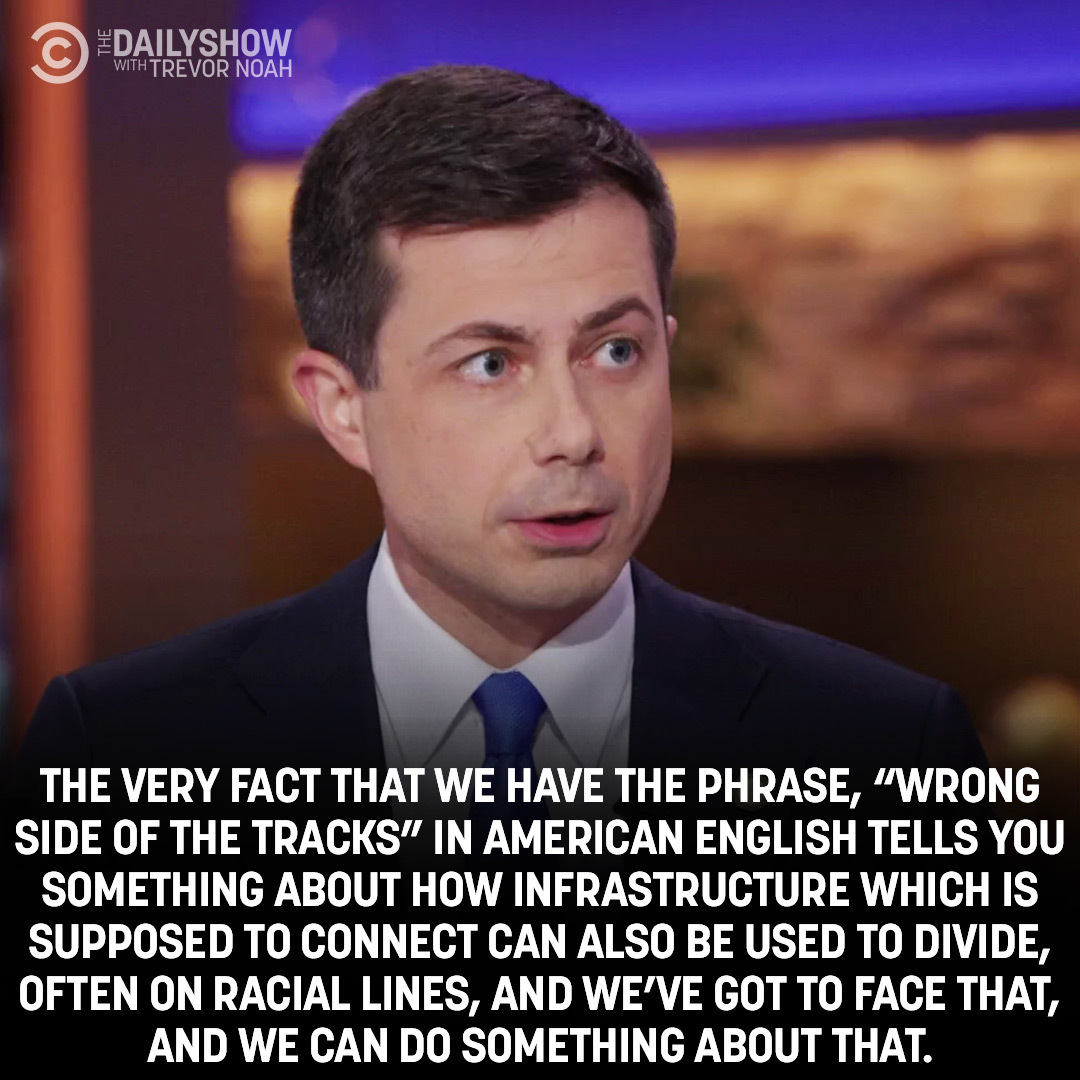
This meme applies the urban transit metaphor of "wrong side of the tracks" to social commentary, suggesting that physical infrastructure like train tracks can function as effective barriers to connection. Just as the path of a train physically separates passengers from different stops, the text argues that cultural divisions act as equally powerful barriers to social integration. It implies that society must acknowledge that the "wrong side of the tracks" (and racial lines) are both designed to isolate people rather than connect them.
simple-description (llama3.2-vision_11b)
The meme is a screenshot of a news headline from The Daily Show with Trevor Noah, featuring a quote from Pete Buttigieg, a former US Secretary of Transportation. The quote reads: "The truth is, if we want to build a transportation system where every American can get where they need to go, whether it's work or to see family, we have to build more than roads. We have to build more than roads. We have to build more than roads." The meme is likely used to comment on the importance of investing in public transportation and infrastructure, and how it can have a positive impact on people's lives.
detailed-analysis (gemma3-27b-vision)
Okay, here's a breakdown of the image and its text, analyzed through the requested theoretical lenses. I'll only include sections where the lenses genuinely apply.
Visual Description
The image is a still from "The Daily Show with Trevor Noah." It depicts Trevor Noah, a biracial comedian and political commentator, speaking directly to the camera. He’s wearing a dark suit with a light blue shirt and tie. The background is dark, likely the stage backdrop of the show. The image quality is crisp and clean, typical of broadcast television. The text is superimposed over the image in a white rectangular banner. The text features a quote about the phrase “wrong side of the tracks” and how infrastructure can be divisive.
Foucauldian Genealogical Discourse Analysis
This quote is prime territory for a Foucauldian analysis. The phrase “wrong side of the tracks” isn’t simply a neutral descriptor; it’s a discourse. It functions as a way of categorizing and creating social distinctions. A genealogical approach would delve into how this phrase emerged, what historical conditions gave rise to it, and what power dynamics it reinforces.
- Power/Knowledge: The phrase operates as an exercise of power. By labeling a place “wrong,” it constructs a narrative of hierarchy and otherness. The knowledge that certain areas are “bad” isn't inherent, it's produced through this discourse.
- Archaeology: Investigating the history of the phrase would reveal how it shifted over time. Originally related to literal railway tracks as boundaries, it evolved into a metaphorical marker of social and economic marginalization.
- Disciplinary Power: The phrase subtly enforces norms. It implies that those living on the “wrong side” are deficient, in need of correction, or undesirable, fostering social control.
- Infrastructure as Discourse: The statement’s central point—that infrastructure can divide—is profoundly Foucauldian. Infrastructure isn’t just a neutral tool; it's a key element in shaping social relations and exercising power. Roads, railways, and even urban planning produce subjectivities and reinforce inequalities.
Critical Theory
The image's message directly aligns with many tenets of Critical Theory, particularly the Frankfurt School's emphasis on ideology and social domination.
- Ideology Critique: The quote exposes how seemingly neutral language ("wrong side of the tracks") masks deeper structural inequalities. It reveals how seemingly objective terms are often loaded with ideological baggage.
- Reason as Instrumental: The way infrastructure is used to divide can be seen as a manifestation of “instrumental reason.” Instead of serving a genuinely equitable purpose, infrastructure is deployed to reinforce existing power structures.
- Critique of Domination: The message fundamentally critiques the systems of domination that create and perpetuate social division. It challenges the notion that inequalities are natural or inevitable.
Marxist Conflict Theory
This image and statement readily lend themselves to a Marxist analysis.
- Class Division: The phrase “wrong side of the tracks” is historically linked to class-based segregation. It represents the spatial manifestation of class divisions, where access to resources and opportunities is determined by geographic location.
- Material Infrastructure & Superstructure: The statement about infrastructure as dividing connects directly to Marxist ideas. Infrastructure (roads, housing, etc.) represents the material base of society, while the social divisions it creates are part of the superstructure—the ideologies, norms, and institutions that reinforce class relations.
- Conflict & Struggle: Recognizing that infrastructure is a source of division is a first step toward challenging the structures that create it. This implicitly calls for conflict and struggle against those who benefit from these inequalities.
Postmodernism
While less central than the other lenses, postmodern themes are present:
- Deconstruction: The quote subtly deconstructs the seemingly straightforward meaning of the phrase “wrong side of the tracks.” It exposes how the phrase is constructed and reveals the hidden assumptions it carries.
- Relativity of Truth: The quote suggests that what constitutes the “wrong side” isn’t an objective truth, but a socially constructed category. This challenges the idea of universal standards or fixed meanings.
- The Problem of Representation: The phrase itself is a form of representation that simplifies and categorizes reality. This raises questions about the accuracy and validity of such representations.
Queer Feminist Intersectional Analysis:
While not immediately apparent, an intersectional lens can deepen the analysis:
- Spatial Inequality & Marginalization: The "wrong side of the tracks" often represents areas with fewer resources, poorer schools, and limited opportunities, disproportionately affecting marginalized communities, including LGBTQ+ individuals and people of color.
- Interlocking Systems of Oppression: The statement speaks to how infrastructure can exacerbate existing inequalities based on race, class, gender, and sexuality. For example, lack of access to safe transportation can limit opportunities for LGBTQ+ individuals, particularly transgender people of color, creating additional vulnerabilities.
- Disrupting Normative Space: Challenging the divisions created by infrastructure can be seen as a way of reclaiming and reimagining space in a more inclusive and equitable way.
Let me know if you’d like me to elaborate on any of these analyses or explore another theoretical perspective!
simple-description (llama3.2-vision)
This meme features a photo of Pete But Not The Pete I Know, a satirical news show host. The text above the photo says, "The very fact that we have the phrase, 'wrong side of the tracks,' in American English, tells you something about how infrastructure which is supposed to connect can also be used to divide, often on racial lines, and we've got to face that, and we can do something about that." The image is a quote from the host of the show.
tesseract-ocr
i es ) THE VERY FACT THAT WE HAVE THE PHRASE, “WRONG S110) 0) ee CMa ae ae Re SOT emma erty eee aa eats SUPPOSED TO CONNECT CAN ALSO BE USED TO DIVIDE, OFTEN ON RACIAL LINES, AND WE’VE GOT TO FACE THAT, AND WE CAN DO SOMETHING ABOUT THAT.