First Seen
2023-06-01T20:35:42+00:00
simple-description (qwen3.5_2b-q8_0)
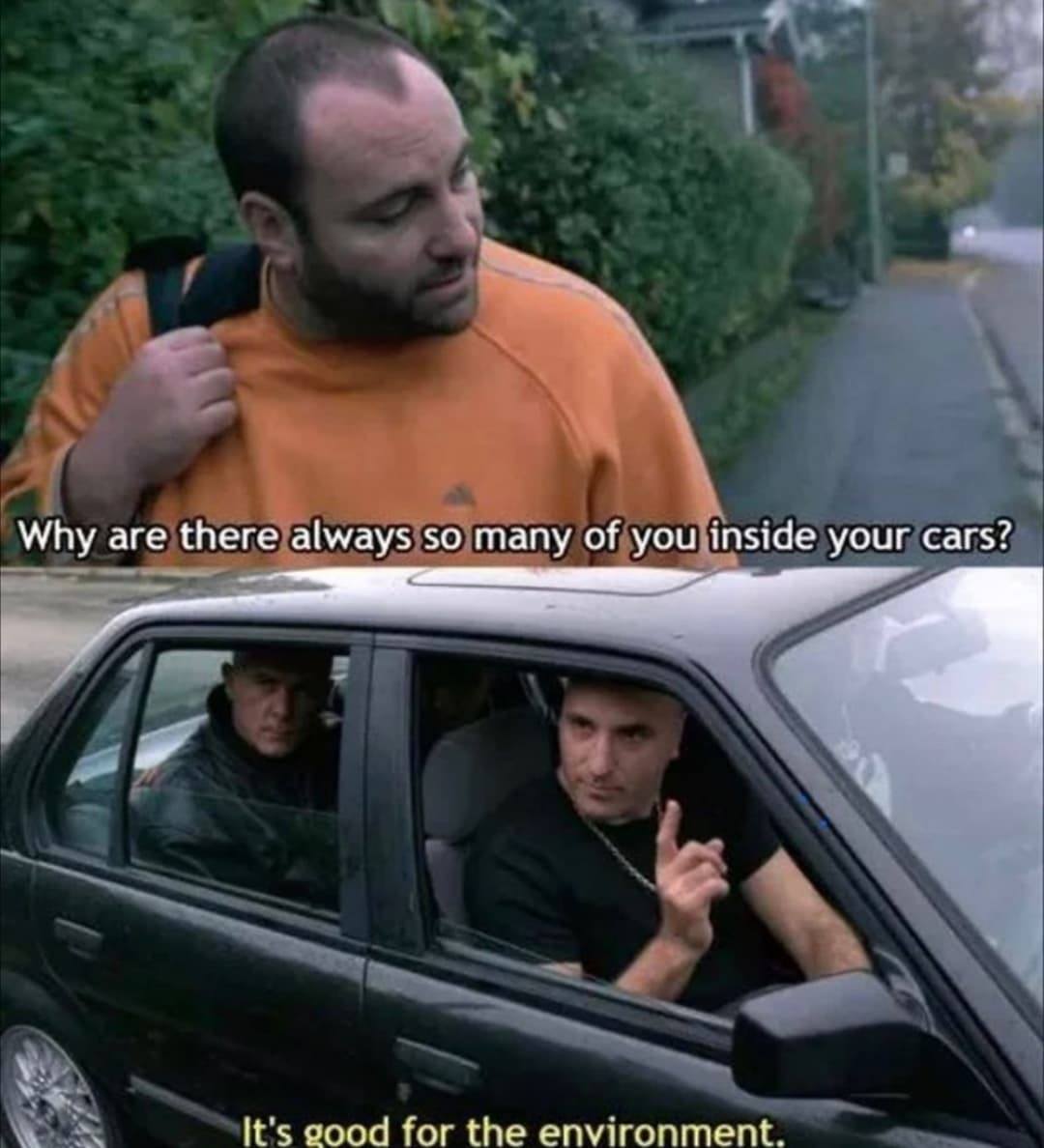
This image satirizes the concept of car ownership by showing a pedestrian asking why everyone is so crowded inside their individual vehicles. The text overlay reads: "Why are there always so many of you inside your cars?" The punchline, "It's good for the environment," humorously plays into the Urbanism context by treating private cars as a low-impact, personal form of public transit.
simple-description (llama3.2-vision_11b)
The meme is a screenshot from a 2004 British comedy film "The Inbetweeners" where a character is asked why there are so many people in his car. The image shows a car with four people packed in, and the text "Why are there so many of you in here?" is overlaid on top. The meme is captioned "Why are there so many of you in here?" and the response "It's like the bus, innit?" is written below.
detailed-analysis (gemma3-27b-vision)
Okay, let's break down this image from Seinfeld through the lenses you've requested. It's a surprisingly rich scene for theoretical analysis.
Visual Description
The image is a still from a Seinfeld episode. It's split into two panels. The top panel shows Cosmo Kramer, a character known for his eccentric behavior, looming over a dark sedan. Kramer is visibly animated, with a concerned/inquisitive expression. He's dressed in an orange sweater and carrying a messenger bag. The bottom panel focuses on the inside of the car, which is crammed with four men, most of whom seem to be looking at the camera, with one raising a hand as if to say "Stop!". The image has a slightly grainy, early 2000s television aesthetic. The lighting is somewhat flat. The dialogue captions read, "Why are there always so many of you inside your cars?" (Kramer) and "It's good for the environment." (men in the car).
Foucauldian Genealogical Discourse Analysis
Foucault would be interested in the discourse surrounding cars, environmentalism, and even the performativity of “normal” behavior.
- Power/Knowledge: The scene reveals how seemingly rational (the environmental justification) can be used to legitimize irrational and/or socially unacceptable behavior (excessive carpooling). The men are constructing a justification for their action, framing it as a positive environmental act, which subtly implies a power dynamic. They’re defining what constitutes environmentalism and acting as authorities on it, even in this absurd scenario.
- Genealogy of "Environmentalism": A genealogical analysis would explore how the concept of “environmentalism” itself has evolved – from early conservation efforts to modern notions of sustainability. The scene’s parody of environmentalism challenges the assumed naturalness or inherent goodness of this discourse. The men aren’t concerned with actual environmental benefit, but rather a justification for their crowded car situation, thus distorting the original intent of the discourse.
- Disciplinary Power: The seemingly innocuous question from Kramer and the absurd answer from the men can be viewed as a momentary disruption of the norms governing acceptable car occupancy and rational justifications. The scene underscores the unspoken rules that govern our behavior and how easily they can be subverted.
Critical Theory
This scene readily lends itself to a Critical Theory reading, specifically focusing on the ways it exposes the irrationality and absurdity of modern life.
- Domination and Control: While seemingly comical, the scene touches on how systems of control operate through seemingly benign practices. The men’s insistence on a “logical” (albeit nonsensical) justification for their crowded car situation demonstrates a need to rationalize their behavior within the existing social framework.
- The Culture Industry: The scene, as part of a popular sitcom, highlights the role of media in perpetuating (or subverting) societal norms. Seinfeld, as a show “about nothing,” often exposed the banality and contradictions of everyday life, subtly challenging dominant ideologies.
- Rationality and Irrationality: The core joke rests on the clash between rational justification (claiming environmental benefit) and the irrationality of the situation (excessive crowding). Critical Theory would suggest this is not merely a comedic juxtaposition but a reflection of the larger contradictions inherent in modern capitalist society, where logic and efficiency are often prioritized over practical needs and common sense.
Marxist Conflict Theory
While not overtly about class struggle, the image can be interpreted through a Marxist lens by examining the ways in which access to resources (cars, mobility) and the justification of behavior are linked to social status and control.
- False Consciousness: The men's "It's good for the environment" could be read as a form of false consciousness, where they are blinded to the actual implications of their behavior (inconvenience, potential safety issues) by a superficial concern for a higher ideal (environmentalism). They're embracing a justification that serves their own immediate needs (fitting more people into a car) while masking the underlying issues.
- Control of Means of Mobility: The car itself represents a means of production/mobility controlled by a select group (those who can afford them). The crowding of the car could be interpreted as a subversion of this control, a temporary attempt to maximize access for more people.
- Commodification of Environmentalism: The phrase "It's good for the environment" is deployed as justification, showing how environmentalism can be commodified and used as a marketing tool to distract from more substantial issues.
Postmodernism
The image embodies many tenets of postmodern thought.
- Irony and Parody: The humor relies heavily on irony and parody – mocking the idea of environmental consciousness while simultaneously presenting a superficially “logical” justification.
- Deconstruction of Meaning: The image disrupts the expected association between environmentalism and practical action. It deconstructs the meaning of "environmentalism" by showing how it can be detached from actual concerns and used as a flimsy justification for irrational behavior.
- Simulacra and Simulation: The men’s justification can be seen as a “simulacrum” - a copy without an original. It's a representation of environmental concern that lacks any genuine connection to actual environmental benefit. It is all facade.
- Loss of Grand Narratives: The scene’s absurdity challenges any grand narrative about rationality, environmentalism, or societal norms. It suggests a fragmented reality where meaning is fluid and subjective.
Queer Feminist Intersectional Analysis
While more subtle, a Queer Feminist Intersectional reading can explore how the image challenges norms around space, bodies, and conformity.
- Spatial Politics: The car is a highly regulated space. The crowding disrupts the expected spatial boundaries and hierarchies, creating a temporary moment of collective, cramped togetherness. It challenges the notion of individual ownership and control over space.
- Challenging Conformity: The scene disrupts expectations of proper social behavior. The men’s refusal to explain why they need to cram into a car and their insistence on the environmental justification can be interpreted as a rejection of societal pressure to conform.
- Collective Identity: The scene portrays a group of men defying the norm together. Although not explicitly about gender or sexuality, it displays an act of defiance against expectations, creating a temporary communal space.
Hopefully, these sections provide a multi-faceted exploration of the image using the theoretical frameworks you requested. It's a deceptively rich piece of visual culture that invites complex analysis! Let me know if you’d like me to elaborate on any of these points further.
simple-description (llama3.2-vision)
The meme is a two-panel image. The top panel shows a man with a confused expression, while the bottom panel shows a car with three men inside, one of whom is making a "V" gesture with his hand. The top panel has the text "Why are there always so many of you inside your cars?" and the bottom panel has the text "It's good for the environment."
tesseract-ocr
ee eee oe ae ~~ a ae © tae ‘ bs cae. re a | oI : ee) — : , f — = > > * * Why are AEE SSO MEU hfe aie!) your, (elgto ar ee _ gr : | € . >» SS { NX \ Aa It's i Se