First Seen
2023-06-02T19:50:17+00:00
simple-description (qwen3.5_2b-q8_0)
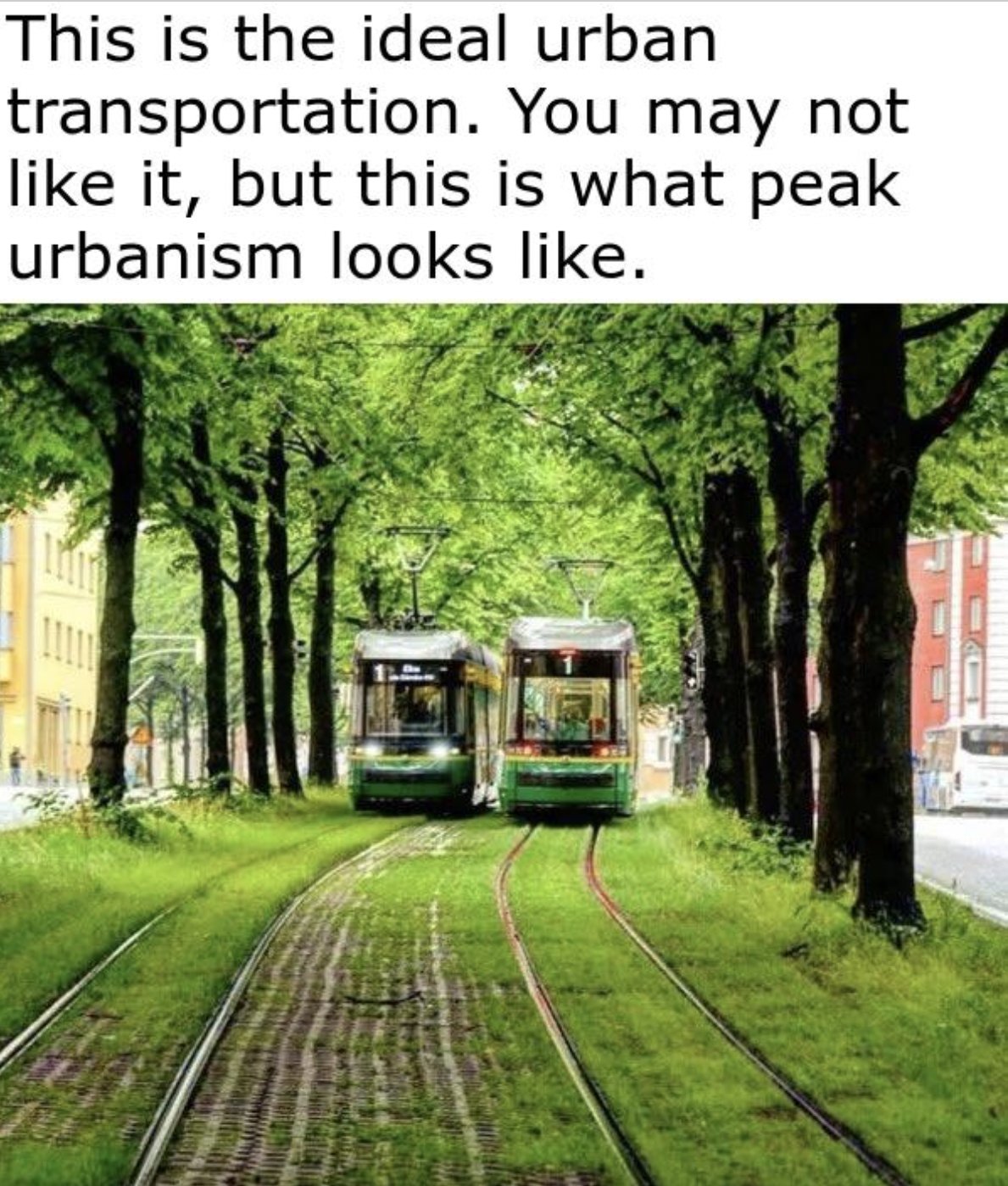
The image displays the caption: "This is the ideal urban transportation. You may not like it, but this is what peak urbanism looks like."
This meme explains the concept of 'peak urbanism' as defined in urban planning literature (such as William Whyte's City of a Thousand Sights). It suggests that the most successful cities prioritize high density and accessible public transit. The caption implies that while traditional car-centric planning might view this kind of infrastructure as unusual or difficult to utilize, it represents the most efficient and desirable way to live in a city where walking and riding trains are the primary modes of transport.
simple-description (llama3.2-vision_11b)
This meme is a humorous commentary on the concept of urbanism, specifically transit. The image depicts a scenic, tree-lined road with tram tracks, but the tram is actually a tram-train, a type of tram that runs on railway tracks. The text overlay reads "This is the urbanism I've always wanted" but the subtext "but it's actually just a tram-train" pokes fun at the idea that this is not actually a tram, but a tram-train, which is a more practical and efficient mode of transportation.
detailed-analysis (gemma3-27b-vision)
Okay, let's break down this image through various theoretical lenses, as requested. I'll only include sections where the image lends itself to that particular analysis. Note that applying these complex theories to an image is interpretive, and different readings are possible.
Visual Description
The image depicts a tram line running through a tree-lined avenue in a European city. The trees form a dense, arching canopy over the tracks, creating a green tunnel effect. Two trams are traveling toward the viewer on parallel tracks. The scene is brightly lit, suggesting a sunny day. Buildings, likely residential or low-rise commercial, are visible in the background, peeking through the trees. The tracks are laid into a meticulously maintained grassy strip. The overall impression is one of tranquility, order, and a harmonious blend of nature and urban infrastructure. The image appears heavily curated or staged to present a very particular vision of urban life.
Critical Theory
This image is ripe for Critical Theory analysis, as it presents an idealized vision of urban transportation and, by extension, urban life. The claim “This is what peak urbanism looks like” is inherently critical, suggesting a normative standard.
- The Ideal vs. Reality: Critical Theory would question whose ideal this represents. The image presents a very specific, affluent, and likely Western European aesthetic. It implicitly frames other forms of urban transportation or urban development as less ideal. This raises questions of power and the imposition of values.
- Technological Determinism: The focus on the tram as the "peak" suggests a degree of technological determinism—the idea that technology shapes society. Critical Theory would ask whether this framing ignores the social, political, and economic factors that enable (or prevent) the implementation of such systems. Is the tram inherently superior, or is it the result of specific political choices and funding priorities?
- The Illusion of Harmony: The perfectly manicured greenery and orderly tracks create an illusion of harmony and stability. Critical Theory would interrogate this surface-level perfection, asking what is obscured by this idealized presentation. What inequalities, pollution, or other problematic elements are hidden from view?
- Normative Framework: The image establishes a normative framework for what a 'good' city looks like. This begs the question of who gets to define 'good' and whose perspectives are excluded.
Marxist Conflict Theory
From a Marxist perspective, this image can be analyzed through the lens of class conflict and the control of infrastructure.
- Infrastructure as Control: The tram line itself represents a form of infrastructure that facilitates the movement of people, but also exerts control over their mobility. Who benefits most from this system? Is it accessible to all members of society, or does it serve the interests of a particular class?
- Aestheticization of Capital: The image aestheticizes the capitalist system, presenting it as harmonious and natural. The perfectly maintained greenery and orderly infrastructure mask the underlying labor and resources required to maintain this system. The image presents a vision of a city that appears to function smoothly, but this smoothness is dependent on exploitation.
- Concealment of Conflict: The lack of any visible signs of social unrest, poverty, or inequality suggests an attempt to conceal the inherent conflicts within capitalist society. The image presents a sanitized and idealized version of urban life.
- Access & Equity: Is this mode of transportation accessible to all classes, or does it primarily serve wealthier neighborhoods? The image, while visually pleasing, doesn't reveal details about fare costs or route accessibility.
Postmodernism
Postmodern analysis would focus on the constructed nature of meaning and the rejection of grand narratives.
- Hyperreality & Simulation: The image can be seen as a simulation of an idyllic urban landscape, a hyperreality that emphasizes aesthetics over functionality. The perfection of the scene borders on artificiality, suggesting that it is more of a curated representation than a genuine reflection of reality.
- Rejection of Universalism: The claim that this is "peak urbanism" attempts to establish a universal standard, but Postmodernism would reject this notion. It would argue that there is no single "best" form of urbanism; rather, there are multiple, diverse, and equally valid approaches.
- Deconstruction of Meaning: Postmodernism would deconstruct the idea of "ideal" transportation, arguing that the concept is socially constructed and subject to interpretation. What one person considers "ideal" may differ significantly from another.
- The Power of Representation: The image itself is a representation, and postmodern analysis would focus on how this representation shapes our understanding of urbanism. What messages is the image conveying, and what perspectives are being marginalized?
I hope this multi-faceted analysis is helpful. Let me know if you'd like me to elaborate on any of these points or explore other theoretical frameworks.
simple-description (llama3.2-vision)
The meme is a commentary on urban transportation. The image shows a serene, tree-lined street with a tramway running through it, surrounded by greenery. The text at the top of the image reads, "This is the ideal urban transportation. You may not like it, but this is what peak urbanism looks like."
tesseract-ocr
This is the ideal urban transportation. You may not like it, but this is what peak urbanism looks like. - 4 fe 3 J eo Se eS ‘* si ai—— | os NS eae - 5 — iff ih aS Yj, if HG |