First Seen
2023-05-27T18:26:54+00:00
simple-description (qwen3.5_2b-q8_0)
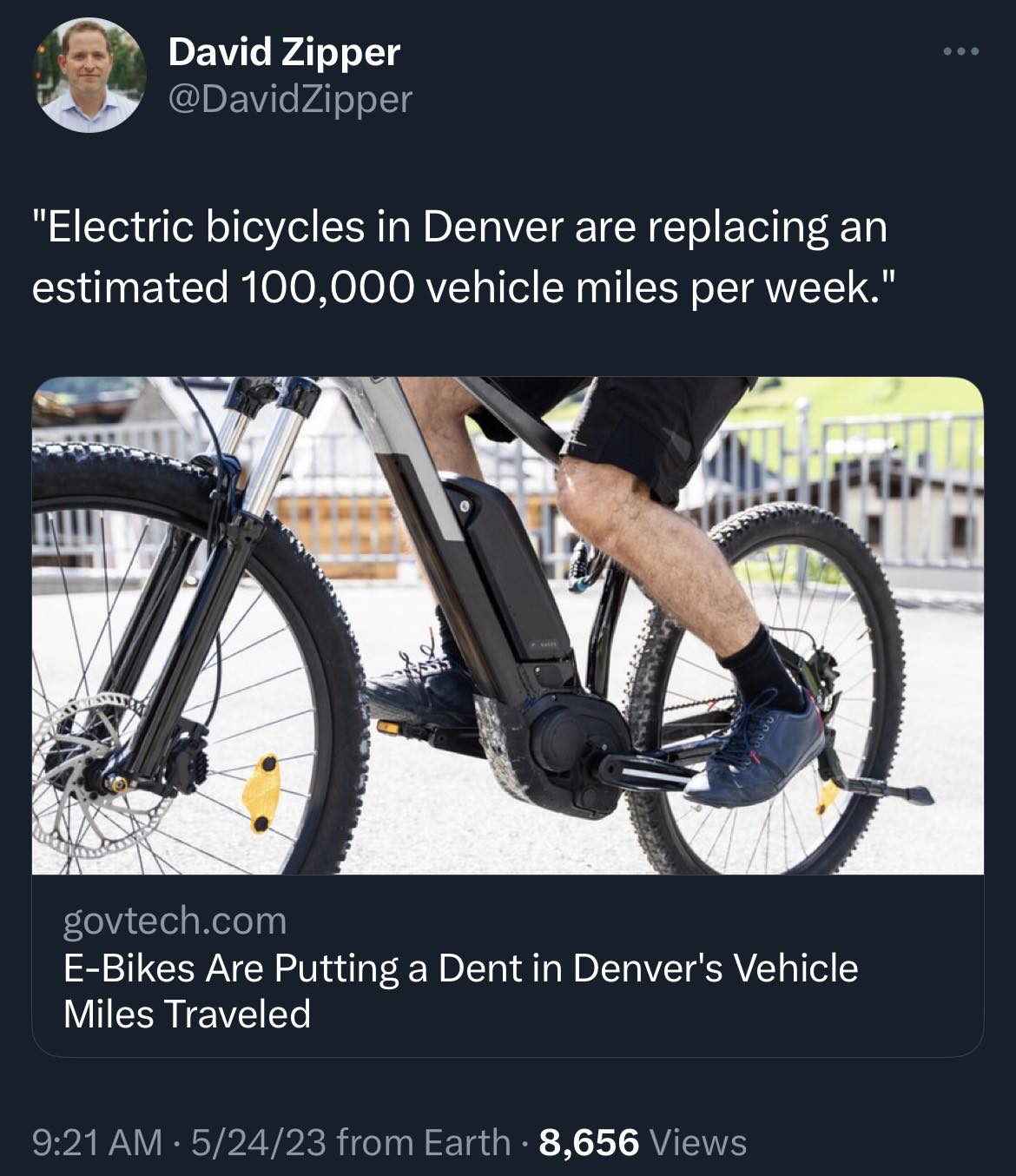
This image, part of a humorous urban transit joke, suggests that electric bikes are so incredibly efficient that they could replace an entire fleet of cars in Denver. The quote claims that one person can be replacing 100,000 vehicle miles of driving in a single week just by riding the bike, effectively turning a car into a walking tool. The photo illustrates the machine's power and speed, implying that a simple bike can handle the city traffic that would normally require many more cars to navigate.
simple-description (llama3.2-vision_11b)
The meme is a screenshot of a news article with a provocative headline: "E-bikes are replacing cars in Denver, but they're not as green as you think." The image shows a person riding an e-bike, but the caption below the headline reads: "Electric bikes are so popular in Denver that they're replacing cars, but they're not as green as you think." The meme is poking fun at the idea that e-bikes are a sustainable alternative to cars, but the article's headline suggests that they're not as environmentally friendly as they seem.
detailed-analysis (gemma3-27b-vision)
Okay, let's break down this Twitter post through the lens of several theoretical frameworks.
Visual Description
The image shows a close-up shot of the front and side of an electric bicycle (e-bike) in motion. The focus is on the tire, front fork, and the mid-drive motor located in the frame. The bike appears to be a mountain bike style, featuring thick tires with a visible tread, suggesting off-road capability, though the background shows a paved city pathway. A person's legs and feet are visible on the pedals, indicating the bike is actively being ridden. The rider is wearing blue jeans and sneakers. The setting appears to be an urban or suburban path, with other pedestrians and infrastructure blurred in the background. The overall feel is dynamic, emphasizing the movement and technological aspect of the e-bike. It’s a marketing-style photo, likely intended to showcase the bike's design and capability.
Foucauldian Genealogical Discourse Analysis
This post and the linked article contribute to a discourse around mobility, technology, and environmental impact. A Foucauldian analysis would examine how the concept of mobility has been historically constructed, shifting from reliance on automobiles to an emerging acceptance (and even promotion) of alternatives like e-bikes.
- Power/Knowledge: The article (and the tweet) establish a "truth" – that cars contribute to high mileage, and e-bikes offer a better alternative. This truth is created through data (100,000 miles replaced) and presented as objective, but it subtly constructs a specific way of understanding transportation. The narrative positions e-bikes as ‘better’ according to implied criteria of sustainability and health.
- Genealogy: A genealogical tracing would show how the idea of the ‘ideal’ form of transportation has shifted over time - horse-drawn carriages, then fossil-fuel driven vehicles, now e-bikes. Each shift wasn't a natural progression but rather a construction of a regime of truth shaped by economic, political, and social forces.
- Discipline: The rhetoric implies that individual choices regarding transportation discipline us – we can choose the ‘responsible’ choice (e-bike) or continue down the path of unsustainable car dependency. The focus on replacing miles subtly suggests a form of self-regulation.
Marxist Conflict Theory
From a Marxist perspective, the tweet reveals underlying class dynamics and the material conditions that shape transportation choices.
- Means of Production: The e-bike itself represents a commodified solution to a problem created by the capitalist mode of production (dependence on automobiles). It's a new form of capital, produced and consumed within the system.
- Class Struggle: The promotion of e-bikes can be seen as a way for capital to absorb the critique of car dependence. It offers a “green” solution that doesn’t challenge the fundamental logic of consumerism and the profit motive. It is an alternative that is accessible to people with disposable income, highlighting a class dimension. The people who can afford e-bikes are not necessarily those most negatively affected by the negative externalities of car culture.
- Ideology: The tweet promotes the idea that individual choices ("riding an e-bike") can solve systemic problems. This is an ideological move that obscures the deeper structural causes of car dependence (urban planning, lack of public transportation investment, etc.). It’s a “feel good” solution that doesn’t challenge the underlying power structures.
Postmodernism
A postmodern reading could emphasize the fragmentation of meaning and the blurring of boundaries.
- Simulacra & Simulation: The e-bike is a "sign" of environmental consciousness, but it might be detached from actual environmental impact. It becomes a representation of sustainability, rather than its substance.
- Deconstruction: The narrative of “replacing” miles implies a binary – car miles as "bad," e-bike miles as "good." Postmodern analysis would deconstruct this opposition, acknowledging that both forms of transportation have environmental and social consequences. (e.g., e-bike production relies on resource extraction and manufacturing processes).
- Meta-Narratives: The tweet contributes to a “meta-narrative” of progress through technological innovation, suggesting that technology can solve our problems. Postmodernism critiques such overarching narratives as simplistic and potentially oppressive.
Queer Feminist Intersectional Analysis
While not immediately obvious, this post can be approached through an intersectional lens:
- Accessibility & Mobility Justice: E-bikes can potentially increase mobility for those who cannot or choose not to drive. However, affordability remains a major barrier, creating a class/economic divide. The tweet doesn’t address the intersection of mobility with disability, race, or gender. Those marginalized groups may have specific mobility needs that aren’t met by e-bikes.
- Urban Planning & Gendered Spaces: The promotion of e-bikes implies a need for safe cycling infrastructure. The lack of this infrastructure disproportionately affects women, trans people, and non-binary individuals, who often experience greater fear of harassment or violence while cycling.
- Challenging Masculine Norms: Historically, cycling (and car culture) has been associated with masculinity. E-bikes, especially when marketed inclusively, can offer an alternative form of mobility that challenges these norms and promotes a wider range of identities. However, the marketing of the bike (as it appears in the image) may lean heavily into a masculine aesthetic.
Disclaimer: These are interpretations based on the image and accompanying text. A more thorough analysis would require a deeper engagement with the linked article and the broader context of the conversation surrounding e-bikes.
simple-description (llama3.2-vision)
This meme is a satirical response to an article about electric bicycles in Denver. The text at the top reads: "Electric bicycles in Denver are replacing an estimated 100,000 vehicle miles per week." The image below is a photo of a person riding an e-bike, but the text at the bottom of the image reads: "E-Bikes Are Putting a Dent in Denver's Vehicle Miles Traveled." The meme is poking fun at the idea that e-bikes are replacing a significant number of vehicle miles, but the actual article title is a bit of a joke, as it's likely that e-bikes are not actually replacing 100,000 vehicle miles per week. The article title is a play on words, using a phrase that's a bit of a pun, but also a bit of a joke.
tesseract-ocr
Mi David Zipper 7 @DavidZipper "Electric bicycles in Denver are replacing an estimated 100,000 vehicle miles per week." a iia Oe | \ eee d . = rr ir Na ‘Mir-~ | / Pe yw % , 8 ay Fan. Vt /\ fa za : (Mf ; , a g rs nS. wa ‘ee bs 5 ty ie y ae. y ¢ 7 —<< 4.¥. govtech.com E-Bikes Are Putting a Dent in Denver's Vehicle Miles Traveled 9:21 AM - 5/24/23 from Earth - 8,656 Views