First Seen
2023-05-10T21:03:42+00:00
simple-description (qwen3.5_2b-q8_0)
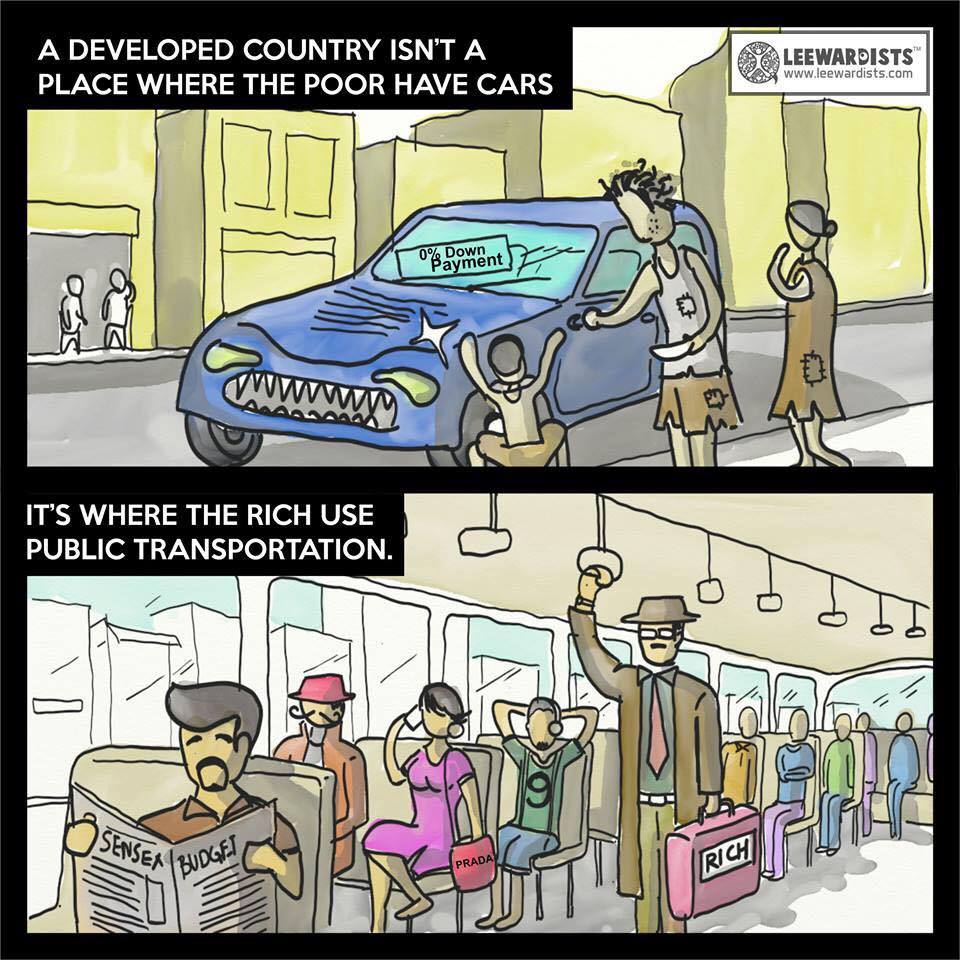
The meme uses the setting of a city street and a bus stop to highlight class differences in transportation. The top panel shows a character sitting on the hood of a luxury car with a giant toothy mouth and a "0% Down Payment" sticker, implying they are borrowing the vehicle rather than owning it. The text above the car explains that "A DEVELOPED COUNTRY ISN'T A PLACE WHERE THE POOR HAVE CARS," while tiny figures can be seen walking in the background on a massive street below.
In the bottom panel, the contrast is drawn between public transit and wealth, showing the poor crowded onto a bus and holding up an umbrella just to avoid the rain. Meanwhile, a wealthy individual confidently stands on the platform holding a grab handle and a pink suitcase labeled "RICH," demonstrating that despite having transit access, the poor often lack the physical mobility to enter.
simple-description (llama3.2-vision_11b)
The meme is a play on the idea that a country's economic development is not solely measured by its wealth, but also by its ability to provide basic services like public transportation. The image shows a city street with a bus, but instead of passengers, it's filled with people holding "I'm rich" signs, implying that the city's wealth is not being used to provide public transportation. The text "It's not that it's expensive, it's just that the rich use it" highlights the irony that the wealthy are using the public transportation system, while the poor are left to rely on other means of transportation.
detailed-analysis (gemma3-27b-vision)
Okay, here's a breakdown of the cartoon with analysis through the lenses you requested, broken down by section, only where applicable.
Visual Description
The cartoon is divided into two panels. The top panel depicts a street scene. A large, blue car, sporting a "0% Down Payment" sign, nearly collides with a pedestrian. The pedestrian is a man in disheveled clothing, his hat seemingly blown off, emphasizing vulnerability. The street is populated with figures in business suits, seemingly unconcerned with the near-accident. The overall impression is one of financial precarity colliding with the careless privilege of wealth.
The bottom panel portrays the interior of a crowded public bus. Passengers are diverse in age and race, but all appear to be upper class, based on their clothing (designer bags, stylish outfits, etc.) One man is reading a newspaper with the headline "SENSE & BUDGET", while another prominently displays a "RICH" sign. The scene is crowded, underscoring the fact that these wealthy individuals are choosing to share a space usually associated with those with fewer resources.
The color palette is relatively simple, utilizing bold lines and a comic-book-like style. The visual contrast between the street scene (emphasis on potential harm) and the bus (cramped but relatively safe) is notable.
Marxist Conflict Theory
This cartoon is strongly rooted in Marxist conflict theory.
- Class Struggle: The central premise of the cartoon directly illustrates class struggle. The image argues that true development isn't measured by the access of the poor to consumer goods (like cars, often secured through predatory loans represented by the "0% Down Payment" sign), but by the willingness of the wealthy to share resources with the broader population.
- False Consciousness: The cartoon implies a critique of “false consciousness.” The idea that the wealthy believe they are deserving of their privilege, and that society is structured in a way that justifies their wealth. The cartoon subverts this by showing them choosing to ride the bus, thereby demonstrating they are not as inherently separate from the working class as they might believe.
- Means of Production & Access: The car in the first panel represents access to the means of transportation, framed as a commodity. The bus in the second panel represents a shared resource, suggesting a different model of societal organization where everyone is reliant on the same systems.
- Critique of Capital: The "0% Down Payment" is not a genuine benefit but a symptom of predatory lending and the system that traps people in debt.
The cartoon suggests that a truly developed society would prioritize equity and accessibility, not just the material possessions of the poor.
Foucauldian Genealogical Discourse Analysis
While not the most prominent lens, Foucault's ideas can inform our understanding.
- Power Dynamics & Normalization: The cartoon subtly addresses power dynamics. The "normal" expectation is that the wealthy have their own transportation and avoid public spaces. By depicting them on the bus, the cartoon disrupts this expectation, creating a "discursive break" – it challenges the accepted norms of class separation.
- Discourse of Development: The cartoon’s very title – "A developed country isn't…" – immediately frames a discourse around what constitutes "development." It’s not simply economic growth (allowing the poor to buy cars), but a shift in societal values.
- Governmentality: The cartoon can be read as a critique of "governmentality"—the ways in which states and institutions exert control through subtle mechanisms. The acceptance of class segregation in transportation is one such mechanism. The cartoon asks us to envision a different form of governance—one that prioritizes shared resources and equitable access.
Critical Theory
The cartoon fits within the broader framework of Critical Theory, particularly its emphasis on challenging social norms and power structures.
- Ideology Critique: The cartoon performs an ideology critique by exposing the underlying assumptions about what constitutes “development” and progress. It challenges the dominant narrative that equates economic growth with societal well-being.
- Social Justice: The cartoon is an implicit plea for social justice. It suggests that true progress is not simply about alleviating poverty but about creating a more equitable distribution of resources and power.
- Emancipation: The cartoon implies a vision of an emancipated society where class distinctions are blurred and resources are shared. The wealthy voluntarily relinquishing their private transport in favor of the bus symbolizes a break from traditional power dynamics.
Regarding other categories:
- Postmodernism: While the style of the cartoon is visually reminiscent of some postmodern aesthetics, the message is relatively direct and doesn't fully engage with the deconstruction, fragmentation, or skepticism central to postmodern thought.
- Queer Feminist Intersectional Analysis: This particular cartoon does not explicitly address issues of gender, sexuality, or intersectionality. While all analyses benefit from considering these dimensions, they are not central to the cartoon’s core message.
Let me know if you'd like me to elaborate on any of these points or explore a different angle!
simple-description (llama3.2-vision)
This meme is a satirical commentary on the relationship between the wealthy and the poor. It presents two contrasting scenarios: one where a person with a low income is struggling to afford a car with a 0% down payment, while a wealthy person is using public transportation. The text accompanying the images reads: "A developed country isn't a place where the poor have cars. It's where the rich use public transportation."
tesseract-ocr
A DEVELOPED COUNTRY ISN'T A gene aca acoeas =a | 1 eee —| A r ee IT'S WHERE THE RICH USE Pia fet eS pal rn a Lae BA em phian All ier Barn pa i Bei baits 2