First Seen
2023-05-10T21:03:42+00:00
simple-description (qwen3.5_2b-q8_0)
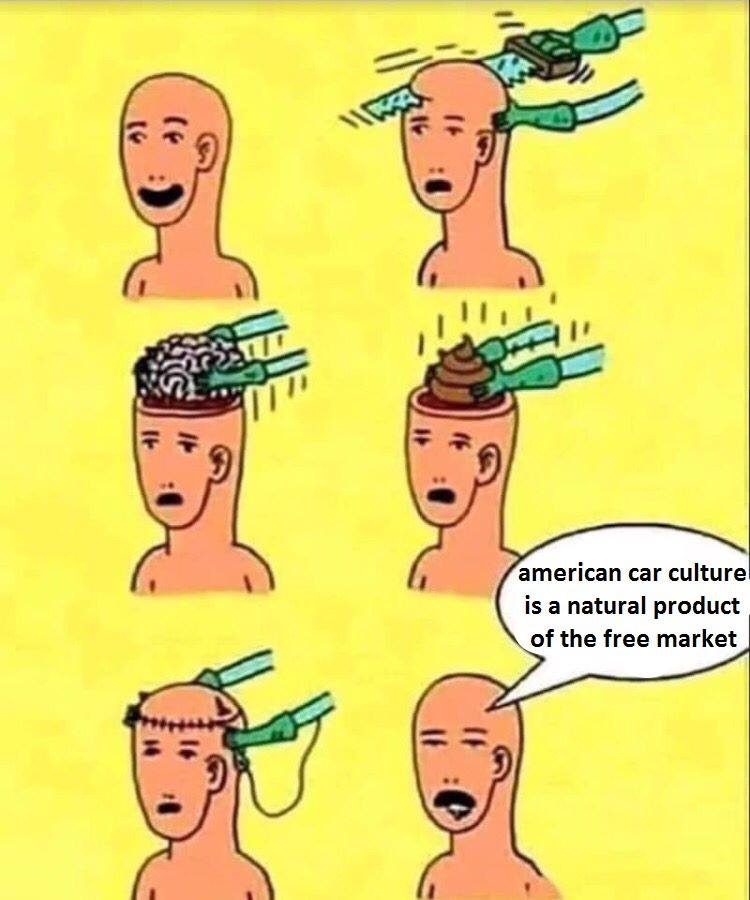
This meme uses the visual language of urban infrastructure to depict the chaotic toll of city driving. It portrays the "head" as a vehicle or the driver's consciousness being constantly dismantled by traffic jams and stress, represented by the scissors and the toxic fumes. The final text, "american car culture is a natural product of the free market," humorously argues that the visible chaos of traffic is simply a side effect of capitalist economic policies.
simple-description (llama3.2-vision_11b)
The meme depicts a person with a mind control device in their head, with a thought bubble showing a cityscape with a bus driving on a road. The text "I'm not arguing, I'm just explaining why public transportation is the best" appears in the bubble. The image is a humorous commentary on the frustration of trying to have a rational discussion about urban planning and transportation, with the mind control device representing the overwhelming influence of societal expectations.
detailed-analysis (gemma3-27b-vision)
Here's an analysis of the image, organized into sections as requested. It's a complex image, and several theoretical lenses are applicable, while some are less relevant.
Visual Description
The image is a six-panel cartoon with a consistent aesthetic. Each panel depicts a simplistic, pale-skinned head in profile, seemingly male. Above each head is a device resembling a car wash sprayer, continuously spraying fluid. The panels demonstrate a progression:
- Panel 1: The head appears normal and happy.
- Panel 2: The head begins to look concerned, showing initial discomfort.
- Panel 3: The sprayer is depositing brain matter, implying the destruction of thought/intellect.
- Panel 4: The sprayer is depositing fecal matter, implying a reduction to base instinct/waste.
- Panel 5: The sprayer is depositing gears/machine parts, implying mechanization/reduction to purely functional components.
- Panel 6: The head is now an open void, an empty space. A speech bubble states, “american car culture is a natural product of the free market.”
The color scheme is overwhelmingly yellow, with pale flesh tones and darker accents. The cartoon style is intentionally crude and reductive.
Foucauldian Genealogical Discourse Analysis
This image is strongly suited for a Foucaultian reading. The 'car wash' device represents power/knowledge at work. It’s not simply a physical washing, but a deliberate, systematic shaping of the subject.
- Genealogy: The image suggests a historical becoming. The progression shows how an individual, initially possessing intellect and agency, is broken down and remade by a system. We can trace the 'lineage' of this process, looking at how market forces and car culture have historically shaped subjectivity.
- Discipline & Biopower: The 'car wash' acts as a disciplinary mechanism. It controls and normalizes through the constant, relentless process of breaking down pre-existing structures (brain, organic matter) and replacing them with functional, mechanistic parts. This ties into biopower, as the image suggests a re-engineering of the subject to become a component within a larger system (the 'free market').
- Subjectivation: The image shows how the subject is constituted through these power dynamics. The initial happy face transforms into an empty void, indicating that individuality and agency have been eroded. The subject is no longer a thinking, feeling individual, but a hollow shell molded by external forces.
- Discourse: The speech bubble stating “american car culture is a natural product of the free market” is a key example of discourse at work. It presents a historically contingent, socially constructed phenomenon (car culture) as “natural” and inevitable, masking the power dynamics that have shaped it.
Critical Theory
The image is highly consistent with the ideas of the Frankfurt School and Critical Theory:
- Domination and Control: The 'car wash' metaphor powerfully illustrates how systems of power (here, the ‘free market’) can dominate and control individuals. It’s not overt coercion, but a subtle, insidious process of shaping consciousness.
- Mass Culture: The image critiques the role of mass culture in creating conformity and suppressing critical thought. The process of 'washing' away intellect and replacing it with mechanical components suggests a loss of individuality and the rise of a homogenized, consumerist society.
- Instrumental Reason: The focus on efficiency and functionality (the gears replacing organic matter) aligns with the Critical Theory critique of instrumental reason – the idea that reason is reduced to a tool for achieving specific, often economic, goals, at the expense of broader ethical or humanistic considerations.
- Reification: The transformation of the subject into a void, a space for the ‘free market’ to occupy, can be seen as a form of reification. It transforms a human being into a mere object, valued only for its functional role within the capitalist system.
Marxist Conflict Theory
From a Marxist perspective, the image depicts the alienation of the individual under capitalism:
- Class Struggle: The ‘free market’ is presented as a dominating force, suggesting an unequal power relationship between capital and labor. The individual, as a 'worker' in this system, is subjected to the demands of the market and stripped of their intellectual and emotional autonomy.
- Commodity Fetishism: The image subtly critiques commodity fetishism. By reducing the individual to a functional component, it implies that human beings are valued not for their inherent worth, but for their utility as consumers or producers.
- False Consciousness: The speech bubble reinforces the idea of false consciousness. The individual is led to believe that car culture is a 'natural' outcome, masking the underlying economic and political forces that have created it.
- Exploitation: The 'car wash' can be seen as a metaphor for the exploitative nature of capitalist production. The individual is subjected to a relentless process of deconstruction and remolding, with their labor and creativity ultimately serving the interests of the market.
Postmodernism
Postmodern lenses offer several interpretations:
- Deconstruction of the Subject: The image powerfully deconstructs the idea of a stable, unified subject. The transformation of the head into a void suggests that the self is not a fixed entity, but a fluid, fragmented construct shaped by external forces.
- Simulacra and Simulation: The image can be seen as a critique of the simulacrum – a copy without an original. The 'free market' is presented as a detached, abstract force that creates a manufactured reality (car culture) divorced from genuine human needs or values.
- Meta-Narratives: The speech bubble challenges the legitimacy of grand narratives (like the ‘naturalness’ of the free market). It suggests that all knowledge and meaning are socially constructed and relative.
- Hyperreality: The image hints at a hyperreal state where the simulation (car culture) has become more real than reality itself. The individual is consumed by a manufactured world, losing touch with authentic experience.
Important Note: It's crucial to recognize that these are interpretations based on theoretical frameworks. The image is open to multiple readings, and different frameworks may offer different insights. The effectiveness of the image lies in its ambiguity and its ability to provoke critical thought.
simple-description (llama3.2-vision)
The meme is a series of six images showing a person's head being repeatedly drilled into by a drill, with each image showing a different stage of destruction. The text in the image reads: "American car culture is a natural product of the free market." This is a satirical commentary on the idea that American car culture is a natural product of the free market, implying that it is not actually a natural product of the free market, but rather a product of the free market's influence.
tesseract-ocr
I i<° > 9) ie = : { ' ‘ it _ - a ect: e I ' > to = SN. fathdeaae | | i 7 = + Ro af = ' \ ‘ / \ I s=,4 iS i —. = = ’ e i '