First Seen
2023-05-10T20:59:59+00:00
simple-description (llama3.2-vision_11b)
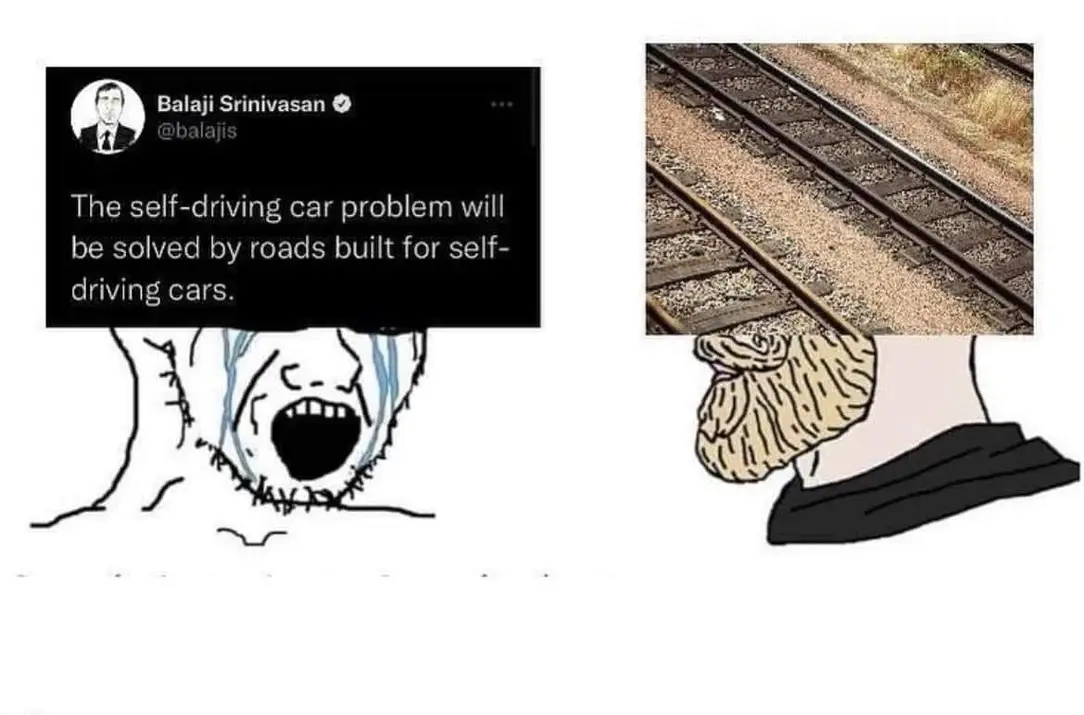
The meme is a play on the idea that self-driving cars are supposed to solve the problem of traffic congestion by eliminating the need for roads. However, the image shows a person's face with a shocked expression, with a caption that reads "the self-driving car problem will be solved by roads built for self-driving cars". The joke is that the solution to the problem of self-driving cars is actually to build roads for them, which is a ridiculous and ironic solution.
detailed-analysis (gemma3-27b-vision)
Okay, let's break down this image (a tweet from Balaji Srinivasan) using the requested theoretical frameworks. It's a complex meme, so some frameworks will be more applicable than others.
Visual Description
The image is a composite of three elements: a screenshot of a tweet, a rough cartoon drawing, and a photograph.
- Tweet: The tweet, from tech entrepreneur Balaji Srinivasan, states "The self-driving car problem will be solved by roads built for self-driving cars."
- Cartoon: A crude, expressive drawing of a man screaming, looking shocked or enraged. It's intentionally simple and mimics a "rage comic" style.
- Photograph: A close-up photo of railroad tracks, specifically the grooves between the rails. This is the key visual juxtaposition.
The composition is designed to present a satirical argument: the tweet proposes a solution to a technological problem (self-driving cars) that is, on the surface, logical. The drawing highlights the supposed “obviousness” of the solution, while the railroad tracks visually represent the idea of a predetermined, inflexible path that dictates movement. The meme's humour arises from pointing out the absurdity of building infrastructure around technology rather than adapting the technology to existing infrastructure.
Foucauldian Genealogical Discourse Analysis
This meme lends itself well to a Foucauldian analysis. The discourse at play is the ongoing narrative surrounding technological "solutions" to problems. Balaji Srinivasan's tweet represents a particular episteme (a way of understanding the world) rooted in technological determinism. It assumes technology is the primary driver of change, and problems can be solved through further technological innovation.
The meme genealogically deconstructs this discourse by suggesting the "solution" is nonsensical and highlights the power dynamics involved. The railroad tracks represent a system of control and constraint, implicitly arguing that building infrastructure for technology replicates these power structures. Instead of freeing movement, it enforces a rigid, predefined path.
The "screaming face" image represents the uncritical acceptance of the "obvious" solution and the silencing of alternative viewpoints that question the underlying assumptions. This meme critiques the unexamined faith placed in technological solutions, illustrating how they can serve to reinforce existing power structures.
Critical Theory
From a critical theory perspective, the meme can be viewed as a critique of instrumental rationality. Instrumental rationality is the application of logic and efficiency to achieve a desired outcome, often without considering broader ethical or social implications. The tweet embodies this rationality by focusing solely on the "problem" of self-driving cars and proposing a purely technical "solution."
The railroad tracks serve as a metaphor for the dehumanizing effects of rationalization and standardization. By building roads specifically for self-driving cars, we further entrench a system that prioritizes technological efficiency over human agency, accessibility, and existing infrastructure.
The meme implicitly asks: who benefits from this "solution"? Who is excluded? It suggests that this approach prioritizes the needs of a tech elite over the needs of the wider public.
Marxist Conflict Theory
From a Marxist viewpoint, the meme highlights the inherent contradictions within capitalist modes of production. The "problem" of self-driving cars isn't simply a technical challenge; it’s tied to the logic of capital accumulation. The push for self-driving cars stems from a desire to reduce labor costs, increase efficiency, and create new markets.
The proposal to rebuild roads for self-driving cars exemplifies the need for constant capital investment to sustain the system. The railroad tracks image subtly conveys this as a closed system that demands more resources. This approach prioritizes the profits of tech companies over the needs of workers (e.g., truck drivers) and the public good.
The meme suggests a class conflict between those who benefit from technological "progress" and those who are negatively impacted. The screaming face can be interpreted as the anger of the working class against a system that ignores their concerns.
Postmodernism
From a postmodern perspective, the meme deconstructs the notion of a singular, objective “solution.” The tweet presents a seemingly logical proposition, but the image challenges its validity through irony and juxtaposition. The railroad tracks disrupt the expected narrative, suggesting that there isn't a straightforward solution.
The meme's humor relies on a playful subversion of expectations and a rejection of grand narratives (like the idea that technology will inevitably solve all our problems). The screaming face represents the absurdity of embracing simple answers to complex issues.
The meme's fragmented nature (tweet, drawing, photo) reflects the postmodern emphasis on fragmentation and the breakdown of traditional structures. It rejects a unified meaning, inviting multiple interpretations.
Queer Feminist Intersectional Analysis
This framework is less directly applicable, but some connections can be made. The meme’s critique of a standardized, inflexible system can be extended to broader issues of social control and marginalization.
The railroad tracks, as a rigid and predetermined path, can be seen as a metaphor for the pressures of heteronormativity and gender conformity. The proposal to rebuild infrastructure for a specific "type" of vehicle (self-driving cars) can be linked to the exclusion of marginalized groups who may not fit into the dominant mold.
The "screaming face" could represent the frustration of those who are forced to conform to restrictive social norms. The meme’s critique of a one-size-fits-all approach implicitly challenges the idea of universal solutions that ignore the diversity of human experience.
Let me know if you'd like me to elaborate on any of these analyses!
simple-description (llama3.2-vision)
The meme is a humorous take on the idea that a self-driving car will be solved by simply putting a car on a train. The image shows a person with a surprised expression, with a train track and a car on the tracks in the background. The text "The self-driving car problem will be solved by roads built for self-driving cars" is meant to be sarcastic and ironic, implying that the solution to a self-driving car problem is actually a train.
tesseract-ocr
& Balaji Srinivasan @ 2 NE BN pe Ne 4 SN SS NG The self-driving car problem will = ie NS a ae TLS be solved by roads built for self- Ee NS fe Nee driving cars. BE NR 2 Coe aa Woe ee Vv i S22 NY y eS RINN\S (' AAS ‘ Ww “Ay ‘ CUse7 te