First Seen
2023-05-10T21:03:42+00:00
simple-description (qwen3.5_2b-q8_0)
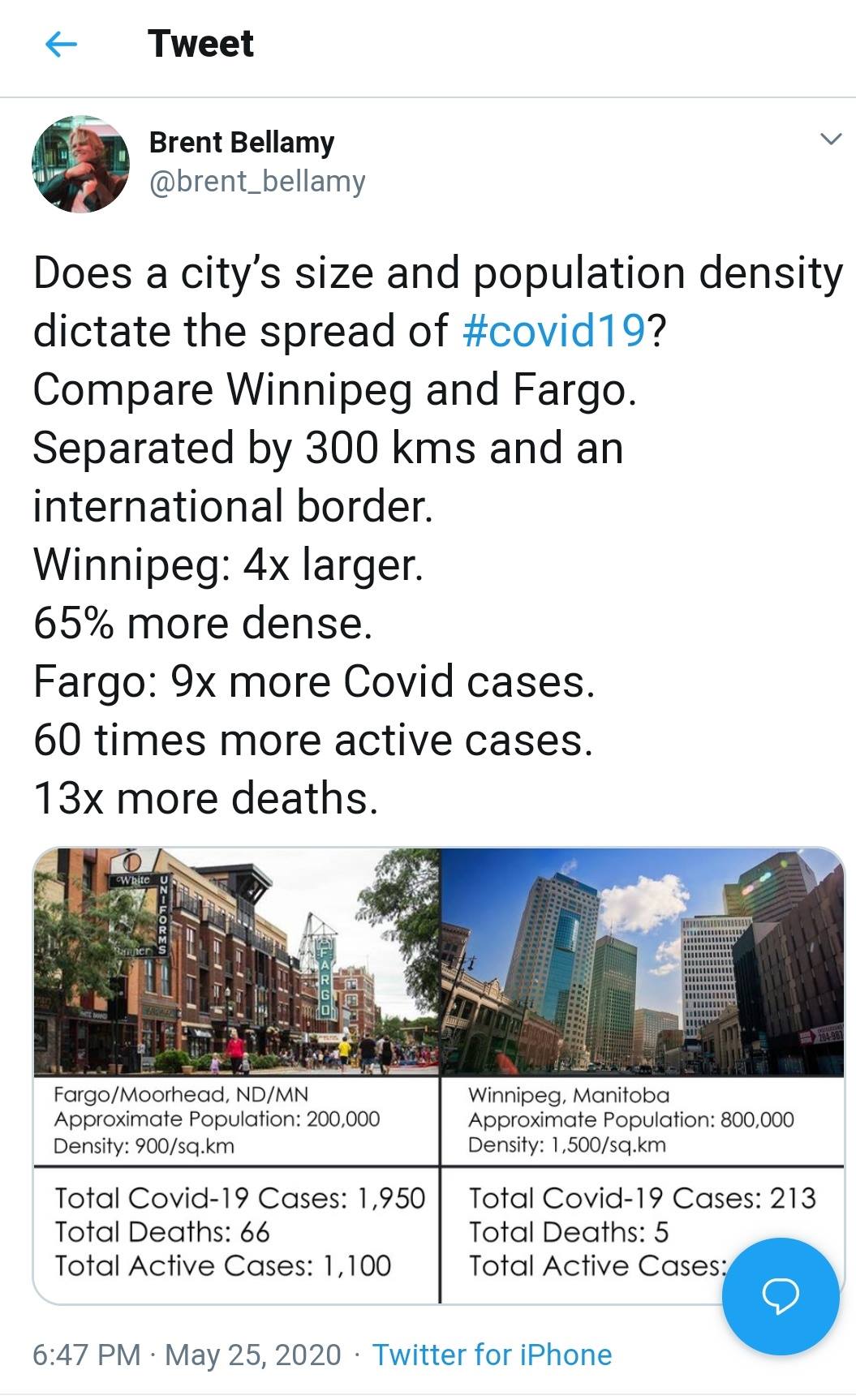
This urbanism meme plays on the assumption that larger populations automatically mean worse viral outcomes. It contrasts the smaller, higher-density city of Fargo with the much larger Winnipeg, highlighting that despite being denser, the smaller city actually suffered disproportionately worse results. The text reveals that Fargo has 9 times more Covid cases, 60 times more active cases, and 13 times more deaths than Winnipeg.
simple-description (llama3.2-vision_11b)
The meme is a humorous comparison between the cities of Winnipeg and Fargo, highlighting their vastly different populations and sizes. The meme states "Winnipeg: 690,000, Fargo: 125,000" and "Winnipeg is 5.5 times bigger than Fargo". This is a lighthearted way to poke fun at the size difference between these two cities.
detailed-analysis (gemma3-27b-vision)
Okay, let's break down this Twitter post through various theoretical lenses. Given the content, some lenses will be more applicable than others.
1. Visual Description
The tweet features a split image: On the left, a street scene of Fargo, North Dakota/Moorhead, Minnesota. It appears to be a typical main street with a mix of low-rise buildings, some storefronts, and trees. The overall impression is of a relatively spread-out urban environment. On the right, a similar view of Winnipeg, Manitoba. This image features noticeably taller buildings, suggesting a higher population density and more compact urban form. Both photos are taken during daylight and show relatively normal street activity. Below the images is a table comparing population, density, and COVID-19 statistics (cases, deaths, active cases) for the two cities. The tweet itself poses a question about whether size and population density correlate with COVID-19 spread.
2. Foucauldian Genealogical Discourse Analysis
This post engages with the discourse of public health and biopower. Foucault's concept of biopower is central here. The post implicitly frames the comparison as an attempt to govern and manage populations. The question isn’t simply about the virus itself, but about understanding how cities are structured and how those structures affect the spread of disease, which then justifies potential interventions (lockdowns, restrictions, surveillance, etc.)
The post initiates a genealogical inquiry by asking how the concepts of "density" and "size" have come to be understood as relevant factors in the discourse around COVID-19. The comparison between Fargo and Winnipeg could be seen as a “dispositive” – an arrangement of elements (statistics, urban layouts, the question itself) that constructs a particular understanding of the relationship between urban form and viral spread. The very act of quantifying COVID-19 cases and deaths reinforces a certain logic of “calculable risk” inherent in biopower. The choice of these two cities, being on opposite sides of an international border, is particularly significant; it highlights the role of the state in defining and managing risk within and across borders.
3. Critical Theory
From a Critical Theory perspective (drawing on thinkers like the Frankfurt School), the tweet can be seen as a contribution to the broader instrumental rationality that characterizes modern society. The post seeks to reduce a complex phenomenon (viral spread) to quantifiable metrics (population, density, cases, deaths). This reductionist approach reinforces the notion that everything can be measured, controlled, and optimized.
Furthermore, the tweet implicitly accepts the status quo of urban planning and infrastructure as given. It doesn't question why cities are built the way they are, or whether those structures contribute to vulnerability during a pandemic. It frames the problem as a matter of managing the effects of density, rather than addressing the underlying socio-political forces that shape urban landscapes. A critical theorist would ask: Who benefits from this way of framing the issue? What power dynamics are reinforced by focusing on these quantifiable factors?
4. Marxist Conflict Theory
A Marxist analysis would focus on the material conditions that contribute to the differing COVID-19 outcomes in Fargo and Winnipeg. While the tweet focuses on population density, a Marxist lens would highlight the role of class, access to healthcare, and social inequalities.
For example, the tweet doesn't reveal information about socioeconomic disparities within each city. It’s likely that the more densely populated areas in Winnipeg (and potentially in Fargo) are also areas with lower-income residents, who may be more vulnerable to the virus due to factors like overcrowded housing, limited access to healthcare, and precarious employment.
The comparison between the two cities also points to the influence of national healthcare systems. Winnipeg is in Canada, which has a universal healthcare system, while Fargo is in the United States, where access to healthcare is more unequal. This difference could explain at least part of the disparity in death rates. The “conflict” here is not just between the virus and the population, but between competing social systems and the resulting inequalities.
5. Postmodernism
A postmodern reading would emphasize the constructed nature of reality and the instability of meaning. The tweet’s question – "Does size and density dictate spread?" – doesn't necessarily seek a definitive answer. Rather, it acknowledges that there are multiple factors at play, and that the relationship between urban form and viral spread is complex and contingent.
A postmodern perspective would also challenge the universalizing tendencies of the question. It would point out that the concept of "density" itself is a social construct, and that its meaning varies depending on the context. The choice of Fargo and Winnipeg as the points of comparison is also significant; it’s a specific, localized comparison that doesn’t necessarily generalize to other cities. The tweet can be read as an example of the fragmentation of knowledge and the questioning of grand narratives.
6. Queer Feminist Intersectional Analysis
An intersectional approach would analyze how the effects of the pandemic (and the impact of city layout) are experienced differently based on multiple intersecting identities, including gender, sexuality, race, class, and ability. The tweet, on its own, doesn’t provide enough information for this analysis. However, a queer feminist lens would point out that:
- Gendered Divisions of Labor: The pandemic disproportionately impacted women, who often shoulder the burden of caregiving and were more likely to lose their jobs during lockdowns. How did city layout (access to childcare, public transportation) affect women’s ability to navigate the pandemic?
- Racial and Ethnic Disparities: Certain racial and ethnic communities were disproportionately affected by the virus. How did urban segregation and systemic racism contribute to these disparities?
- LGBTQ+ Vulnerabilities: LGBTQ+ individuals may have faced unique challenges during the pandemic, such as limited access to healthcare, discrimination, and increased social isolation.
- Access for people with disabilities: Density can make navigating public spaces difficult for people with disabilities.
To apply this analysis, we would need additional data about the demographics and lived experiences of people in Fargo and Winnipeg.
I hope this detailed breakdown is helpful! Let me know if you'd like me to elaborate on any of these points.
simple-description (llama3.2-vision)
This meme is a comparison of the cities of Winnipeg and Fargo, highlighting their differences in size and population. The text reads: "Winnipeg: 690,000. Fargo: 125,000. Winnipeg is 5.5 times larger. Winnipeg is 55% denser."
tesseract-ocr
< Tweet Sm Brent Bellamy Vv @brent_bellamy Does a city’s size and population density dictate the spread of #covid19? Compare Winnipeg and Fargo. Separated by 300 kms and an international border. Winnipeg: 4x larger. 65% more dense. Fargo: 9x more Covid cases. 60 times more active cases. 13x more deaths. ea wh | ll Se: ee ti cat eet Thee... §«=6aaeye ae > ieee 5 tsa f 4 y ; ramp fi § Fargo/Moorhead, ND/MN | Winnipeg, Manitoba Approximate Population: 200,000 Approximate Population: 800,000 Density: 900/sq.km Density: 1,500/sq.km Total Covid-19 Cases: 1,950 | Total Covid-19 Cases: 213 Total Deaths: 66 Total Deaths: 5 Total Active Cases: 1,100 Total Active “9 6:47 PM - May 25, 2020 - Twitter for iPhone