First Seen
2023-05-10T21:03:42+00:00
simple-description (qwen3.5_2b-q8_0)
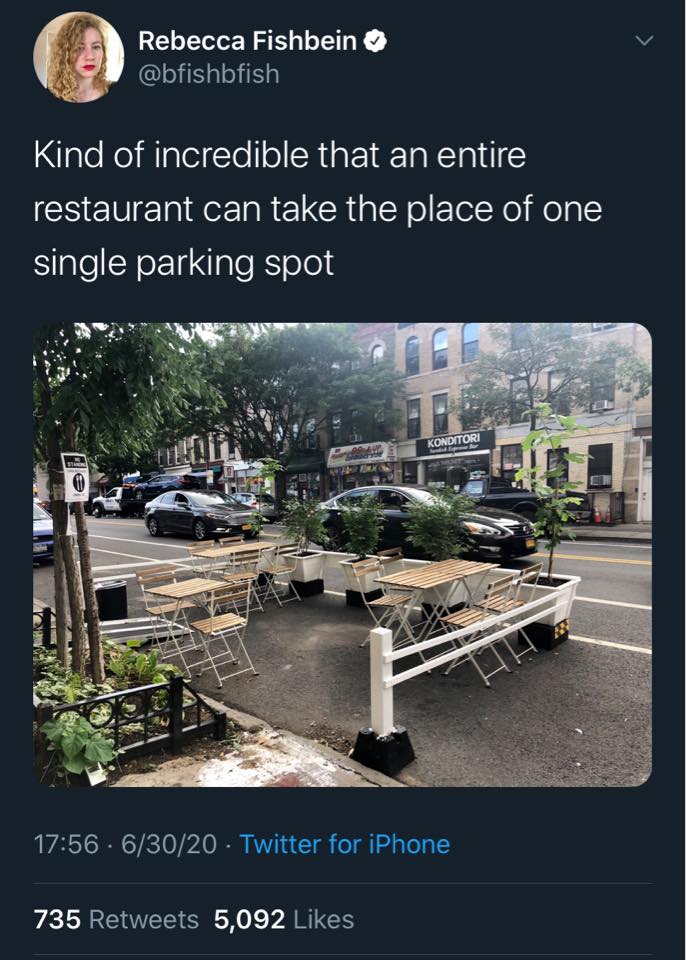
This urban meme highlights a humorous take on how a business has effectively "land-grabbed" an entire public parking lot. The image shows tables and chairs set up on asphalt, clearly occupying what should be empty parking spaces for other vehicles. The tweet accompanying it adds a layer of irony by noting that it is "kind of incredible" that the restaurant took over a spot that shouldn't be there, playing on the reality that parking lots are public real estate meant for cars, not just eating.
simple-description (llama3.2-vision_11b)
The meme is a photo of a small outdoor seating area in a city, with a few tables and chairs, and a sign that says "parking for 1 car". The text above the image reads "When the restaurant has a single parking spot but you still have to walk 10 blocks to get to it". This meme is poking fun at the absurdity of urban planning in cities, where a small outdoor seating area is given a single parking spot, but customers still have to navigate through crowded streets to get to it.
detailed-analysis (gemma3-27b-vision)
Okay, here's an analysis of the tweet and image, broken down into sections based on the requested theoretical lenses. I'll indicate where a particular lens doesn't significantly apply to keep things concise.
Please note: This is interpretive and leans heavily on assumptions made from limited data (one tweet, one image). A fuller, more robust analysis would require much more context.
1. Visual Description
The image shows a street scene, likely in an urban setting. A significant portion of the roadway has been repurposed as outdoor seating for a restaurant ("Konditori" is visible). Several wooden tables and benches, painted white, are arranged where cars would typically park. The seating area is bordered by planters filled with greenery, seemingly to delineate the space and provide a barrier. There are cars parked on the remainder of the street. The overall impression is one of a street transformed to prioritize pedestrian and social space over vehicular traffic. The sky is overcast, and the image appears to have been taken during a relatively quiet time. A "No Parking" sign is visible, further emphasizing the re-appropriation of the space.
2. Foucauldian Genealogical Discourse Analysis
This image is rich with possibilities for a Foucauldian analysis. The re-appropriation of a parking spot isn't merely a practical change; it’s a manifestation of shifting discourses surrounding public space, urban planning, and societal values.
- Genealogy of the "Parking Spot": We can trace the historical emergence of the parking spot as a normalized element of urban life, linked to the rise of automobile culture, consumerism, and a certain form of modernity. Its ubiquity is not natural but constructed through power dynamics and economic forces.
- Shifting Power/Knowledge: The image shows a challenge to this established order. By replacing a parking spot with a social space, the restaurant and potentially the city (through permitting/policy) are enacting a different form of power/knowledge. This isn’t necessarily about oppression but about a reconfiguration of what is deemed valuable and worthy of space. The old “knowledge” was that streets are for cars; now, it’s shifting to prioritize pedestrian experience and communal gathering.
- Discipline and Control: The planters and arrangement of tables, though seemingly benign, can be seen as subtle forms of spatial discipline – guiding how people move and interact within the space. This is not necessarily overt coercion, but a “soft” power that shapes behavior.
3. Critical Theory
The image speaks directly to core tenets of Critical Theory.
- Critique of Instrumental Reason: The prioritization of parking spots reflects an instrumental rationality focused on efficiency and maximizing individual mobility (car ownership). Replacing it with a communal space challenges this logic and introduces values like social interaction, community, and quality of life, which are not easily quantified or measured.
- The Public Sphere: The restaurant seating area could be interpreted as an attempt to re-activate the public sphere – a space for dialogue, debate, and social interaction. However, critical theorists would also ask who is benefiting from this re-activation? Is it inclusive? Does it inadvertently exclude certain groups?
- Commodification of Space: Is this a genuine effort to reclaim public space for community, or is it merely a tactic to boost the restaurant’s profits by expanding seating capacity? Critical theory would demand an examination of the underlying economic motivations.
4. Marxist Conflict Theory
From a Marxist perspective, the image represents a potential struggle over the means of production (in this case, urban space) and the relations of production (who controls and benefits from that space).
- Class Conflict: Access to public space is often unequally distributed. The ability to transform a parking spot into outdoor seating requires capital (restaurant ownership) and the support of city authorities. This raises questions about who has the power to shape the urban environment and who is excluded.
- Superstructure and Base: The transformation of the parking spot can be seen as a change in the “superstructure” (cultural and social institutions) reflecting changes in the “base” (economic relations). Perhaps a shift towards a more service-based economy, prioritizing leisure and social experiences, is driving this trend.
- Alienation: While seemingly positive, could the restaurant be appropriating public space for its private gain, thus contributing to a sense of alienation from the city for those who lack access to such spaces?
5. Postmodernism
A postmodern reading of the image highlights the deconstruction of fixed meanings and the fluidity of urban space.
- Simulacra and Simulation: The image challenges the “original” function of a parking spot, replacing it with a simulation of a social space. This blurs the boundaries between “real” and “artificial” and raises questions about the authenticity of urban experiences.
- Fragmentation and Hybridity: The image represents a fragmentation of traditional urban planning – a mix of car traffic, pedestrian spaces, and commercial activity. It embodies a hybridity that is characteristic of postmodern cities.
- Deconstruction of Grand Narratives: The image implicitly challenges the "grand narrative" of car-centric urbanism. It suggests that there are alternative ways to organize and experience the city.
6. Queer Feminist Intersectional Analysis
This lens requires more context, but we can still speculate.
- Accessibility & Inclusive Space: Is this outdoor seating accessible to people with disabilities? Is it designed to be inclusive of diverse bodies and identities? An intersectional analysis would ask how different groups experience this space differently.
- Public/Private Boundaries: The blurring of public and private space raises questions about safety and harassment, particularly for marginalized groups. Are there measures in place to ensure that this space is welcoming and secure for everyone?
- Challenging Normative Space: The appropriation of space can be seen as a disruption of traditional urban planning, which is often shaped by patriarchal and heteronormative assumptions. Is this a small step toward creating more equitable and inclusive cities?
I hope this comprehensive analysis helps. Let me know if you’d like me to elaborate on any specific point or theoretical lens.
simple-description (llama3.2-vision)
This meme is a picture of a small, empty parking space with a sign that reads "2 cars max". The caption above the image says "In a world where 1 car is a luxury, a 2 car garage is a mansion". The meme is poking fun at the idea that a small parking space is being touted as a luxury, implying that the standards for what is considered "luxurious" have become absurdly low.
tesseract-ocr
> Wierda sn sak) M2 dt fais aie Kind of incredible that an entire restaurant can take the place of one single parking spot Re, a eR bs Ut 9 vy eee : eu pe E ce ee poe . a. a ee i as ee ae aa _s — ‘i a. iS OE es Bilge a =e Be = a ee | Ul ati jf ————™ as Le 17:56 - 6/30/20 - Twitter for iPhone 735 Retweets 5,092 Likes