First Seen
2023-05-10T21:03:42+00:00
simple-description (qwen3.5_2b-q8_0)
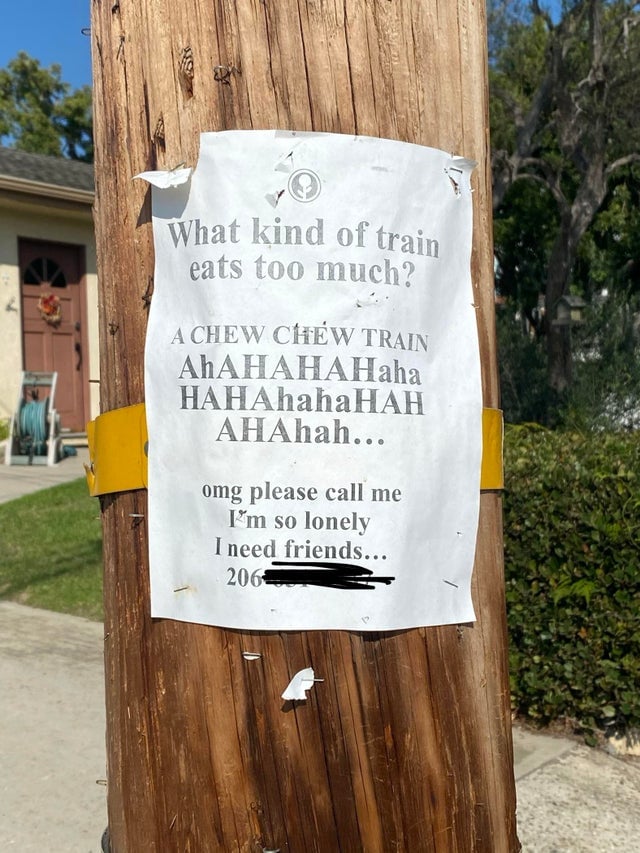
A blind person reading this sees a white paper taped to a wooden utility pole in a residential street. The poster asks a humorous question about trains that "eat too much" of attention and offers to answer a query by calling the poster on the phone. The text "A CHEW CHEW TRAIN" and "I'm so lonely" transforms the pole into a lonely character begging for connection in the public space.
simple-description (llama3.2-vision_11b)
The meme is a play on the classic "why was the math book sad?" joke, but with a twist. The image shows a sign on a street pole with the text "Why was the math book sad? Because it had too many problems." However, the sign is now modified to say "Why was the math book sad? Because it had too many problems... or so I've heard...". The phrase "or so I've heard" is crossed out, and a new phrase "because it was missing one equation" is scribbled in.
detailed-analysis (gemma3-27b-vision)
Okay, here's an analysis of the image, broken down into sections as requested. I'll only include sections where the analysis genuinely applies, as not every theoretical framework will be relevant.
Visual Description
The image shows a small, torn, and aged flyer pasted onto a weathered wooden utility pole. The flyer is predominantly yellow, with black text. The text reads: “What kind of train eats too much?” followed by the phrase “A CHEW CHEW TRAIN” repeated several times with escalating and erratic capitalization (“AHA HA HA”). Beneath this is a plea: “omg please call me I'm so lonely I need friends…” followed by a partially obscured phone number. The flyer is peeling at the edges, indicating exposure to the elements and suggesting it's been up for a while. The background shows a suburban environment with a house and a grassy lawn. The overall impression is one of decay, desperation, and a strange, unsettling humor.
Foucauldian Genealogical Discourse Analysis
This flyer is a fascinating example of how discourses operate and are manifested in everyday life. Foucault would be interested in the power dynamics at play within the flyer itself and in its placement within the urban landscape.
- Discourse & Subjectivity: The flyer isn't simply seeking information (a straightforward question about trains). It’s constructing a subject—a lonely, perhaps eccentric, individual desperate for connection. This subject positions itself as vulnerable, creating a demand for response. The form of the flyer produces this subject, rather than simply reflecting pre-existing loneliness.
- Power/Knowledge: The "joke" about the train and chewing, though seemingly nonsensical, functions as a way to gain attention. It uses a playful form to create a space for vulnerability. However, the repetitive laughter ( “AHA HA HA”) can be read as either genuine amusement or a frantic attempt to mask underlying despair. The power dynamic lies in the author’s attempt to elicit a response – to force a connection.
- Genealogy: Tracing the genealogy of this flyer’s form could reveal the history of public posting as a means of communication, from announcements to advertising to desperate pleas. The flyer itself is a fragmented trace of a fleeting communication attempt, a “document” in the Foucauldian sense, revealing power relations embedded in the practice of public display.
Postmodernism
The flyer screams postmodern aesthetics and themes.
- Fragmentation & Pastiche: The torn paper, nonsensical "joke," and erratic capitalization all embody fragmentation. It blends seemingly disparate elements (a train pun, desperate plea, manic laughter) into a jarring, unsettling whole. This is a clear example of pastiche – borrowing and remixing elements without clear unifying logic.
- Loss of Grand Narratives: There's no overarching meaning or moral lesson here. The flyer doesn't subscribe to any coherent worldview. It’s a localized, fragmented expression of individual loneliness, rejecting any universal truth or meaning.
- Simulation & Hyperreality: The flyer can be seen as a simulation of connection. It attempts to create a real connection through this display, but the message is so fractured and desperate that it reads as artificial. The repetitive laughter adds to this sense of inauthenticity.
Queer Feminist Intersectional Analysis
While not immediately obvious, a queer feminist intersectional reading can offer interesting insights.
- Vulnerability & Social Isolation: The flyer’s plea for friendship and the admission of loneliness represent a profound vulnerability. For individuals occupying marginalized identities (especially queer/trans individuals, people of color, people with disabilities), social isolation is often a heightened experience due to systemic oppression and discrimination. This flyer could be interpreted as a cry for connection from someone experiencing that heightened isolation.
- Disrupting Normative Connection: The absurdity of the "joke" and the fragmented, chaotic nature of the message can be seen as a disruption of normative expectations for social interaction. This disruption might be an unconscious form of resistance to the constraints of heteronormative and cisnormative social structures. The flyer is rejecting conventional ways of signaling for help.
- Performance of Self: The flyer's desperate attempt at humor and connection can be viewed as a performance of self. The author is constructing a persona—vulnerable, quirky, and seeking acceptance—in an attempt to elicit a response. This act of self-performance is often utilized by marginalized communities to negotiate social spaces and challenge dominant narratives.
Let me know if you’d like me to elaborate on any of these points or explore additional theoretical frameworks.
simple-description (llama3.2-vision)
The meme is a play on the classic "knock-knock" joke, but with a twist. The image shows a sign on a tree with a question mark, and below it, the answer "A chicken, because it's egg-cellent!" is written in a childlike handwriting style. The joke is a pun on the phrase "egg-cellent" and the word "egg" being a common chicken-related pun.
tesseract-ocr
oh aa a a ee i ‘| A eS 4 iat oe as | Re pL ae i =i) aL | oa) a 4 S / | HY f ‘@ en WI \ AhA HAHA Hah | HAHA hahaHAH | ee ha AHAhah.. } Pret id omg please call me # I’m so lonely Ineed friends... _ 0M