First Seen
2023-05-10T21:03:42+00:00
simple-description (qwen3.5_2b-q8_0)
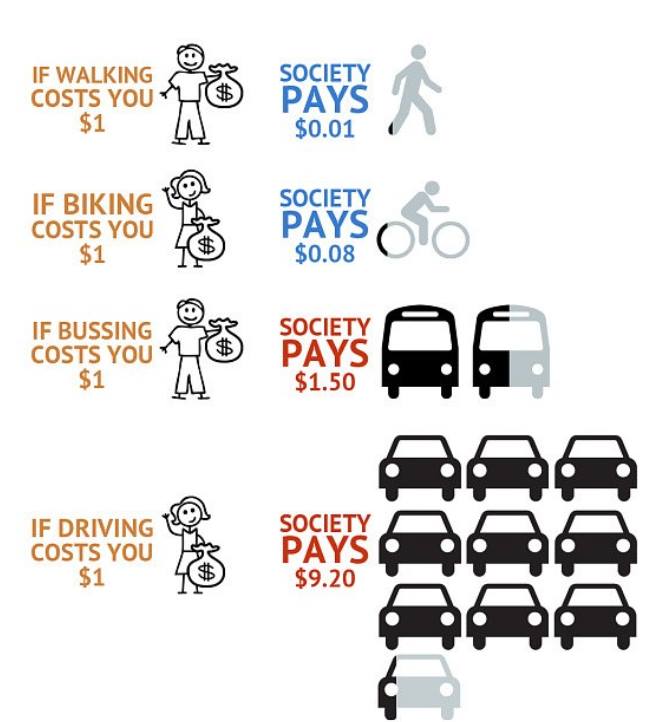
This urban meme humorously illustrates the efficiency of public transit versus private car use. It shows that for the city, "walking" costs pennies ($0.01) and "biking" costs a few cents ($0.08), but using "busses" costs over a dollar ($1.50), while driving costs almost ten dollars ($9.20). The punchline implies that the society actually pays to provide the infrastructure to move people, suggesting that public transit is incredibly resource-efficient compared to driving.
simple-description (llama3.2-vision_11b)
The meme is a humorous comparison of transportation costs in a city. It shows a person walking and a person on a bike, with the text "If walking is free, and biking is 1 cent" above them. Below, it shows a person on a bus and a person on a train, with the text "If bus is 1 cent, and train is 1.5 cents" above them.
detailed-analysis (gemma3-27b-vision)
Here’s a breakdown of the image using the requested theoretical frameworks. It's important to remember these lenses often overlap and enrich each other.
Visual Description
The image is a simple infographic divided into four vertical sections. Each section contrasts individual cost for a specific mode of transportation ("If [Mode] Costs You $1") with what “society pays” (represented numerically). The infographic uses stick figure representations of people with an image of a dollar sign on their chest.
- Walking: If you walk, the individual spends $1, but society pays $0.01, with a stick figure image on the right.
- Biking: If you bike, the individual spends $1, but society pays $0.08, with a bicycle image on the right.
- Bussing: If you take the bus, the individual spends $1, but society pays $1.50, and the image has a bus.
- Driving: If you drive, the individual spends $1, but society pays $9.20, and the image has a multitude of cars.
The graphic visually implies that while individual cost remains consistent across all modes, the broader societal cost of each mode dramatically differs. The more "individual" the mode (walking, biking) the less society “pays”, and the more reliant on infrastructure and shared resources (cars) the more society "pays”. The use of basic stick figures and simple graphics makes the message accessible and easily digestible.
Marxist Conflict Theory
This image is powerfully resonant with a Marxist interpretation. At its core, it highlights the hidden costs of capitalist infrastructure and prioritization.
- Class & Unequal Burden: The “society pays” portion represents the collective burden of infrastructure – roads, parking, environmental damage, health costs associated with pollution – disproportionately borne by the working class. The cost of car infrastructure is enormous ($9.20 compared to fractions of a dollar for walking or biking). The working class subsidizes the ease of mobility for those who can afford cars.
- Commodity Fetishism: The image implicitly critiques commodity fetishism. While driving appears to be a straightforward, individual mode of transportation, the image exposes the complex web of societal resources it depends on and the costs that are obscured. We only see the individual cost of gas, insurance, and the car itself, not the broader societal cost of sustaining that entire system.
- Alienation: The reliance on cars, facilitated by massive infrastructure, leads to alienation from the community and from physical activity. The image indirectly highlights how car-centric infrastructure isolates individuals.
In essence, the image can be read as a visual argument for a re-evaluation of transport policies, aiming to redistribute the costs more equitably and prioritize modes of transport that are less resource-intensive and less harmful to the collective well-being.
Critical Theory
The infographic lends itself to a Critical Theory analysis by raising questions about power, ideology, and the construction of “common sense”.
- Ideology of Mobility: The image challenges the dominant ideology that prioritizes individual car ownership and freedom of mobility. The huge disparity in societal costs suggests that this “freedom” is not freely obtained but is sustained by a system that extracts resources and burdens from society.
- Rationalization & Control: The obsession with car infrastructure can be seen as a manifestation of the rationalizing forces of modernity, seeking to maximize efficiency and control at the expense of other values (sustainability, public health, community).
- Deconstruction: The graphic deconstructs the seemingly neutral concept of “transportation” by revealing the hidden costs and power dynamics embedded within it. It forces the viewer to question the assumption that individual mobility is the ultimate goal, and to consider the broader societal implications.
- Power Relations: The enormous difference in "society pays" for car use compared to walking or biking isn’t just an economic disparity, but a power relation. Those who control the infrastructure (governments, corporations) benefit from maintaining a car-dependent system, and the broader public bears the cost.
Foucauldian Genealogical Discourse Analysis
From a Foucauldian perspective, the image is not simply about economics but about how the discourse around transportation has shaped our understanding of mobility and societal norms.
- Genealogy of the Car: A genealogical analysis would trace the historical development of the car as not simply a technology, but as a discursive practice. How did the car become associated with freedom, status, and progress? What power relations were at play in constructing this discourse?
- Governmentality: The image illustrates the concept of governmentality – how power operates through seemingly neutral institutions and practices. The construction of roads, parking lots, and traffic regulations is not simply about facilitating transportation but about governing populations and controlling space.
- Disciplinary Power: The image suggests how car-centric infrastructure disciplines bodies – encouraging sedentary lifestyles, isolating communities, and creating dependence on a specific mode of transportation.
- Normalization: The infographic implicitly critiques how car dependence has been normalized – presented as a natural and inevitable part of modern life, rather than as a socially constructed system with significant costs. The graphic subtly demonstrates that walking and biking shouldn't be perceived as less efficient, but as less costly to society.
Postmodernism
A Postmodern reading would focus on the breakdown of grand narratives and the instability of meaning in the image.
- Deconstruction of "Mobility": The image deconstructs the notion of "mobility" as a singular, objective concept. It demonstrates that mobility is not simply about getting from point A to point B, but about the complex social, economic, and environmental factors that shape our movement.
- Rejection of Universal Truths: The image rejects the idea that there is a single "best" mode of transportation. It highlights the trade-offs involved in each choice and challenges the notion that individual freedom should always take precedence over collective well-being.
- Emphasis on Discourse: The image acknowledges that the meaning of transportation is not inherent in the technology itself, but is constructed through discourse. The "society pays" figures are not objective measurements, but rather interpretations that reflect particular values and priorities.
- Fragmentation & Contingency: The image implicitly suggests that the current system of transportation is not inevitable but is contingent on historical and social factors. It opens up the possibility of alternative futures and challenges the notion that the car will always be the dominant mode of transportation.
It’s worth noting that these analyses aren't mutually exclusive. For example, the Postmodern critique of grand narratives complements the Marxist analysis of ideology, while the Foucauldian focus on power relations enriches both. The image is a surprisingly rich and complex piece of visual communication.
simple-description (llama3.2-vision)
The meme is a humorous comparison of two types of transportation: walking and driving. It presents a satirical take on the concept of "if you pay for it, it's yours" by applying it to transportation. The text in the image reads: "If walking costs you $1, then driving costs you $1.25. If biking costs you $1, then driving costs you $1.25."
tesseract-ocr
6 IF WALKING 9 SOCIETY Costs You S{@) PAYS $1 [h\ $0.01 ¢ CS IF BIKING 44 SOCIETY costs You /5 PAYS $1 ® $0.08 ( IF BUSSING OR SOCIETY COSTS YOU PAYS $1 [\ $1.50 a an ana IF DRIVING SOCIETY COSTS YOU PAYS Ga) Ga) Gu) $4 $9.20 = = fax}