First Seen
2023-05-10T21:03:42+00:00
simple-description (qwen3.5_2b-q8_0)
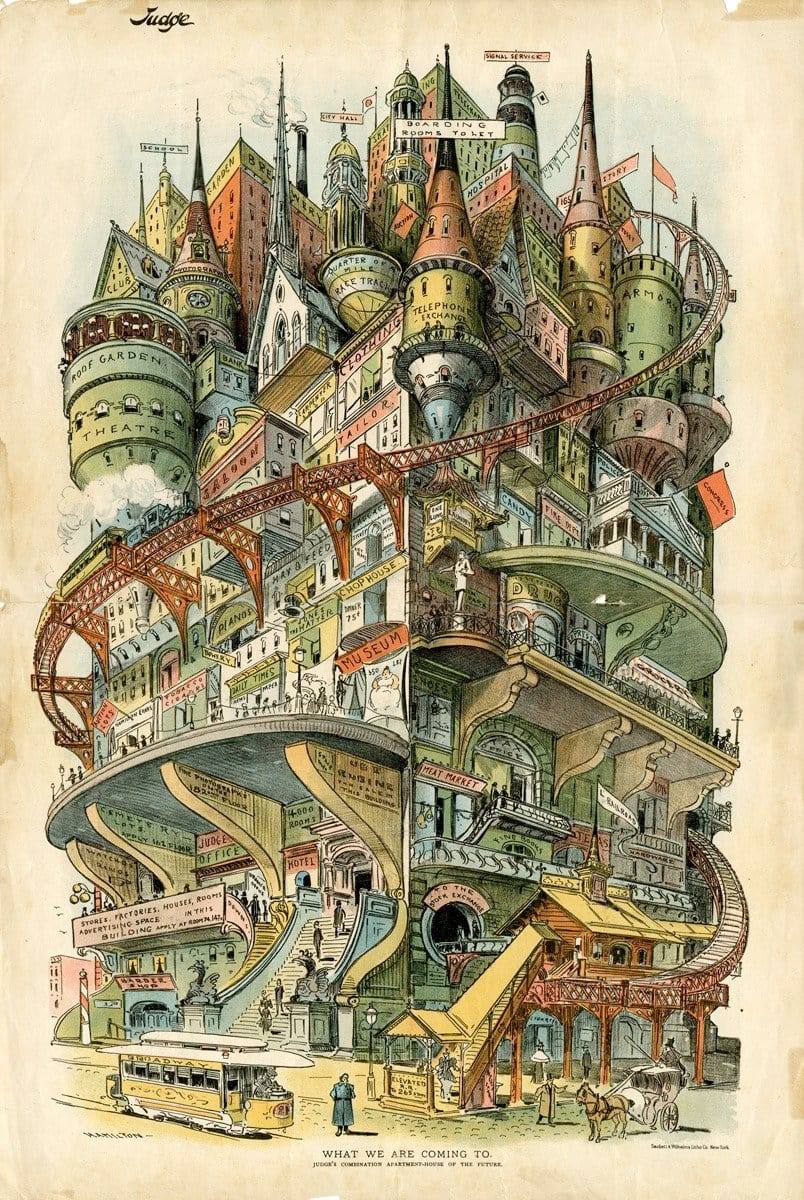
This hyper-detailed illustration mocks urban density by depicting an impossible, stacked-together tower where buildings touch each other so high they create a chaotic, impossible cityscape. Floating signs like "Telephones Exchange," "City Hall," and "Roof Garden" float in the sky to emphasize the vertical scale and absurdity of the construction, while the caption "What we are coming to" at the bottom acts as a warning about the future's dense, confusing urban environments.
simple-description (llama3.2-vision_11b)
The meme is a satirical illustration of a futuristic cityscape, depicting a towering metropolis with a labyrinthine layout of skyscrapers, bridges, and tunnels. The image is captioned "The Future of New York" and is a commentary on the chaotic and overcrowded nature of urban planning in the late 19th century. The illustration is a humorous exaggeration of the city's growth and congestion, with buildings and infrastructure becoming increasingly complex and entangled.
detailed-analysis (gemma3-27b-vision)
Okay, let's break down this fascinating illustration, titled "What We Are Coming To: Judge’s Combination Apartment House of the Future," through several critical lenses.
Visual Description
The image is a highly detailed, color lithograph depicting a fantastical, incredibly dense, multi-tiered "apartment house" (though it resembles much more than a typical dwelling) as envisioned by someone named “Judge”. It's a towering structure built on a grand scale, supported by elaborate, almost Gothic-revival style pillars and foundations.
The building is a labyrinthine amalgamation of different functions and spaces. You can identify elements like:
- Transportation: Railroad tracks integrated into the structure, an elevated tram line looping around the exterior, and at the very bottom, what appear to be streetcars.
- Commercial and Recreational Spaces: A theater, hotel, museum, market, tea room, shops, a roof garden, a "roof playground", and seemingly a host of other businesses and leisure facilities.
- Residential Spaces: Though interwoven with everything else, apartments and living quarters are visible.
- Work Spaces: Factories, offices, and even a printing press are integrated.
- Public Utilities: A "power station" and elements hinting at plumbing/sewage are visible.
- Architectural Style: A blend of Victorian, Gothic Revival, and a touch of the Art Nouveau. Very ornate and detailed.
- Figures: People are depicted using the various facilities—riding the tram, shopping, entering buildings, etc. These figures are very small, emphasizing the scale of the structure.
- Overall Impression: The image conveys a sense of both utopian ambition and overwhelming complexity. It’s a vision of maximizing space and integrating all aspects of life into a single structure.
Foucauldian Genealogical Discourse Analysis
This image offers rich material for a Foucauldian analysis. The structure is a manifestation of power/knowledge relationships.
- Panopticism: The sheer visibility within the structure, despite its complexity, is striking. Though not a literal panopticon, the internal arrangement suggests that inhabitants could potentially be observed from multiple points. This supports the idea of self-regulation through perceived surveillance. The structure produces a form of "docile body"—a population accustomed to being watched and controlled.
- Discipline & Normalization: The integration of work, leisure, and residence into a single structure creates a highly disciplined environment. There is little separation between spheres of life, potentially leading to normalization of constant activity and productivity.
- Genealogy of Modernity: The "future" envisioned here is heavily influenced by the late 19th/early 20th-century industrialization, urban density, and the rise of new technologies. The image reveals anxieties and aspirations surrounding these changes—the desire to control and optimize urban life, but also the potential for alienation and loss of individuality.
- Discourse of Efficiency & Progress: The emphasis on combining everything into a single structure speaks to a discourse of efficiency and progress—the belief that technology and rational organization can solve social problems.
Critical Theory (Frankfurt School)
A Critical Theory approach, particularly drawing on the Frankfurt School, highlights the image's potential for alienation and the "culture industry."
- Instrumental Rationality: The structure is a perfect example of instrumental rationality—the emphasis on means-ends calculations and efficiency. However, this focus on efficiency comes at the cost of human connection, autonomy, and critical thought. The building treats people as mere units in a system.
- Commodity Fetishism: The sheer variety of shops, businesses, and leisure facilities within the structure promotes a culture of consumption. The image suggests that happiness and fulfillment can be achieved through the acquisition of commodities.
- Mass Culture & Standardization: The structure, despite its ornate detail, ultimately represents a homogenization of experience. All aspects of life—work, leisure, residence—are standardized and integrated into a single system. This leads to a loss of individuality and critical thought.
- One-Dimensional Man: The image suggests a future where individuals are increasingly passive and conform to the demands of the system. There is little room for creativity, dissent, or independent thought.
Marxist Conflict Theory
A Marxist lens reveals potential class divisions and power imbalances embedded in the structure.
- Ownership & Control: Who owns and controls this massive structure? It's likely a small number of wealthy individuals or corporations. This creates a significant power imbalance, as they control access to essential resources and opportunities.
- Exploitation of Labor: The presence of factories and offices suggests that workers are being exploited to produce goods and services for the benefit of the owners.
- Social Stratification: Even within the structure, there are likely to be clear divisions between the wealthy and the poor. The upper levels may house luxurious apartments, while the lower levels may be cramped and overcrowded.
- Alienation: Workers are alienated from their labor, as they do not control the means of production or the products they create. They are treated as mere cogs in a machine.
- Commodification of Life: The integration of all aspects of life into a single structure commodifies even basic human needs. Everything—housing, food, entertainment—is subject to market forces.
Postmodernism
From a postmodern perspective, the image can be viewed as a hyperreal and fragmented representation of modern life.
- Simulacra & Simulation: The structure is not a genuine representation of reality but a simulation—a copy without an original. It’s a pastiche of different styles and functions, creating a chaotic and overwhelming effect.
- Fragmentation & Deconstruction: The image rejects the idea of a unified and coherent worldview. It embraces fragmentation, ambiguity, and contradiction.
- Loss of Grand Narratives: The structure rejects the idea of progress and utopia. It suggests that there are no overarching narratives that can explain or justify the human condition.
- Hyperreality: The image is more real than real. It’s a simulation that has become more compelling and immersive than actual reality.
- Parody & Irony: The image can be read as a parody of modern life—a satirical critique of its excesses and absurdities.
Queer Feminist Intersectional Analysis
This lens is arguably the most challenging to apply directly, but some interpretations are possible:
- Spatial Control & Gendered Spaces: The structure's design implicitly regulates movement and access. What spaces are reserved for men, women, or specific social classes? Are there hidden spaces for marginalized groups? Is there a lack of safe or accessible spaces for queer individuals?
- Reproductive Labor & Domesticity: How does the structure accommodate or ignore the needs of those performing unpaid reproductive labor (childcare, elder care, housework)? Is domestic space relegated to the margins or integrated into the overall design?
- Intersectionality of Oppression: The structure likely reinforces existing inequalities based on race, class, gender, and sexuality. For example, access to desirable spaces may be limited for marginalized groups.
- Challenging Heteronormative Spatial Arrangements: Does the structure promote or hinder the creation of queer spaces and communities? Is there any recognition of diverse family structures or relationships?
- Control & Surveillance: The visibility implied by the structure (from a Foucauldian perspective) could be particularly oppressive for those who are already marginalized or subject to surveillance.
I hope this breakdown is helpful! Let me know if you'd like me to elaborate on any particular aspect.
simple-description (llama3.2-vision)
This meme is an illustration of a futuristic cityscape, with towering skyscrapers and flying cars zipping through the air. The image is captioned "This is what the future will be like" and features a series of wacky and fantastical elements, including a giant robot, a flying car, and a person riding a unicycle on a high wire. The overall tone is playful and humorous, implying that the artist has a tongue-in-cheek view of what the future might be like.
tesseract-ocr
age. nal jth A Ciieney 4 ny IE | ie Giean ARIAL IN a Ly Non aa a Mas AAS ao BS ened Be WR RENO TV. =e De RB Wy ey Ned ie oe sv =; Wig - a ew eS! i 294 Cia (ie (“Si Se Fo OP oii el iy. a a en I NINS e ee ale aN, Gree a Ne SN Ti oe aN Coo Rez Sa pe LICKS Mee, en ee IN Bn oA N\ Ns ae ea > Se Vale) game oe aT SL foe Jee SFr OFN, Ate ah — — aw Tks oe ray = {temas fb i es tAy ae ae ee SS 4 ae