First Seen
2023-05-10T21:03:42+00:00
simple-description (qwen3.5_2b-q8_0)
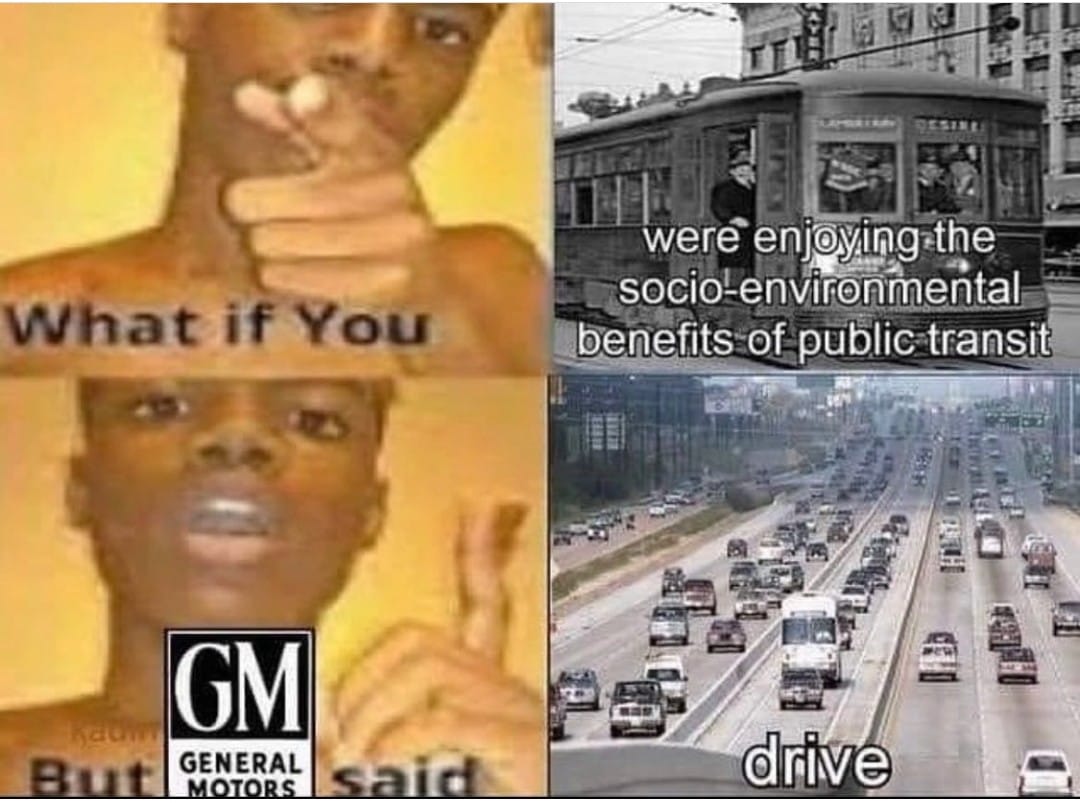
This urbanism meme humorously explains why people drive their private cars despite the environmental perks of public transit. The top section of the image displays the text "were enjoying the socio-environmental benefits of public transit" superimposed over a subway train, while the bottom section features a highway scene with the text "drive" and the "But GM said" logo. This combination suggests that while the subway might offer good eco-features, the practical reality for everyone is simply to drive.
simple-description (llama3.2-vision_11b)
This meme is a play on the idea of urban planning and the concept of "public transportation" vs. "private transportation". The image shows a person saying "I love public transportation" but then saying "I hate public transportation" with a picture of a car, highlighting the irony of enjoying the benefits of public transportation while also enjoying the freedom of driving a car. The meme is poking fun at the idea that people often say one thing but do another, in this case, enjoying the benefits of public transportation while also enjoying the freedom of driving a car.
detailed-analysis (gemma3-27b-vision)
Okay, let's break down this image through the lenses you requested. This is a complex meme, and each theoretical approach will illuminate different facets. I'll address each heading only if the meme lends itself to the analysis.
Visual Description
The image is a meme presented as a split panel or diptych.
- Left Panel: Features a close-up of a Black man’s face with overlaid text bubbles. The bubbles are structured as a question/response. The initial bubble above his face reads, "What if You..." and the bubble below reads, "But GM said..." The image has a vintage quality.
- Right Panels: The right side is split into two separate photographs. The upper photo is of an old-style trolley car in an urban setting. The lower photo shows a multi-lane freeway packed with cars.
- Text Overlays: Across the upper right panel (trolley car photo) is the text “were enjoying the socio-environmental benefits of public transit.” Beneath the highway scene is the text “drive”.
- Overall Impression: The meme constructs a stark contrast between a past where public transit was readily available and a present dominated by automobile reliance. There's a clear implication that General Motors (GM) played a role in this shift.
Foucauldian Genealogical Discourse Analysis
This meme is ripe for a Foucauldian analysis.
- Discourse and Power/Knowledge: The meme points to a historical discourse surrounding transportation, urban planning, and consumerism. Foucault would argue that this discourse wasn’t neutral, but constructed through power relations. GM, as a major player, didn't just offer a product (cars); it actively shaped the very ways we think about mobility and urban life. The meme implies that GM produced a specific “truth” about the desirability of car ownership and the inadequacy of public transit.
- Genealogy of Control: The meme suggests a genealogical tracing of power. It implies a history of how control over mobility was shifted from public systems (like trolleys) to private, individualized forms (cars). This shift isn't presented as a natural progression, but as a manufactured one. The genealogy would explore the tactics used by GM and others to dismantle public transit and promote automobile dependence – lobbying, advertising, infrastructure investment favoring roads over rail, and even the deliberate sabotaging of trolley systems (as historically documented).
- Disciplinary Power: The meme subtly suggests that the embrace of the car has become a form of self-discipline. We internalize the idea that car ownership is essential for freedom, convenience, and status. This internalizing of norms is a core aspect of Foucault’s concept of disciplinary power.
- Historical Erasure: The meme implies an erasure of history and a constructed present. It asks us to imagine a different past and a different potential future, suggesting the present is not inevitable, but an outcome of specific power dynamics.
Marxist Conflict Theory
This meme is powerfully aligned with Marxist thought:
- Class Struggle: The meme speaks to a conflict between the interests of a corporation (GM) and the collective good. GM's pursuit of profit inherently clashes with the potential benefits of accessible public transportation for all members of society.
- Capital Accumulation: GM’s success is directly tied to the accumulation of capital. Promoting car ownership expands the market for its products, creating more profit. This accumulation happens at the expense of potentially more equitable and sustainable transportation systems.
- Commodification of Mobility: The meme argues that mobility (the ability to move freely) has been commodified. It’s no longer seen as a fundamental right, but as something that must be purchased. This commodification creates inequality, as those without the financial means to own a car are marginalized.
- Ideology and False Consciousness: The promotion of car culture can be seen as a form of ideology that obscures the exploitative nature of the system. People are encouraged to believe that owning a car is the key to freedom and success, distracting them from the social and environmental costs. This fosters a false consciousness – a lack of awareness of their own exploitation.
- Means of Production: The meme points to a manipulation of the "means of production" of transportation. Instead of investing in and maintaining public transit (a collectively owned means of transportation), investment was directed toward the production and sale of private vehicles.
Postmodernism
While not the primary lens, Postmodern ideas can be applied:
- Meta-Narrative Breakdown: The meme challenges the dominant meta-narrative that car ownership is synonymous with progress and freedom. It deconstructs the idea that this is a natural, inevitable outcome.
- Simulacra and Simulation: Postmodern theorists like Baudrillard might argue that the “freedom” offered by cars is a simulation – an illusion that obscures the underlying constraints and inequalities. We are chasing an image of freedom that is not actually attainable.
- Rejection of Grand Narratives: The meme implies a rejection of the "grand narrative" of industrial progress and consumerism. It asks us to question the assumptions that underpin our society.
- Intertextuality: The image draws on a historical context (the dismantling of public transit) and connects it to the present. This intertextuality encourages a critical reading of contemporary culture.
Critical Theory
This meme is very much in line with Critical Theory’s concerns:
- Emancipation & Ideology Critique: Critical Theory seeks to understand and challenge the systems of domination that perpetuate inequality. This meme does exactly that by exposing how GM (representing corporate power) potentially shaped our societal values and infrastructure for its own profit. It invites us to question why we accept the current state of affairs.
- The Culture Industry: The meme implicitly critiques the "culture industry" (a concept developed by Adorno and Horkheimer). The promotion of car culture through advertising and media can be seen as a form of cultural manipulation that reinforces capitalist values.
- Reason and Domination: The meme can be read as an example of “instrumental reason” gone awry. The focus on technological advancement and economic efficiency (building roads, manufacturing cars) has come at the expense of social and environmental well-being.
- Power Structures: The meme critiques the power structures that exist in society and how they benefit certain groups (like corporations) at the expense of others (the public, the environment).
Let me know if you would like me to expand on any particular section, or explore another theoretical lens!
simple-description (llama3.2-vision)
The meme is a humorous take on a common phrase "I can see for miles and miles" but with a twist. The image shows a person with a confused expression and a caption that reads "I can see for miles and miles" but with the words "but I'd rather not" inserted in the middle. The meme is poking fun at the idea that just because you can see something, it doesn't mean you have to do something about it.
tesseract-ocr
~~ JESS ia i! : Hl ; : t Ht 2 a + | , y ’ gw ; — = ; P _ t ) ,. ¥ . . ter - faa) ot on a Le a Gl | Daa “ were aM OvAlny gthe = ei hal “socio-environmentals i hat if You ibenefits-of public-transit? : . ‘get i i wits ik ph ites ity Hy me a Pipes I oll ant pe a ‘ee: S Pe 9 RO | AT art | SNE les ich lemCliyS =,