First Seen
2023-05-10T21:03:42+00:00
simple-description (qwen3.5_2b-q8_0)
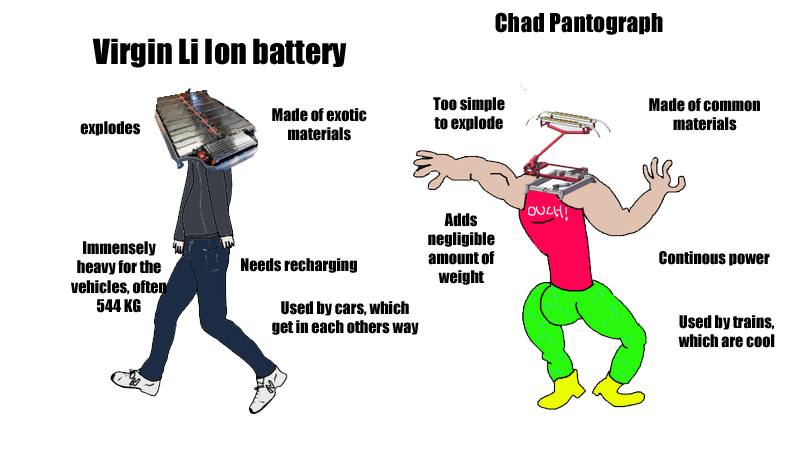
In the context of urbanism, this meme visualizes the transition from heavy, dangerous infrastructure to modern, efficient transit. The left side depicts a "Virgin Li Ion battery" that is excessively heavy (544 kg), dangerous enough to explode, and difficult to maintain, representing the weight and hazards of old-fashioned infrastructure. The right side shows a "Chad Pantograph," which symbolizes the sleek, modern electric transit solution with negligible weight and continuous power, highlighting how cities have shifted away from hazardous old technology toward safe, integrated transport systems.
simple-description (llama3.2-vision_11b)
This meme is a play on the concept of urban planning and the design of cities. The image shows a person carrying a massive block of concrete on their shoulders, with the caption "Urban Planning: Where the only thing we have in common is our dislike for it".
detailed-analysis (gemma3-27b-vision)
Here's an analysis of the image, broken down into the requested theoretical frameworks, only when applicable. It's worth noting that this image relies heavily on internet meme culture ("Virgin vs. Chad") which informs much of its potential interpretation.
Visual Description
The image is a "Virgin vs. Chad" meme, featuring two stick figures. On the left is a figure labeled "Virgin Li-Ion battery," with a large battery physically replacing its head. This figure is depicted in a stooped, almost defeated posture, wearing sneakers and trousers. Text surrounding this figure highlights perceived weaknesses – it "explodes," is "immensely heavy" (544kg), "needs recharging," and is "used by cars, which get in each other’s way.”
On the right is a figure labeled "Chad Pantograph," with a pantograph (the arm that collects power from overhead lines on trains) replacing its head. This figure is much more robustly drawn, in a dynamic, upright pose, wearing minimal clothing. Text surrounding this figure emphasizes its perceived strengths – it's “made of common materials”, “adds negligible weight”, provides “continuous power”, and is "used by trains, which are cool.” The "ouch!" text near the pantograph suggests a level of danger, but is presented in a way that feels almost boastful.
Foucauldian Genealogical Discourse Analysis
This image can be analyzed through a Foucauldian lens by examining the discourses surrounding energy sources and transportation. The binary opposition of "Virgin" vs. "Chad" creates a power/knowledge relationship. The battery (the "Virgin") is framed as inherently dangerous ("explodes"), unwieldy ("heavy"), and dependent ("needs recharging"). This discourse positions it as something to be managed and controlled, reinforcing a perception of risk and the need for regulation.
The pantograph ("Chad"), on the other hand, is presented as simple, lightweight, and reliable – qualities that diminish the need for constant scrutiny or intervention. The association with trains ("cool") further normalizes and valorizes this technology.
A genealogical approach would investigate how this discourse emerged – tracing the historical development of perceptions around these technologies, the role of marketing and public opinion, and the ways in which power dynamics have shaped our understanding of them. This image doesn’t reveal truth; it produces a specific way of understanding the comparison.
Critical Theory
From a Critical Theory perspective, the meme can be seen as a reflection of broader societal anxieties about technological dependency and environmental sustainability. The Li-Ion battery, frequently associated with electric vehicles, represents a move towards a different energy paradigm. However, the image discredits this paradigm by emphasizing perceived flaws.
The meme promotes a nostalgic, romanticized view of rail travel (trains being “cool”) – potentially ignoring the infrastructural costs, environmental impact, and other challenges of rail systems. The binary opposition serves to obscure the complex realities of both technologies, reinforcing a simplistic, emotionally charged narrative. The image functions as a form of ideological reinforcement – subtly promoting a preference for traditional technologies while discrediting perceived threats to the status quo.
Marxist Conflict Theory
A Marxist analysis could see this image as reflecting class-based anxieties. Electric cars (powered by Li-Ion batteries) are often seen as a status symbol, and their adoption can be linked to increasing economic inequality. The image subtly positions these as problematic due to their weight and dependence.
Rail travel, historically accessible to a broader range of social classes, is idealized as “cool.” This can be interpreted as a subconscious preference for collective, publicly owned infrastructure over private, consumerist solutions. The conflict isn’t explicitly stated, but it’s implied – a struggle between individual consumerism and collective well-being. The figure on the left is burdened and weighed down, symbolic of the weight of modern consumerism.
Postmodernism
The image embodies several Postmodern principles. It's hyperreality – a simulation of a comparison based on pre-existing cultural tropes (the "Virgin vs. Chad" meme) rather than a direct reflection of objective reality. The qualities attributed to each technology are exaggerated and subjective.
The image deconstructs the idea of technological progress by questioning the inherent superiority of newer technologies. The playful, ironic tone undermines any serious attempt at objective comparison. The emphasis on visual spectacle and the appropriation of existing cultural references further demonstrate Postmodern characteristics.
Queer Feminist Intersectional Analysis
This area doesn’t have much direct applicability here unless we make certain readings. The "Virgin vs. Chad" meme itself often relies on and reinforces hypermasculine ideals. The figure "Chad" is a stereotypical depiction of masculine strength and confidence. However, this is a fairly shallow reading within this particular image. The primary focus is on technology, not gender, and the intersectional implications are minimal. We could speculate that the framing of "new" vs. "traditional" technologies taps into broader anxieties around societal change, potentially impacting marginalized groups in different ways, but this requires significant extrapolation.
Important Note: These analyses are interpretations based on the visual and textual cues present in the image. Different viewers might draw different conclusions depending on their own experiences and perspectives. Also, the image's primary function is likely humorous or provocative rather than deeply philosophical.
simple-description (llama3.2-vision)
The meme is a comparison between two different versions of a character from the popular TV show "Game of Thrones". The left image shows a character from the show, Jon Snow, in his "Jon Snow" outfit, while the right image shows the same character in a ridiculous, over-the-top outfit. The text in the meme reads: "I'm not a lawyer, but I play one on TV" and "I'm not a doctor, but I'll be your doctor".
tesseract-ocr
Chad Pantograph Virgin Lilon battery - i Too simple Made of common \ Maule of exotic 4 Ms explodes S ; > materials to explode materials Adds immensely jaa negligible ; heavy for’ the Needs recharging —_ Continous power vehicles, often weig! 544 KG Used by cars, which - get in each others way Used by trains, which are cool