First Seen
2023-06-17T06:33:48+00:00
simple-description (qwen3.5_2b-q8_0)
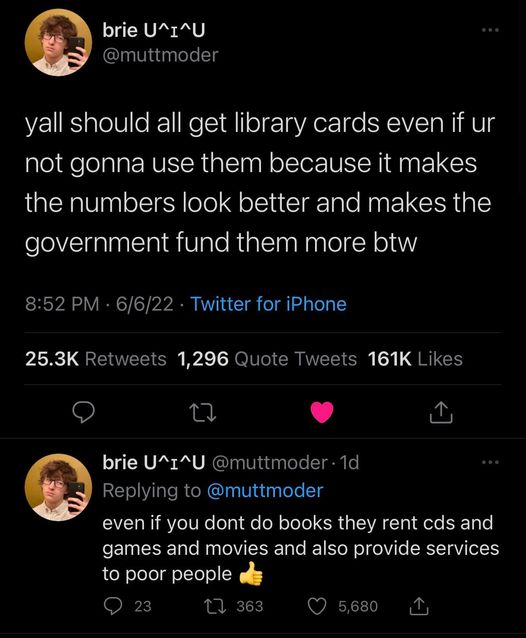
From the perspective of urbanism, this meme is a satirical critique of how bureaucratic data is used to manipulate the funding of public institutions like libraries. The poster argues that simply collecting library cards generates numbers that "look better," which "makes the government fund them more" regardless of actual usage.
simple-description (llama3.2-vision_11b)
The meme is a screenshot of a Twitter post by a user named "brian" with a humorous take on a public library's policy change. The post says "If you need to use a library just read the books don't photocopy them" and is captioned "When you're trying to be a good person but you're also trying to save money".
detailed-analysis (gemma3-27b-vision)
Okay, let's break down this Twitter thread using the frameworks you've requested. Keep in mind that applying these frameworks can be interpretive, and there's room for different readings. I'll note where things are more speculative.
Visual Description
The image captures a two-part Twitter thread posted by the user @muttmoder. The profile picture shows a person with dark, wavy hair and a dark-colored shirt. The first tweet states, "yall should all get library cards even if ur not gonna use them because it makes the numbers look better and makes the government fund them more btw." It includes timestamps (8:52 PM 6/6/22) and information about the device used (Twitter for iPhone), as well as metrics of engagement (25.3K Retweets, 1,296 Quote Tweets, 161K Likes). The second tweet, replying to the same user, states "even if you dont do books they rent cds and movies and also provide services to poor people 🫶". It also includes engagement metrics. The tone is informal and uses internet slang ("yall," "btw," "ur").
Foucauldian Genealogical Discourse Analysis
This tweet can be analyzed through a Foucauldian lens by looking at how metrics and statistics have become a form of power/knowledge. The poster isn't advocating for library use based on its inherent value (reading, learning, community), but on its ability to perform a certain outcome – increased funding.
- Genealogy: The historical development of library funding is relevant. Libraries historically were seen as sites of civic virtue and enlightenment. The shift to measuring success based on circulation numbers and "user engagement" (as driven by funders) represents a discursive shift. What counts as "successful" library operation has changed.
- Power/Knowledge: The act of measuring and quantifying library usage creates a regime of truth. Funding bodies (the government) exercise power by defining what "good" library usage looks like. The poster implicitly acknowledges this power structure and suggests a way to "game" the system—increase the numbers to secure funding, regardless of actual use.
- Discourse: The discourse around libraries has moved from a focus on intellectual and cultural access to a focus on quantifiable outputs. The tweet participates in this discourse by prioritizing statistics over intrinsic value. The poster understands that manipulating the appearance of usage is enough to influence the decision-makers.
Critical Theory
The tweet challenges the idea of the library as a purely altruistic institution. Critical Theory examines how seemingly neutral institutions are deeply embedded in systems of power.
- Instrumental Reason: The tweet embodies a highly instrumental approach to library usage. Libraries are viewed not as ends in themselves, but as means to an end— securing funding. This reflects a broader trend of instrumental reason in modern society where everything is valued for its utility.
- Commodification of Culture: Even though libraries offer services for free, this tweet positions them as subject to market-like pressures. The need to "perform" to secure funding mirrors the demands placed on businesses to demonstrate "value" to investors.
- Ideology: The tweet subtly reinforces the ideology that quantifiable metrics are the primary indicators of success. This can mask underlying social issues (like lack of access to resources) by focusing on superficial numbers.
Marxist Conflict Theory
This tweet can be seen as a comment on the unequal distribution of resources and the struggle for funding.
- Class Dynamics: The second tweet highlights the library's role in serving "poor people." Libraries often function as vital resources for those with limited economic means. The framing of the initial tweet ("get library cards even if you don't use them") suggests a collective effort to secure funding for these services, acknowledging that those who benefit most might not always be the ones actively engaging with the system.
- Resource Scarcity: The tweet implies that library funding is not guaranteed. The call to inflate numbers is a strategy to address a perceived scarcity of resources, reflecting the broader conflict over allocation of public funds.
- False Consciousness: While subtle, there's a potential argument that the tweet subtly perpetuates a system of manipulation. Encouraging people to participate in a deceptive practice (getting a card you won't use) could be seen as a form of “false consciousness”– a manipulation that reinforces the status quo.
Postmodernism
The tweet embodies certain postmodern characteristics.
- Simulacra and Simulation: The emphasis on appearing to use the library, rather than actually using it, can be seen as a form of simulacra (a copy without an original). The performance of library usage becomes more important than the reality of it.
- Deconstruction of Grand Narratives: The tweet challenges the traditional "grand narrative" of the library as a purely benevolent institution dedicated to the pursuit of knowledge. It reveals the underlying economic and political forces that shape its operation.
- Hyperreality: The focus on metrics and funding can create a hyperreal experience where the representation of library usage becomes more real than the actual experience of using the library.
Queer Feminist Intersectional Analysis
This is where the connection is more subtle, but still present.
- Accessibility & Resource Distribution: Libraries often serve as safe spaces and provide vital resources for marginalized communities, including LGBTQ+ individuals and people of color. The plea to increase funding—even through somewhat manipulative means— acknowledges the importance of maintaining these resources.
- Challenging Systems: The act of "gaming the system" to secure funding could be seen as a form of resistance against dominant power structures. While not explicitly feminist or queer, it’s a challenge to the traditional bureaucratic channels.
- Intersectionality: The framing of libraries as resources for “poor people” inherently highlights the intersection of class and access. Libraries can act as a site of empowerment for those facing multiple forms of marginalization.
Let me know if you’d like me to elaborate on any of these points or explore other interpretive lenses!
simple-description (llama3.2-vision)
The meme is a screenshot of a tweet from a user named "bored in the future" (not the actual name, but the username is displayed in the tweet). The tweet reads: "yall should get library cards even if you dont have money, they're free and you can get books, music, and movies for free. also, most libraries have free wifi and you can use their computers for free. it's a game changer."
tesseract-ocr
brie U*1*U @muttmoder yall should all get library cards even if ur not gonna use them because it makes the numbers look better and makes the government fund them more btw 8:52 PM - 6/6/22 - Twitter for iPhone 25.3K Retweets 1,296 Quote Tweets 161K Likes 9) a Ld ra brie U*1*U @muttmoder- 1d Replying to @muttmoder even if you dont do books they rent cds and games and movies and also provide services to poor people Py Lor) uno) \O-5-1-\) min]