First Seen
2023-05-10T21:03:42+00:00
simple-description (qwen3.5_2b-q8_0)
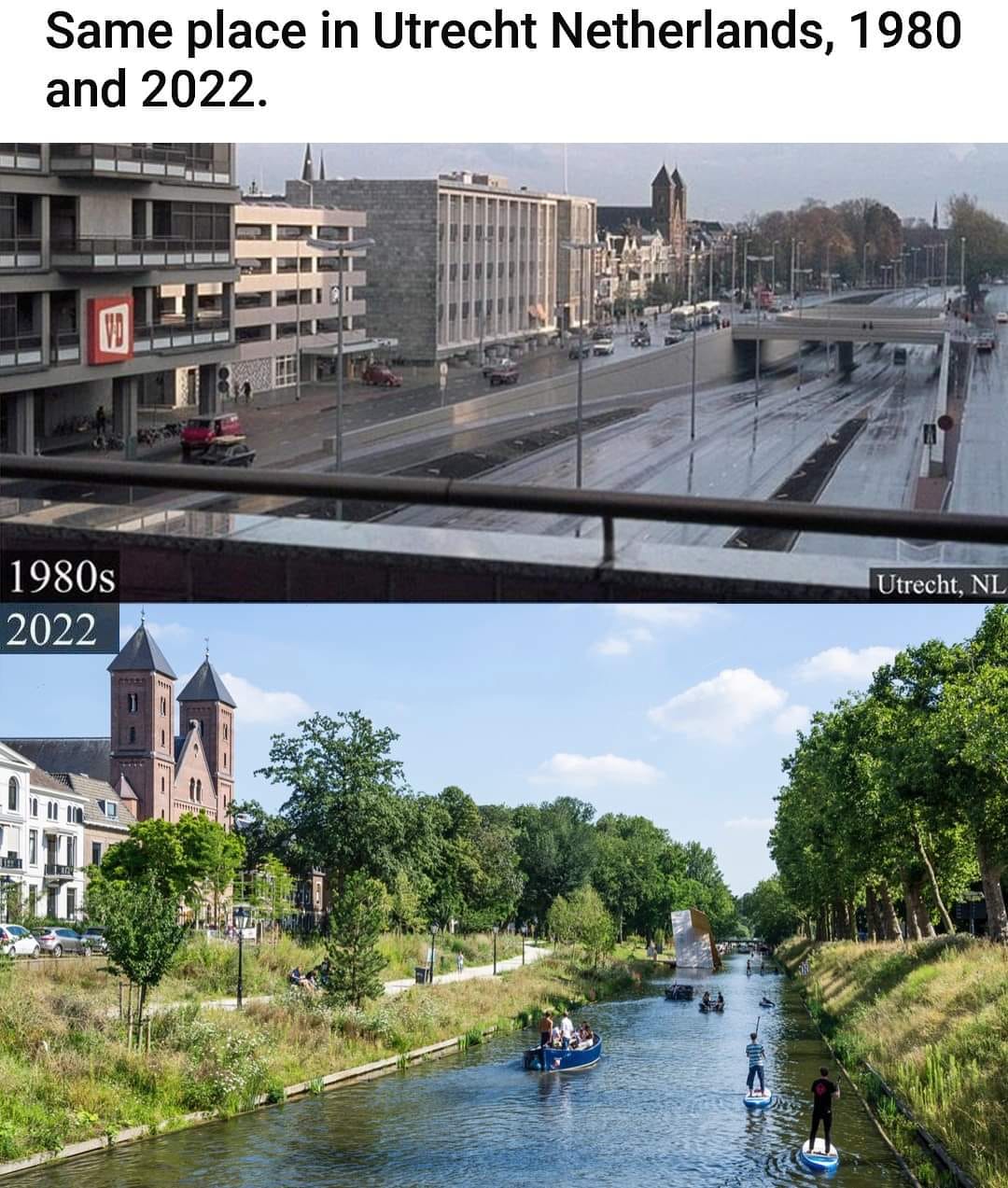
This meme presents a side-by-side comparison of the city of Utrecht, Netherlands, highlighting its significant urban transformation over four decades. The top image, labeled "1980s," shows a concrete highway and industrial structures, including a building with a red "VD" sign. In contrast, the bottom image from 2022 shows the same spot has been reclaimed as a scenic canal where people are enjoying paddleboarding and walking through a green, tree-lined park.
simple-description (llama3.2-vision_11b)
The meme is a side-by-side comparison of a busy city street in 1980 and a similar street in 2022. The text "Same place, different time" is often used to describe the meme, but in this case, it's more accurate to say "Same place, same city, but with a lot more cars and fewer pedestrians".
detailed-analysis (gemma3-27b-vision)
Okay, let's break down these images of Utrecht, Netherlands (1980 vs. 2022) through several theoretical lenses, as you've requested. I'll only cover those lenses where the images offer substantial material for analysis, avoiding forcing interpretations where they don’t fit.
1. Visual Description
- 1980s Image: Dominated by concrete and steel. The scene is centered around a railway track cutting through the urban landscape. The city appears industrial and busy, with cars and buses on a multi-lane road adjacent to the tracks. Buildings are largely functional and brick, with a visible focus on infrastructure. The color palette is muted and grayer. The presence of railway tracks prominently signifies a city heavily invested in industrial and transport-based modernity.
- 2022 Image: The railway line is still present, but largely obscured by greenery and water. A canal now occupies much of the space previously taken by the road. The cityscape appears more organic and integrated with nature. The buildings are still present, but softened by trees and reflected in the water. A sense of leisure and recreation (boating, paddleboarding) dominates the scene. The color palette is much brighter and more saturated, with vibrant greens and blues.
The overall impression is one of a significant transformation from a car-centric, industrial urban space to a more pedestrian- and water-focused, green, and recreational environment.
2. Foucauldian Genealogical Discourse Analysis
This image pair offers rich ground for a Foucauldian analysis focusing on the shifting discourses of urban planning and the construction of "progress" or "quality of life."
- 1980s: The scene embodies a discourse of modernist urban planning. The emphasis on efficient transport (rail, roads) and functional architecture reflects a belief in technological progress as the primary means to organize and improve urban life. The "normalization" of car dependency is also evident—the road is wide, and the scene is geared towards vehicular movement. This represents a power/knowledge regime where expertise in engineering and traffic management dictates spatial organization.
- 2022: The transformation signifies a shift towards a sustainable urbanism and a prioritization of livability. The canal, green spaces, and recreational activities demonstrate a new discourse focused on environmental consciousness, public health, and quality of life. This isn't necessarily a rejection of technology, but rather a reframing of its role—technology is now employed to integrate the city with nature, rather than to dominate it.
The genealogical approach would also ask: what historical contingencies led to this shift? What were the struggles, the debates, the compromises that resulted in the canal project? What discourses were challenged or suppressed? The image implies a move away from a top-down, expert-driven planning model to one that might be more responsive to citizen needs and environmental concerns.
3. Critical Theory (Specifically, Habermas & the Public Sphere)
The transformation can be interpreted through the lens of Habermas’s work on the public sphere.
- 1980s: The image suggests a fragmented public sphere. The focus on transportation infrastructure implies a city organized around instrumental rationality—everything is geared toward efficiency and functionality. There's little evidence of spaces for genuine communication, deliberation, or collective action. The road and railway act as barriers, dividing the city.
- 2022: The canal and green spaces can be seen as attempts to reconstruct the public sphere. These spaces invite social interaction, recreation, and communal activity. They offer opportunities for citizens to encounter each other and engage in informal deliberation. The canal itself becomes a shared space, fostering a sense of community.
However, a critical perspective would also question whether this reconstruction is genuine or merely a form of colonization of space—aestheticized “public” spaces designed to reinforce existing power structures. Are these spaces truly accessible to all? Are there hidden controls or restrictions on their use?
4. Marxist Conflict Theory
A Marxist interpretation would focus on the material conditions that underpinned the transformation and the potential class implications.
- 1980s: The focus on railway and road infrastructure suggests a city geared toward facilitating the movement of capital and goods. The emphasis on industrial transport aligns with the needs of a capitalist economy. The working class would likely be concentrated near the railway and industrial areas.
- 2022: The canal project can be seen as a form of spatial restructuring. It's likely that the canalization involved gentrification—raising property values and displacing lower-income residents. The "recreational" use of the canal suggests a shift towards a post-industrial economy where leisure and tourism are key drivers of growth. This might lead to a further polarization of class, with a wealthier population enjoying the canal while lower-income residents are pushed to the periphery. The canal is likely an amenity serving the interests of capital, promoting a desirable image of the city that attracts investment and tourism.
Let me know if you'd like me to delve deeper into any of these theoretical frameworks or explore additional ones!
simple-description (llama3.2-vision)
The meme is a side-by-side comparison of two images. The top image shows a crowded, polluted city street in the 1980s, with cars and pedestrians everywhere. The bottom image shows a serene, green park with a canal running through it, with people biking and walking along the path. The text "In 2 minutes" appears in the bottom left corner of the top image, and "Now" appears in the bottom right corner of the bottom image. The caption at the top of the meme reads "In 2 minutes" and "Now", implying that the transformation from a polluted city to a peaceful park occurred in just 2 minutes, but is actually a joke referencing the 2-minute noodle brand.
tesseract-ocr
Same place in Utrecht Netherlands, 1980 and 2022. —- im, = El |e SF oe / 1 ul. ay “ oe Llanes Ne. i i] ae wet a : eet i‘ el ee : a ee ee mee SO ce ee ce ag | fF e} i re eee 2022 df ~~ 4 a ne : 1 ae ce ha eet ae. - ae Seba a MRS INC es OER sc Os aN RE A 8 ed ae Wee a. eee hin, sala a Be ie 28