First Seen
2023-06-05T05:52:52+00:00
simple-description (qwen3.5_2b-q8_0)
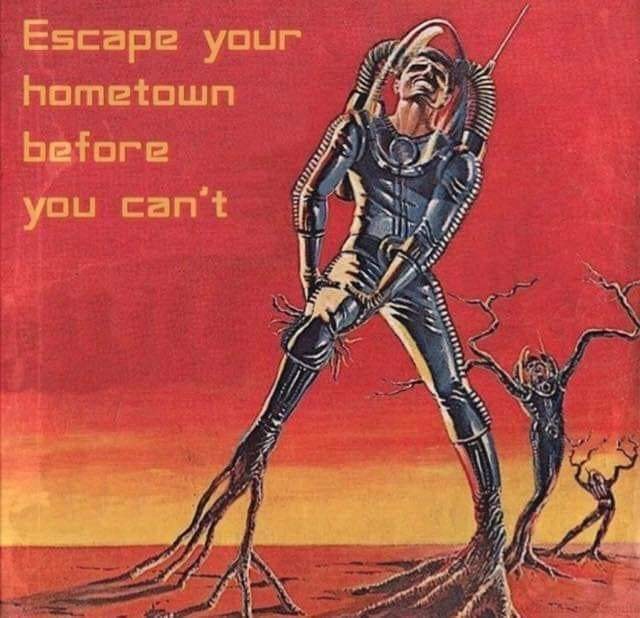
In the context of urbanism or neighborhood life, this meme suggests that you must leave your current home or living area before you lose the ability to afford rent or maintenance. It translates the sci-fi visual of a character stranded on a dead, ruined planet into the metaphorical danger of being evicted or homeless. The text warns that you have to "escape" your "hometown" before you physically lose the property you occupy.
simple-description (llama3.2-vision_11b)
The meme is a play on the phrase "Escape from New York," but instead of escaping from a city, it's about escaping from a rural or suburban area to a city. The image likely features a person in a futuristic or sci-fi setting, with the phrase "Escape your hometown" written in a bold, futuristic font.
detailed-analysis (gemma3-27b-vision)
Okay, let's break down this striking image with the requested critical lenses.
Visual Description
The image appears to be a vintage-style science fiction illustration, reminiscent of mid-20th century pulp magazine covers. A figure clad in a sleek, dark, futuristic spacesuit or diving suit struggles to lift their feet from a network of thick, grasping, root-like tentacles. The tentacles rise from a cracked, reddish-brown landscape, suggesting barren earth or a dystopian environment. The color scheme is dominated by reds and dark blues, creating a sense of danger and urgency. A smaller, similar, yet less fully formed figure can be seen in the background, seemingly emerging from the root system. Text overlays the image: "Escape your hometown before you can’t." The composition is dramatic, with the central figure occupying a large portion of the frame, emphasizing their struggle.
Foucauldian Genealogical Discourse Analysis
This image powerfully evokes Foucault’s concepts of power and discourse. The roots can be interpreted as a metaphor for the discourses that produce us – the systems of knowledge, norms, and expectations that shape our identities and limit our possibilities. The "hometown," and by extension, the origins and traditions it represents, function as a disciplinary force. These roots grip the figure, symbolizing the ways in which familial, societal, and cultural expectations bind us. The suit represents a possible attempt at escaping this control—to construct a different self, however, this attempt is still entangled within those roots.
Foucault would be interested in the genealogy of this image itself—how did this particular visual representation of escaping origins come about? What historical conditions and power dynamics informed its creation? The very act of urging "escape" can be analyzed as a discourse that reinforces the idea that origins are something to escape from, thereby contributing to the problem it proposes.
Critical Theory
From a Critical Theory perspective, this image critiques the oppressive forces of tradition and social structures. The figure’s struggle is symbolic of the alienation and dehumanization experienced by individuals in a society that prioritizes conformity over individuality. The image suggests that “home” and “origin” can become sources of constraint rather than belonging.
The roots represent the weight of societal expectations and the limitations placed upon individuals by their upbringing. The figure's attempt to break free can be seen as an act of resistance against these oppressive forces. Critical Theory would likely see the text as a call to liberation—a challenge to question and dismantle the structures that hold us back.
Marxist Conflict Theory
While less explicitly Marxist than some imagery, this image can be viewed through the lens of class and historical materialism. The "hometown" can represent the traditional, often conservative, forces that maintain the status quo, inhibiting social change. The roots can be viewed as the inherited power structures and ideologies that perpetuate inequality.
The figure's struggle embodies the class conflict inherent in challenging these structures. It suggests that escaping the limitations of one's origins—whether economic, social, or ideological—is a necessary step towards liberation. The attempt to break free is a struggle against a system that seeks to keep individuals tethered to their predetermined roles. The smaller figure emerging from the roots could be read as the next generation, inheriting these constraints and potentially perpetuating the cycle.
Postmodernism
From a postmodern perspective, the image deconstructs the notion of a stable, authentic self rooted in a specific place or origin. The futuristic suit and alien landscape challenge traditional notions of identity and belonging. The figure is not simply escaping a physical place, but a set of narratives and expectations that have been imposed upon them.
The image embraces the idea of fragmentation and instability. The roots are not necessarily negative, but simply a part of the complex web of forces that shape our identities. The act of escape is not about achieving a final, complete liberation, but about embracing the ongoing process of self-creation and challenging fixed categories. The image subverts the idea of "home" as a source of comfort and security.
Queer Feminist Intersectional Analysis
From a queer feminist intersectional perspective, the image becomes particularly potent. The roots could represent the deeply ingrained patriarchal and heteronormative structures that constrain individuals who deviate from traditional norms. For those who do not fit neatly into societal expectations based on gender, sexuality, or other identities, "home" and "origins" can often be sites of oppression and trauma.
The struggle to break free from the roots can be interpreted as a metaphor for the ongoing fight for liberation from these oppressive structures. The futuristic suit represents a possibility for constructing alternative identities and challenging fixed categories. The smaller figure emerging from the roots could represent a new generation seeking to create a more inclusive and equitable society. The intersectionality of this struggle highlights the ways in which multiple forms of oppression intersect and reinforce each other. For individuals at the margins, escaping the constraints of one’s origins is not just a personal journey, but a political act.
I hope this breakdown is helpful! Let me know if you’d like me to elaborate on any specific aspect.
simple-description (llama3.2-vision)
The meme is a play on the phrase "Escape from New York" but with a sci-fi twist. The image depicts a person in a futuristic spacesuit, surrounded by a desolate and barren landscape, with the caption "Escape from New York... to Mars" or "Escape from New York... to the Moon" (the exact text is not specified, but it's a play on the original phrase).
tesseract-ocr
Escape your Vee arstutetds lth / v7 Wy sha) ar] EIT Z® ot | Se + ‘