First Seen
2023-10-31T21:21:39+00:00
simple-description (qwen3.5_2b-q8_0)
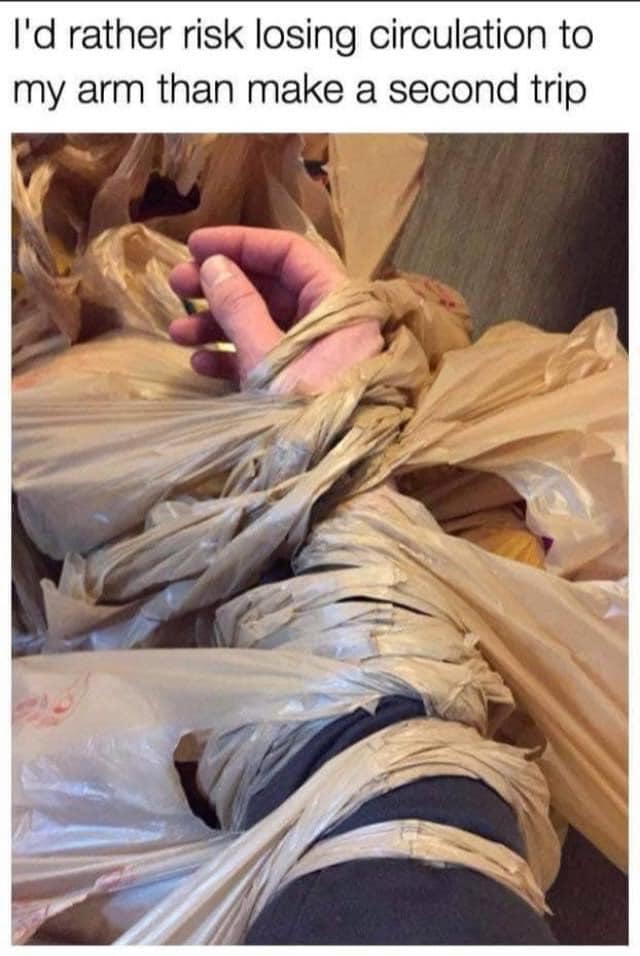
This image captures a relatable, humorous scenario found in everyday city life, specifically the chaotic struggle of trying to get groceries. The text explains a relatable moment of urban desperation, where the person humorously prefers to stay stuck in a tangled bag situation rather than leave and perhaps get back in a similar predicament.
simple-description (llama3.2-vision_11b)
The meme is a humorous image of a person's hand stuck in a plastic bag, with a caption that pokes fun at the idea of being stuck in a situation. The text "I'd rather risk getting stuck in a plastic bag than... " is implied, but the rest of the sentence is not shown.
detailed-analysis (gemma3-27b-vision)
Okay, let's break down this image and its accompanying text through the requested theoretical lenses. It's a quirky and somewhat absurd image, so applying all lenses isn't necessarily fully fitting, but we'll explore where they do apply.
Visual Description
The image shows a person’s arm completely bound and swaddled in a multitude of plastic grocery bags. The bags are crumpled, twisted, and overlapping, creating a dense cocoon around the arm. The lighting is warm, making the plastic appear somewhat golden. The person’s hand is visible at the top, appearing to be in the process of tightening or further wrapping the bags. The second image, a close-up, is the same scene but shows the plastic bags very closely and emphasizes the tight and constricting layers. The text overlay reads: "I'd rather risk losing circulation to my arm than make a second trip." The scene conveys a sense of playful exasperation and extreme aversion to returning to a place (presumably a store) for forgotten items. The visual is starkly humorous due to the extreme and unnecessary measure taken to avoid a simple task.
Foucauldian Genealogical Discourse Analysis
This image offers a subtle, yet intriguing point of entry for a Foucauldian analysis. The act of wrapping and binding is intrinsically linked to power dynamics. In a broader historical context, binding can represent control, confinement, discipline, and even punishment. Think of historical constraints on bodies (corsets, restraints) or the ways in which institutions (prisons, asylums) function through bodily regulation.
Here, the wrapping isn’t necessarily imposed (the person is seemingly doing it to themself), but it functions as a self-discipline. The person chooses discomfort (potential loss of circulation) over the perceived burden of making another trip. This "burden" is constructed through discourse - societal norms surrounding efficiency, convenience, and the avoidance of inconvenience. The discourse of consumerism tells us we should get everything in one go, and this person is rebelling against that expectation by enacting a dramatically absurd solution. The plastic bags themselves become a symbol of that consumerist discourse, ironically used to resist it. The genealogy could trace the historical shift in expectations around shopping, the rise of convenience culture, and how these things have shaped our relationship to tasks and discomfort.
Critical Theory
This image aligns well with the tenets of Critical Theory, particularly the Frankfurt School’s focus on the commodification of everyday life and the resulting alienation. The plastic bags, as symbols of consumer culture, are not just tools for carrying goods, but indicators of a system that prioritizes accumulation and efficiency at the expense of simple human experiences.
The act of wrapping oneself in the bags can be seen as a form of protest – albeit a quirky one. The person is rejecting the logic of “doing more with less,” of maximizing convenience, and actively choosing discomfort. It's a symbolic rejection of the relentless pressure to optimize, to be efficient, and to conform to the demands of consumerism. The visual emphasizes the absurdity of the situation, highlighting how far we’ll go to avoid minor inconveniences in a society built around maximizing efficiency.
Marxist Conflict Theory
While not a primary fit, a Marxist reading can find purchase here. The plastic bags, produced through capitalist labor, become an ironic symbol of resistance. They represent the products of exploitation, yet are used to create a personal barrier against the demands of the capitalist system (the perceived “burden” of another shopping trip).
The “conflict” is not a grand class struggle, but a micro-level conflict between the individual and the demands of consumer culture. The person is saying, "I would rather endure a physical discomfort than participate in the system (another shopping trip) that produces these bags and sustains the cycle of consumption." It's a tiny act of rebellion against the commodification of time and effort.
Postmodernism
This image is very much in line with postmodern sensibilities. The absurdity, the playfulness, and the rejection of grand narratives all resonate with postmodern themes. The image doesn’t offer a solution or a profound statement; it simply is. It's a deliberately nonsensical act, a playful deconstruction of everyday expectations.
The image also plays with the concept of simulacra. The plastic bags are not their intended use, but are employed as a bizarre substitute for…well, doing another trip. It's a blurring of boundaries and a rejection of functional logic. The irony is key – the solution is far more cumbersome and inconvenient than the problem it’s supposedly solving. The image revels in its own illogicality.
Queer Feminist Intersectional Analysis
This is the least obvious fit, but can be stretched to explore certain points. Feminist theory often analyzes the ways in which women are expected to manage domestic labor and emotional work. In this case, the "second trip" can be seen as representing the disproportionate burden often placed on women to manage household tasks and "fix" oversights. The person’s extreme reaction (wrapping themself in plastic) could be interpreted as a hyperbolic expression of exhaustion and resistance to these expectations.
Intersectional analysis would also acknowledge the potential intersections of gender with other identities (class, race, etc.) that might shape the experience of this everyday burden. The image challenges normative expectations around convenience and efficiency, potentially offering a space for subverting those norms. It's not a direct analysis of oppression, but a playful disruption of expected behavior.
I hope this detailed breakdown is helpful! Let me know if you'd like me to elaborate on any particular point or theoretical lens.
simple-description (llama3.2-vision)
This meme is a humorous image of a person's arm stuck in a garbage can, with a trash can lid on top of their arm, and a note that says "I'd rather die than get my arm stuck in a garbage can... said no one ever". The text above the image reads "I'd rather die than get my arm stuck in a garbage can... said no one ever".
tesseract-ocr
I'd rather risk losing circulation to my arm than make a second trip eV ve A A @ - Sn f ™~ x ' ee di ~ | ~—ae= ae af ae : i = eae) 3 es LF -—