First Seen
2023-12-17T04:17:41+00:00
simple-description (qwen3.5_2b-q8_0)
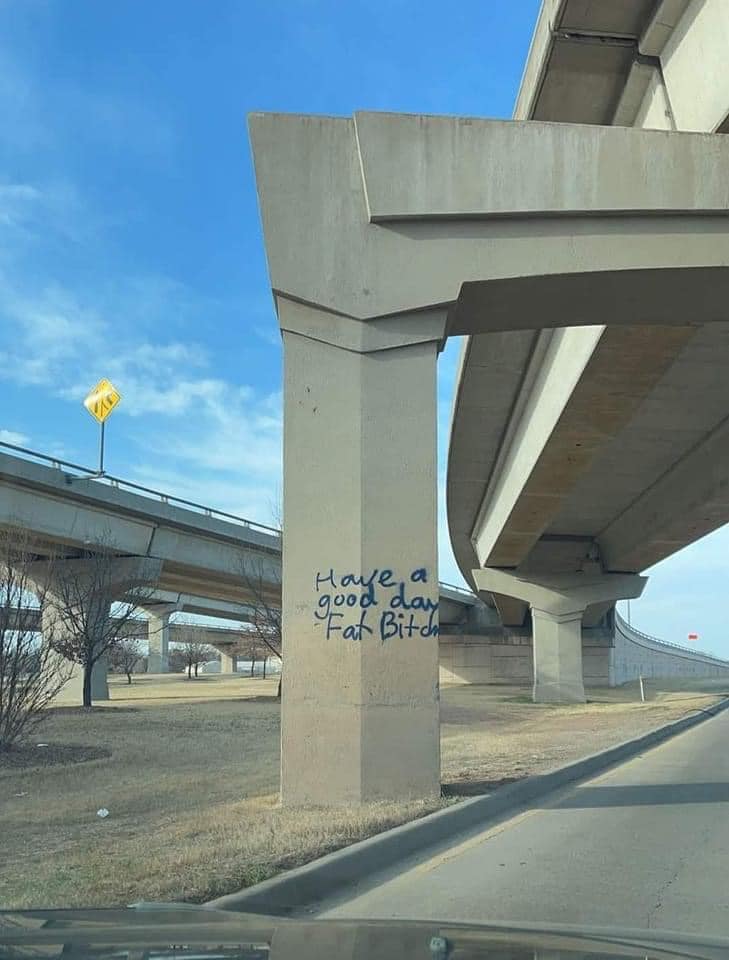
This spray-painted graffiti is written on a massive concrete highway support pillar, which is a fundamental component of urban infrastructure. It represents the use of public buildings and roadways as a canvas for street art and social commentary. From the perspective of urbanism, the concrete structure—typically viewed as a utilitarian element—has been repurposed by the public to deliver the offensive slang term "Fat Bitch," creating a ironic and rebellious dialogue about beauty standards.
simple-description (llama3.2-vision_11b)
The meme is a photo of a highway overpass with a graffiti tag that reads "Have a nice day, f**k you". The text is written in a childish, sloppy handwriting style, which adds to the humor and irony of the situation.
detailed-analysis (gemma3-27b-vision)
Okay, here's an analysis of the image, broken down into the requested sections, where applicable. I'll explain why certain sections aren't relevant too.
Visual Description
The image depicts a concrete support pillar for an elevated highway/overpass. The pillar is a pale beige/tan color and is relatively clean, though has some staining/wear from exposure to the elements. The pillar is prominently featured in the foreground, partially obscuring the view of the highway above. Graffiti, written in dark blue or black ink, is visible on the pillar reading, “Have a good day, Fat Bitch.”
The surrounding landscape consists of dry, brown grass and a few bare trees, suggesting either late autumn/early spring conditions or an arid climate. The sky is blue with scattered white clouds. The image appears to be taken from inside a vehicle, likely a car, as a portion of the dashboard and windshield are visible at the bottom of the frame. The overall aesthetic is somewhat stark and utilitarian, with the concrete structure dominating the scene.
Foucauldian Genealogical Discourse Analysis
This image is ripe for Foucauldian analysis. The graffiti isn’t simply a message; it’s a discourse enacting power relations.
- Power/Knowledge: The inscription demonstrates how language is not neutral but is deeply intertwined with power. The seemingly innocuous phrase "Have a good day" is immediately undermined and rendered aggressive through the addition of “Fat Bitch.” This demonstrates how certain categories (like "fat" in this context) are historically constructed and used to exert control and discipline. The graffiti isn’t about wishing someone well; it’s about defining and degrading through labeling.
- Genealogy of "Fat": Tracing the historical emergence of the term "fat" reveals it isn’t a purely descriptive term, but one loaded with moral judgment, associating it with laziness, lack of self-control, and inferiority. The inscription taps into this historical discourse. It is a way of marking an “other” and attempting to exert power by invoking these historical judgements.
- Discipline and Normalization: The graffiti can be read as an attempt to discipline and normalize bodies. By highlighting “fatness” with an insult, it reinforces dominant, often unattainable, standards of beauty and body size. The perpetrator seeks to reinforce the 'normal' through the shaming of the "other".
- The Concrete Structure as a Site of Power: The very infrastructure of the overpass represents an exercise of power – control over movement, spatial organization, and the imposition of a built environment. The graffiti, written on this structure, becomes a counter-discourse, an attempt to disrupt or reclaim a space dominated by established power.
Queer Feminist Intersectional Analysis
This image is exceptionally fertile ground for queer feminist intersectional analysis, due to the ways it embodies interconnected systems of oppression.
- Misogyny and Body Shaming: The use of "bitch" is inherently misogynistic, historically deployed to control and demean women. Combined with the body shaming (“fat”), it's a potent combination targeting a marginalized subject. The graffiti is not simply about weight; it is an attempt to assert dominance over a perceived other.
- Intersectional Oppression: The intersection of gender, body size, and potentially other marginalized identities is key here. This message doesn't just target someone because of their weight; it targets someone as a woman and reinforces the societal pressure to conform to unrealistic beauty standards. The “fat bitch” is more than simply a description; it represents a complex web of intersecting oppressions.
- Subversion and Reclamation: Despite the aggression, graffiti can be an act of resistance. In some contexts, reclaiming derogatory terms can be a form of empowerment. While the intent of this graffiti is clearly harmful, its very presence on a public structure challenges the dominance of mainstream discourses. The act of tagging itself can be a defiant assertion of agency, even within a hostile environment.
- Spatial Politics: The graffiti's location – on a massive concrete structure that dictates the movement of traffic – can also be analyzed through a spatial lens. Public spaces are often sites of control and surveillance, and graffiti can be seen as a way of disrupting this control and reclaiming space for marginalized voices.
Marxist Conflict Theory
While not the most prominent lens, Marxist Conflict Theory can still be applied.
- Power Dynamics & Class: The placement of the graffiti on a piece of public infrastructure can be seen as a manifestation of class conflict. The overpass is a symbol of capital investment and the control of transportation – tools used to maintain the existing power structure. The graffiti, as an act of vandalism or resistance, can be interpreted as a challenge to this structure.
- Alienation & Discontent: The aggressive and demeaning nature of the graffiti could be seen as a symptom of broader social alienation and discontent. In a capitalist system, individuals may feel powerless and marginalized, leading to outbursts of anger and frustration. While this is a limited interpretation, it suggests that the graffiti is not an isolated incident but a reflection of deeper social tensions.
- Control of Public Space: The graffiti's location on public infrastructure can be seen as a struggle for control over public space. The state and corporations invest in these structures to facilitate commerce and control movement, while the graffiti represents a counter-claim, an attempt to re-purpose the space for alternative meanings.
Critical Theory
This image readily lends itself to analysis through the lens of Critical Theory.
- Ideology & Hegemony: The graffiti challenges dominant ideological norms around body image and gender. It exposes the underlying power structures that perpetuate these norms and attempts to reinforce them through linguistic violence.
- Commodification of the Body: The critique of body shaming relates to the broader commodification of the body in contemporary society. The graffiti reinforces the pressure to conform to idealized body standards that are often promoted by advertising and the media.
- The Role of Language: Critical Theory emphasizes the role of language in shaping our perceptions and reinforcing power relations. The use of a derogatory term like “bitch” highlights the ways in which language can be used to objectify and devalue individuals.
Not Applicable Sections
Postmodernism: While elements could potentially be stretched to fit a postmodern framework (deconstruction of meaning, challenging grand narratives), it isn’t a particularly strong fit. The image doesn't inherently rely on irony, pastiche, or self-referentiality in a way that makes a postmodern analysis the most fruitful.
Let me know if you'd like me to elaborate on any of these sections or explore a different theoretical framework!
simple-description (llama3.2-vision)
The meme is a photo of a highway overpass with a graffiti tag on the side of the structure. The text reads "Have a nice day" in a sarcastic, illegible handwriting style, implying the opposite sentiment. The phrase is meant to be ironic and humorous, poking fun at the idea of expressing goodwill in a public space.
tesseract-ocr
i 4 } i ee ~~ | Ad i" | Howea AS He Gook Ag ; bie he Pe Be is a Le ee = Ve ee z : = wo “ — a yi