First Seen
2023-12-16T19:43:55+00:00
simple-description (qwen3.5_2b-q8_0)
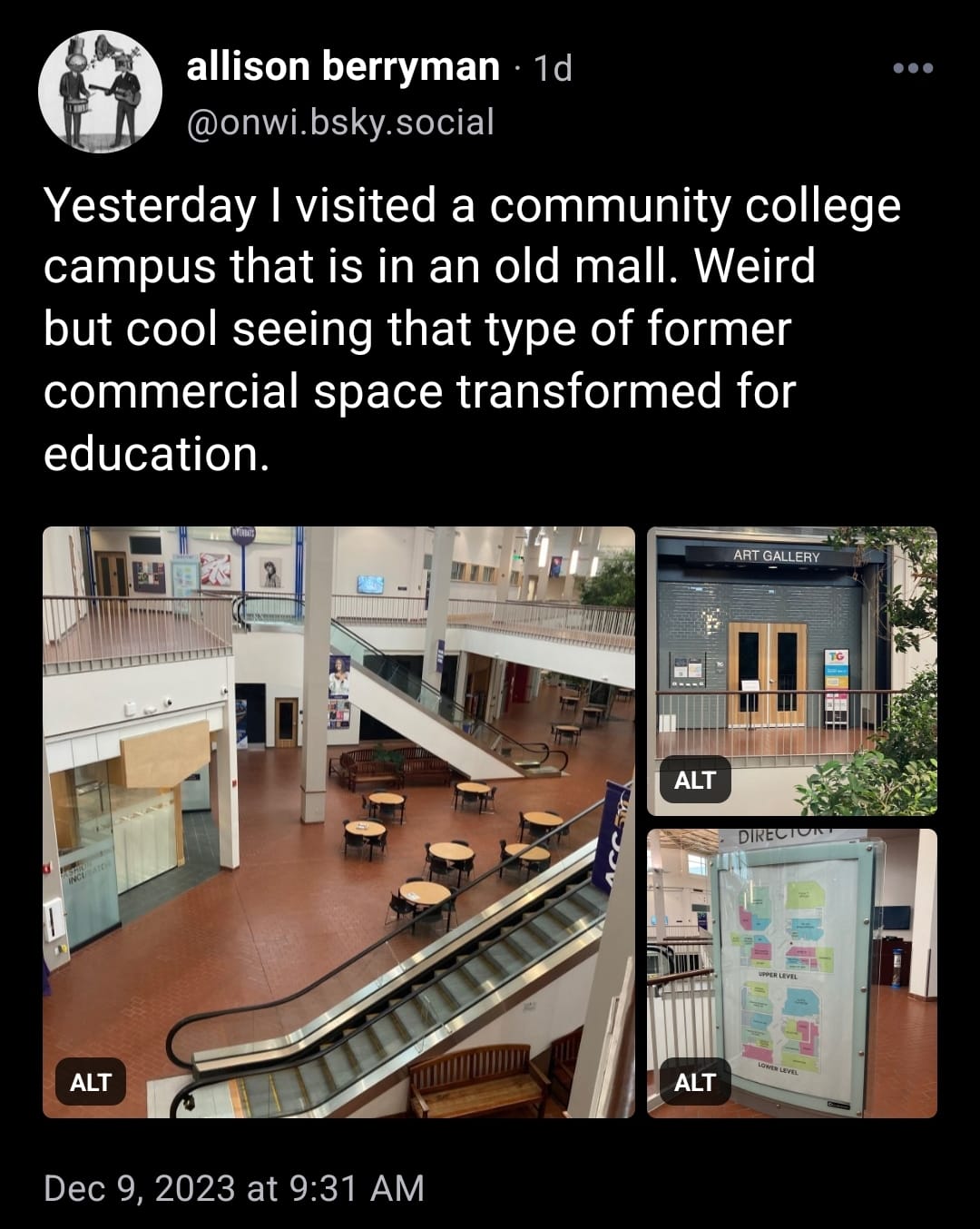
From an urbanist's perspective, this image illustrates the concept of adaptive reuse, where a traditional shopping mall is repurposed as a community college campus. The photo reveals the old mall architecture transformed into a multi-level atrium featuring wooden floors, communal seating, and large escalators. The inclusion of "ALT" buttons on the smaller photos indicates that the space is designed for accessibility, clearly organizing the area into distinct zones like an Art Gallery and a Directory.
simple-description (llama3.2-vision_11b)
The meme is a humorous observation about the contrast between the modern, tech-savvy environment of a community college and the nostalgic, outdated atmosphere of a traditional mall. The text accompanying the image reads: "I went to my community college and I realized it's actually just a mall that got converted into a school." The meme pokes fun at the idea that a community college can be mistaken for a shopping mall, highlighting the blurring of lines between education and commercial spaces.
detailed-analysis (gemma3-27b-vision)
Okay, here's an analysis of the image and the accompanying caption, broken down into sections as requested. I'll only include the headings where the analysis is truly applicable.
Visual Description
The image presents a repurposed interior space, clearly once a shopping mall. We see a multi-level concourse with the remnants of mall architecture – tiled floors, railings, and structural columns. The escalator is a prominent feature, still in place but no longer directing shoppers. The space is now populated with student-style seating—small round tables and chairs scattered throughout. There’s a sign for an "Art Gallery" visible, and another for a "Directory." The color palette is muted with beige, peach, and gray tones, punctuated by the darker tones of the seating. The image feels open and airy, despite being indoors. There's a sense of an attempt to humanize a previously sterile commercial space.
Foucauldian Genealogical Discourse Analysis
The image powerfully illustrates Foucault’s concept of heterotopias—spaces that are other to the surrounding norm, simultaneously existing inside and outside of it. The mall, traditionally a space of consumption and leisure, has been re-sited as a space of education. This repurposing isn't simply a change in function, but a change in discourse.
- Disciplinary Power: The mall originally functioned through the panoptic power of constant surveillance (security cameras, store employees) aimed at encouraging consumption. Now, the layout still exists, but the power dynamics have shifted—it’s about knowledge production and evaluation, rather than purchasing power. It's a shift, but it's not complete; the layout remembers its original function.
- Genealogy of Control: Looking at the "genealogy" of this space reveals how control has been redefined. Instead of controlling the spending of individuals, the space now seeks to shape their minds. The escalator, once facilitating the flow of customers, now facilitates the flow of students. The directory, once guiding shoppers, now guides learners.
- Truth & Power: The space implicitly argues that education can exist in unexpected places, even outside of the traditional campus model. This challenges the "truth" of what constitutes a legitimate learning environment. The image, in its very visual form, is part of a larger discourse about access to education and the repurposing of infrastructure.
Critical Theory
This image evokes themes prominent in Critical Theory, specifically regarding the built environment and social control.
- Spatial Dialectic: The image exemplifies the idea that space is not neutral. The mall was designed to induce a specific behavior (consumption). Now, the same space seeks to induce a different behavior (learning). The built environment shapes our actions and ways of thinking.
- Commodification of Space: The mall was a highly commodified space, everything was for sale. Transforming it into a learning environment attempts to de-commodify it, offering a "public good" (education) within the shell of a commercial enterprise. However, it’s important to question whether the underlying logic of commodification is truly absent. Does the space still subtly encourage a certain type of learning or student?
- Habitus: The space evokes the "habitus" (Bourdieu) of both consumption and learning. Students may unconsciously carry the habits and expectations of a consumerist environment into their educational experience—and vice versa.
Postmodernism
The image speaks directly to postmodern sensibilities:
- Pastiche & Hyperreality: The space is a collage of former and current functions—a "pastiche" of the mall and the college. It's not a pure educational space; it retains elements of its former self. This creates a sense of "hyperreality"—a simulation of both the mall and the college.
- Deconstruction: The image "deconstructs" the traditional idea of what a college campus should look like. It challenges the assumed boundaries between commercial and educational space.
- Fragmentation: The image itself is fragmented—multiple photos offering different perspectives on the space. This reflects a postmodern distrust of grand narratives and totalizing systems.
Let me know if you'd like me to delve deeper into any of these areas or explore other potential analytical frameworks!
simple-description (llama3.2-vision)
The meme is a screenshot of a university's website, featuring a photo of an empty, old-looking student union building with a sign on the wall that reads "Student Union - Closed for Renovations". The caption reads: "Just went to my old college's student union and it's just a big empty room with a sign that says 'closed for renovations' 5 years ago".
tesseract-ocr
F& allison berryman - id eee ir @onwi.bsky.social Yesterday | visited a community college campus that is in an old mall. Weird but cool seeing that type of former commercial space transformed for education. | ty ila | | a anh ites ay eee ne 7 7, _ al an oS eee _ ae PL ET pe a -t. ma! Ze JM | 2 teat eRe ed | eo se ber Syess DIRECTV ] fet aa = ba 7 y Bn me i] A a Dec 9, 2023 at 9:31 AM