First Seen
2024-04-11T06:03:18.216811+00:00
simple-description (qwen3.5_2b-q8_0)
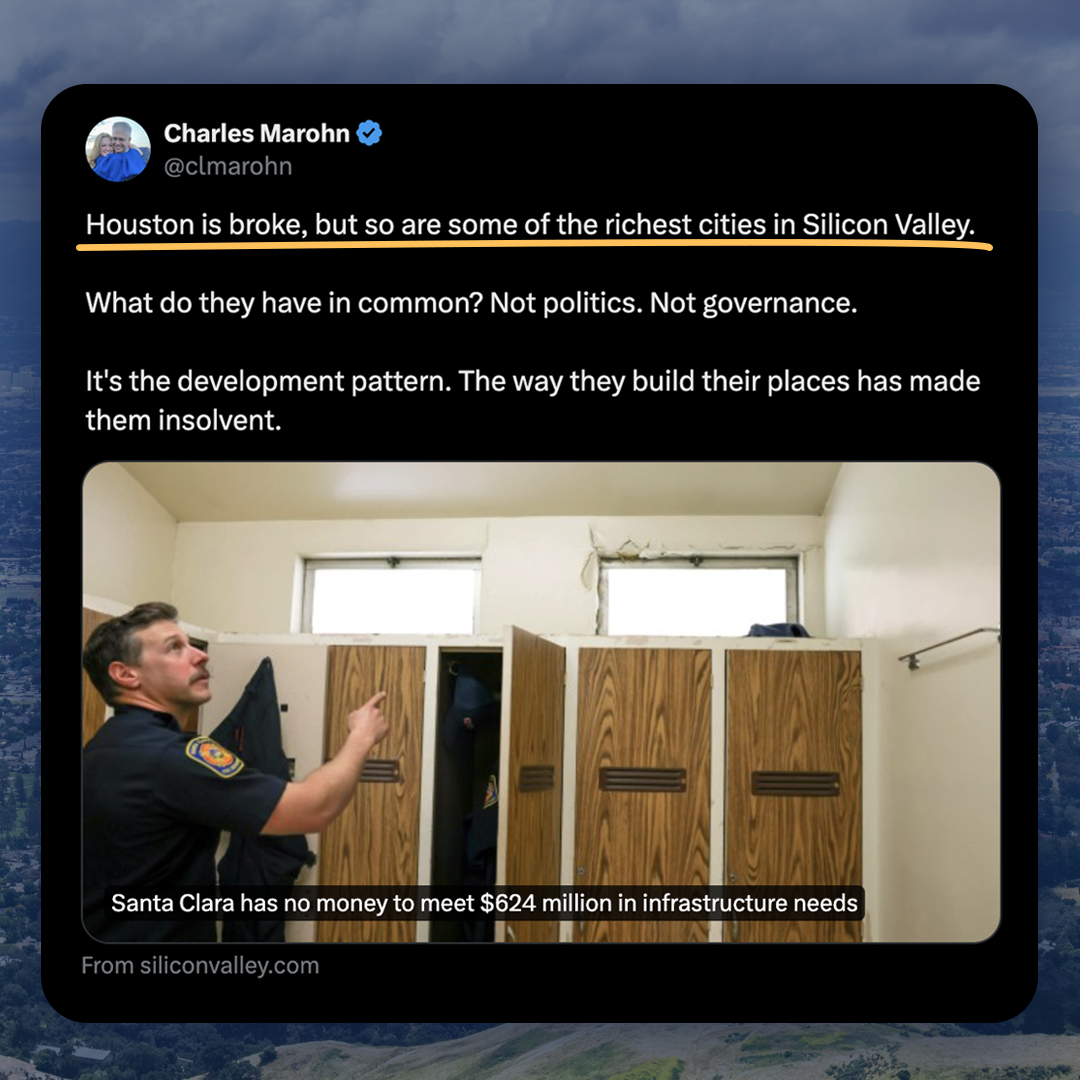
This urbanism meme argues that the physical layout and quality of public buildings—not politics or governance—are the primary causes of financial ruin in these cities. It suggests that developers who rush to build cheap, outdated facilities for cities like Silicon Valley and Santa Clara create a structural debt that becomes insolvent. The accompanying photo reinforces this by showing a grim, dated locker room, serving as a stark visual warning that the city's infrastructure has no money left to meet its needs.
simple-description (llama3.2-vision_11b)
The meme is a screenshot of a tweet by Twitter user @clmarohn, where he expresses frustration with the lack of resources in the city of San Jose, California, and compares it to Houston, Texas, which has a more developed infrastructure. The tweet reads: "San Jose is like Houston is not. San Jose is like Detroit is not. San Jose is like St. Louis is not. San Jose is like Cleveland is not."
detailed-analysis (gemma3-27b-vision)
Okay, here's an analysis of the tweet and accompanying image, broken down into sections as requested. Note that some sections will be more applicable than others, and certain interpretations are subjective, fitting within the frameworks.
Visual Description
The tweet features a photo of a man, presumably Charles Marohn (based on the Twitter handle), standing in front of a row of closed, dark wooden doors. The doors appear to be fire doors or access points, and are set into a beige or light-colored concrete wall. The setting seems to be inside a large, institutional building – potentially a parking structure or a service area. The lighting is somewhat dim, and the doors themselves create a slightly ominous or cavernous effect. The image is accompanied by text overlaid on a dark background: "Santa Clara has no money to meet $624 million in infrastructure needs." The larger Twitter post indicates a comparison between Houston and Silicon Valley, claiming infrastructure patterns cause insolvency.
Foucauldian Genealogical Discourse Analysis
This image and text lend themselves well to a Foucauldian analysis. The "infrastructure" isn’t simply concrete and steel, but a discourse that shapes power relations and knowledge.
- Archaeology of Knowledge: The tweet implies a historical shift in how places are built. The “development pattern” isn’t a neutral technical issue; it’s a product of specific discourses around growth, investment, and profit. The tweet highlights the consequences of prioritizing certain modes of building over others.
- Power/Knowledge: The fact that Santa Clara has the problem of needing $624 million in infrastructure suggests a specific configuration of power. This could mean a reliance on certain types of development (e.g., high-tech campuses needing extensive roadways and utilities) that were driven by a particular economic ideology. The knowledge of this infrastructure need isn’t necessarily neutral. It’s often framed by experts (engineers, planners, developers) who themselves operate within these power structures.
- Genealogy: Marohn, through this tweet, is tracing a history of how these development patterns came to be. He's suggesting that the current insolvency isn’t an accident, but a result of a historical trajectory of choices and decisions made over time.
The doors themselves could be symbolic of closed-off possibilities – the lack of funding shuts off the potential for necessary infrastructure improvements.
Critical Theory
From a Critical Theory perspective, this tweet points to the inherent contradictions within late capitalist urban development.
- Reason and Domination: The “development pattern” – presumably a model prioritizing short-term profit and unsustainable growth – is presented as "rational" from a purely economic standpoint. However, the tweet suggests that this "rationality" leads to domination – the domination of infrastructure needs over fiscal responsibility, and ultimately, the domination of economic imperatives over public well-being.
- Commodification: This tweet implies that the city has been built based on commodification. Everything has a monetary value and the needs of those who don’t add monetary value get ignored.
- Alienation: The tweet suggests that the infrastructure isn't serving the community. The doors, representing a lack of access, are representative of alienation from the infrastructure that the community needs.
Marxist Conflict Theory
From a Marxist lens, this tweet can be interpreted as evidence of the contradictions inherent in capitalism.
- Class Struggle: While not explicitly stated, the tweet indirectly touches upon class dynamics. The "development pattern" likely benefits a certain class – developers, landowners, tech companies – while the burden of the infrastructure costs falls on the public. The closed doors could represent the barriers to access and resources faced by the working class.
- Capital Accumulation: The unsustainable development pattern is driven by the relentless pursuit of capital accumulation. The focus on short-term profits leads to neglect of long-term infrastructure needs.
- Exploitation: The building of unsustainable infrastructure is exploitation. The current unsustainable building practices are built for short-term profits while the city and the community will be paying for it in the long run.
Postmodernism
While the tweet doesn't scream "postmodernism," some elements resonate with that framework.
- Meta-Narratives: The tweet challenges the meta-narrative of "growth is always good." It suggests that the conventional wisdom about economic development is flawed.
- Deconstruction: The tweet deconstructs the idea of a "rational" development pattern. It reveals the hidden costs and contradictions within that system.
- Simulacra & Simulation: The "development pattern" could be seen as a simulacrum – a copy without an original. It’s a system of building that’s divorced from genuine community needs and sustainable practices.
Queer Feminist Intersectional Analysis
This is the least directly applicable framework, but some intersections can be explored.
- Access & Exclusion: The closed doors are a visual metaphor for exclusion. Feminist and queer analyses often focus on how spaces are designed to exclude certain groups. The lack of infrastructure can disproportionately affect vulnerable populations.
- Care Work & Infrastructure: Feminist theorists often emphasize the importance of "care work" and social infrastructure. The failure to invest in basic infrastructure can be seen as a devaluation of care and a neglect of the needs of marginalized communities.
- Interlocking Systems of Oppression: The tweet, while not explicitly addressing gender or sexuality, highlights the ways in which economic systems intersect with other forms of oppression. For instance, the lack of affordable housing (a result of unsustainable development) can disproportionately affect women, people of color, and LGBTQ+ individuals.
I hope this comprehensive breakdown is helpful! Let me know if you'd like me to elaborate on any of these sections.
simple-description (llama3.2-vision)
The meme is a screenshot of a tweet from a Twitter user named @NotMyTaxBill, showing a photo of a police officer standing in front of a row of lockers, with a caption that reads: "I'm a cop, not a janitor."
tesseract-ocr
mo Charles Marohn ‘ @clmarohn Houston is broke, but so are some of the richest cities in Silicon Valley. What do they have in common? Not politics. Not governance. It's the development pattern. The way they build their places has made > them insolvent. : — ———— P ot = - ; 4 | | j my i ' " h \\) 4 } 5 Cs j ! Wl hn \) 4 = , — A it f \ Hue | H fy WW t AWE | | Yall \ hi’ DN UA ESA Er Tal ROMA MaMa MCN ta ctel ae LoVe Mal eam AM Nie RL CCU CesU CMa I -Le hs Seni NT Mb NST From siliconvalley.com le se 4 ee Se Ke 55 berries a