First Seen
2023-05-10T21:03:42+00:00
simple-description (qwen3.5_2b-q8_0)
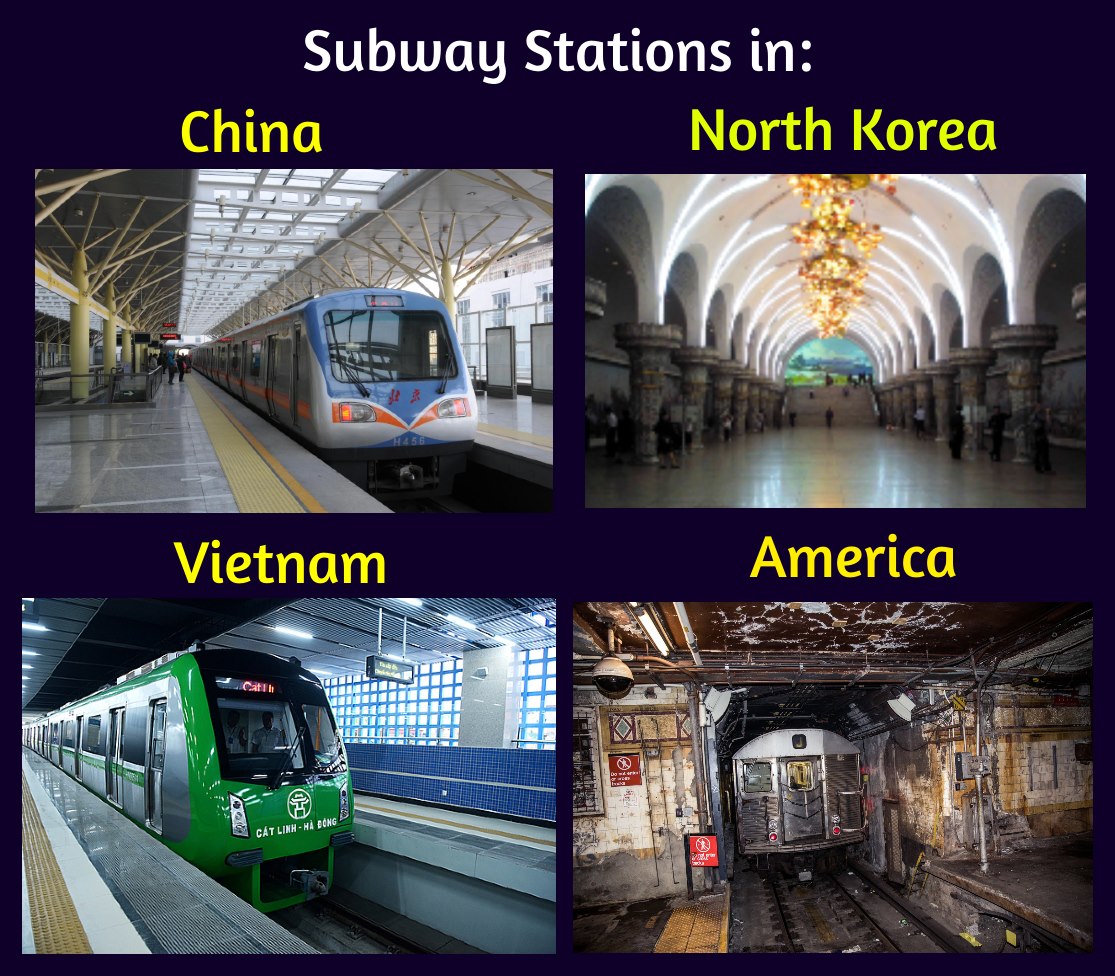
This visual meme contrasts the varying states of public transportation infrastructure across different nations to highlight how urban transit systems evolve over time. The top-left corner shows a modern, brightly lit train station in China, while the top-right features the grand, marble-floored station of North Korea. In the bottom row, the image places a relatively clean green train from Vietnam next to a grimy, industrial-looking American subway, underscoring the diversity and often deteriorating nature of these historic urban systems.
simple-description (llama3.2-vision_11b)
The meme is a humorous comparison between the underground transportation systems of two cities, with a caption implying that one city's subway system is more...underground than the other. The image likely shows a stark contrast between the cleanliness and modernity of a typical Western subway station (e.g. New York City's subway) and a rundown, decrepit station in a city like Pyongyang, North Korea.
detailed-analysis (gemma3-27b-vision)
Okay, let's break down these subway station images using the requested theoretical frameworks. I'll cover each section only if the imagery lends itself to that analysis.
Subway Station Analysis: A Multi-Theoretical Approach
Visual Description
Here’s a breakdown of the visual characteristics of each image:
- China: A bright, modern station with a vaulted ceiling reminiscent of traditional architecture but executed with modern materials. The lighting is abundant, and the station appears clean and spacious. The train is sleek and colorful, appearing fairly new.
- North Korea: This station is strikingly ornate and grandiose. It features arched ceilings with elaborate light fixtures resembling crystal chandeliers. The overall impression is one of over-the-top display and a sense of almost cathedral-like solemnity. The people appear as figures within this spectacle.
- Vietnam: A more functional and modern design, but with a touch of color in the green train. The station is clean, lit by neon lights, and appears to serve a practical purpose. The materials seem more utilitarian, but still in good repair.
- America: A stark contrast to the others. This station appears old, weathered, and neglected. The lighting is dim, and the walls are covered in graffiti and discoloration. There’s a palpable sense of decay and a lack of maintenance.
Foucauldian Genealogical Discourse Analysis
This framework lends itself most strongly to understanding the power dynamics expressed through the design and representation of these spaces.
- Discipline & Surveillance: Subway stations are, by their nature, sites of controlled movement and potential surveillance. The American station, with its visible decay, might suggest a breakdown in the mechanisms of control. The other stations, especially North Korea’s, seem to enforce a specific order through the sheer awe-inspiring nature of the space. It's a subtle form of control—shaping behavior through the emotional effect of the environment.
- Genealogy of Space: Examining the history of subway systems and their evolution reveals how these spaces have been constructed to serve particular social and political ends. The Chinese station's blending of traditional and modern aesthetics speaks to the nation's attempt to project a particular image of itself – a technologically advanced country rooted in its heritage. The American station, conversely, is a testament to decades of disinvestment in public infrastructure.
- Normalization: Subway stations contribute to normalizing certain behaviors (e.g., orderly queuing, deference to authority). However, the American station—with its graffiti and signs of disorder—might represent a space where normalization breaks down.
Critical Theory
Critical Theory focuses on how systems of power and domination are embedded in social structures.
- The Public Sphere: Subway stations are theoretically public spaces, but the degree to which they genuinely function as open arenas for dialogue and exchange varies significantly. The North Korean station, with its imposing grandeur and likely tight security, severely restricts the public sphere. The American station might function as a more chaotic, unregulated public space, but it is also a space of marginalization and social exclusion. The China and Vietnam stations represent spaces in between.
- Commodification and Urban Space: Subway systems are often subject to privatization and commercialization. The degree of advertising and branding within these stations (not visible in these images) can reveal the extent to which public space is being turned into a marketplace.
- Alienation and Modernity: The subway system, as a feature of modern urban life, can contribute to feelings of alienation and anonymity. The American station particularly embodies this – a sense of being lost and disconnected within a vast, impersonal system.
Marxist Conflict Theory
From a Marxist perspective, subway stations can be analyzed as sites of class struggle and control.
- Access and Inequality: Subway systems are often crucial for enabling access to employment, education, and other opportunities. However, the quality and availability of these systems vary dramatically depending on social class and geographic location. The contrast between the well-maintained stations in China, North Korea, and Vietnam, and the dilapidated condition of the American station, is a clear indication of these inequalities.
- Control of Movement: Subway systems are, by their nature, systems of control over the movement of people. They can be used to facilitate the efficient transport of workers to their jobs, but they can also be used to restrict movement and suppress dissent.
- Infrastructure as a Reflection of Class Power: The state of the subway infrastructure in each of these countries is a direct reflection of the priorities of the ruling class. The Chinese station suggests a commitment to investment in public infrastructure, while the American station indicates a neglect of the needs of working-class communities.
Postmodernism
A postmodern lens suggests that these stations represent the fragmentation and decentering of grand narratives.
- Eclecticism & Pastich: The Chinese station’s blend of traditional and modern aesthetics can be seen as an example of postmodern eclecticism, borrowing from different styles and eras.
- Hyperreality & Simulation: The North Korean station, with its over-the-top opulence, can be interpreted as a simulation of grandeur, a hyperreal representation that is more spectacular than any actual historical or cultural context.
- Deconstruction of Meaning: The American station’s decay and graffiti can be seen as a deconstruction of the intended meaning of the space, a rejection of the idea that public spaces must be clean, orderly, and functional.
Note: Some of these interpretations are speculative, as the images only provide a limited view of these subway systems. A more thorough analysis would require additional information about the social, political, and economic contexts in which they are located.
I hope this detailed response is helpful! Let me know if you’d like me to elaborate on any of these points or explore other theoretical frameworks.
simple-description (llama3.2-vision)
The meme is a visual comparison between the train stations of China and the United States. The image shows two side-by-side photos, one of a sleek, modern Chinese train station with a bright, clean interior, and the other of a worn, dimly lit New York City subway station with graffiti-covered walls. The text "China vs USA" appears above the images, implying that the contrast between the two stations is a reflection of the countries' differing economic and social systems.
tesseract-ocr
Subway Stations in: G tactm | aan a 5 ee eee an ' r EL /, nvm .\\ pi ’ P ~ Ts tal fees ' j ae Sa = —— M4 < ESS SEY Ce cb ines tg” AY A FE ae ae eae nicl att = omman ie eee Wy aD nacre I rary a gilt 4 , \ ii i een BE — aa AS ee = re tant lad