First Seen
2023-05-10T21:03:42+00:00
simple-description (qwen3.5_2b-q8_0)
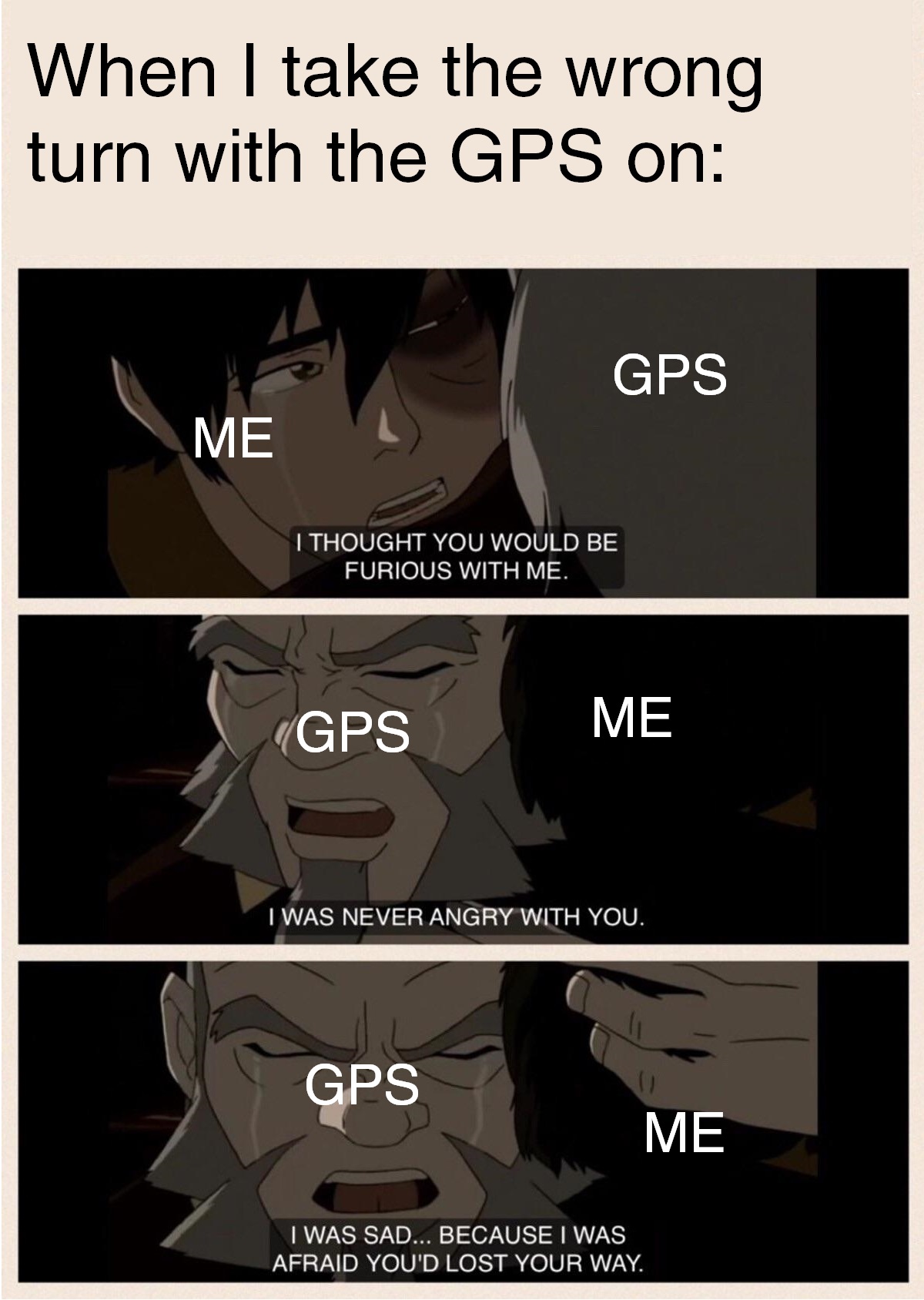
This meme satirizes the critical infrastructure of modern urban life by treating the GPS system as a vital part of city navigation. Much like traffic lights and street signs guide vehicles through a city, the GPS must correctly direct a driver to their destination. When the user takes the wrong turn, the joke plays out as a dramatic breakdown in this essential urban connection. The text highlights the emotional toll of this failure: the user was hurt because the system panicked that they had actually lost their way.
simple-description (llama3.2-vision_11b)
The meme is a humorous take on the frustration of using GPS navigation. The image depicts a person looking at a GPS screen with a shocked expression, with the text "I thought you'd be able to lead me to my destination" above it. The caption below reads "When I trust GPS to get me somewhere and it takes me to the middle of nowhere". The meme pokes fun at the common experience of relying on GPS navigation only to end up lost or in an unexpected location.
detailed-analysis (gemma3-27b-vision)
Okay, here's a breakdown of the meme, analyzed through the lenses you requested. I'll only include sections that are relevant; not every theoretical framework applies meaningfully here.
Visual Description
The image is a three-panel meme utilizing screen captures from what appears to be an anime or animated series. The style is characterized by dramatic lighting and stylized character expressions. Each panel features two characters positioned opposite each other. One character, labeled "ME," is positioned on the left, appearing emotionally distraught (crying, intense expressions). The other character, labeled "GPS," is positioned on the right, portrayed with a relatively stoic expression. Each panel presents a dialogue exchange between these characters, using white text boxes for the spoken lines. The background is primarily dark, focusing attention on the characters and their emotional exchange. The panels illustrate a shifting power dynamic and emotional revelation as the dialogue progresses.
Foucauldian Genealogical Discourse Analysis
This meme is interestingly amenable to Foucauldian analysis, not because it addresses historical power structures, but because it illustrates the discourse surrounding navigation and control.
- Power/Knowledge: The GPS embodies a form of power through its knowledge of the correct route. It has the ‘truth’ of where one should be going. "ME" is positioned as reliant on this knowledge, but initially presumes a power dynamic where the GPS holds judgment ("I thought you would be furious with me"). This is a projection of discipline onto the technology.
- Disciplinary Practices: The expectation of the "ME" character that the GPS would be angry reveals internalized disciplinary norms. We are conditioned to expect external correction when we deviate from expected paths, even from a machine. The GPS's statement ("I was never angry with you") disrupts this expectation.
- Genealogy of Navigation: A broader genealogical look would explore how the very concept of “correct” routes and expected behavior emerged. Historically, navigation was reliant on human expertise, maps, and societal conventions. The GPS is a modern manifestation of this, presenting a seemingly objective standard. The meme hints at the anxiety of surrendering our agency to these systems.
- Subjectivation: The “ME” character’s sadness isn't rooted in the mistake itself, but in the fear of the GPS's judgment. The GPS’s response re-writes the conditions of “ME’s” subjectivity, revealing the imagined projection.
Critical Theory
This meme can be explored through the lens of Critical Theory, specifically focusing on the concept of instrumental reason and the anxieties of modernity.
- Instrumental Reason: The GPS represents pure instrumental reason – it calculates and provides directions without consideration of emotional states or personal preferences. The "ME" character initially assumes the GPS should react based on a failure to follow its calculations.
- Alienation: The meme subtly highlights a sense of alienation in a technologically mediated world. The "ME" character is projecting feelings onto the GPS (assuming anger) and deriving meaning from a non-sentient source.
- Commodification of Guidance: The GPS itself is a commodity—a product designed to alleviate the anxiety of getting lost. However, the meme suggests that this commodification doesn't necessarily resolve the anxiety, but rather shifts it, leading to projections of emotion onto the tool itself.
- Dehumanization: The meme’s humor comes from the absurdity of “apologizing” to a machine. This highlights a potential for dehumanization within a hyper-technological society.
Postmodernism
The meme lends itself to a postmodern reading through its subversion of expectations and its commentary on the constructed nature of reality.
- Simulacra and Simulation: The GPS, as a digital representation of reality, can be seen as a simulacrum – a copy without an original. The ‘ME’ character’s emotional response is directed toward this simulacrum.
- Deconstruction of Authority: The GPS’s dismissal of anger dismantles the traditional notion of authority figures/systems (in this case, navigational assistance) holding judgment. The GPS does not judge, it is.
- Playfulness and Irony: The meme relies heavily on irony. The humor arises from the incongruity of expressing emotions to a machine. This is a distinctly postmodern aesthetic.
- Fragmentation of Self: The self, as represented by “ME,” is fractured, dependent on an external source for guidance and validation. The self is constructed in relation to the GPS, demonstrating the fluidity of identity in the postmodern era.
Let me know if you'd like me to elaborate on any of these analyses or explore additional theoretical frameworks!
simple-description (llama3.2-vision)
The meme is a humorous take on a common frustration when using GPS navigation. It depicts a character from the animated series "Avatar: The Last Airbender" (Zuko) and a narrator's internal monologue as they become increasingly frustrated with their GPS directions. The text "I was supposed to turn left 3 miles ago" is overlaid on the image, highlighting the character's growing anger and disappointment.
tesseract-ocr
When | take the wrong turn with the GPS on: \ GPS “ME & \ \Gps ts ; \ GPS : ME