First Seen
2023-05-10T21:03:42+00:00
simple-description (qwen3.5_2b-q8_0)
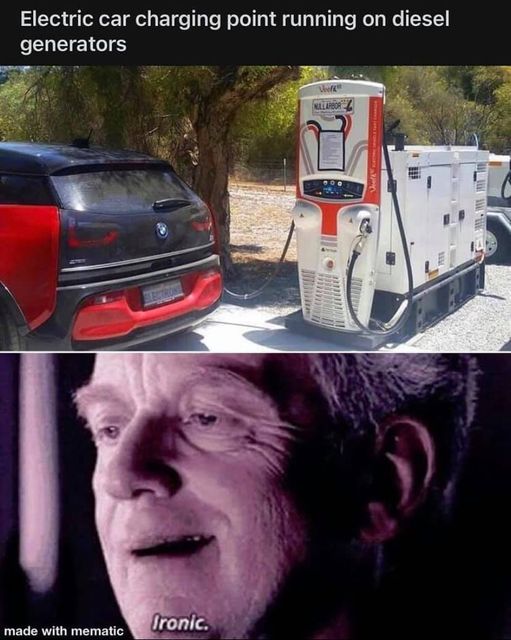
This urban humor piece satirizes the disconnect between modern infrastructure promises and reality, depicting an electric car charging station powered by a diesel generator. For a viewer unable to see it, the image shows a dark character delivering a sarcastic line that reads "Ironic," highlighting the irony of a city charging grid relying on fossil fuels instead of green energy. The caption at the top reads, "Electric car charging point running on diesel generators," further emphasizing the contradiction between the promise of technology and the actual fuel source used to power urban charging infrastructure.
simple-description (llama3.2-vision_11b)
The meme is a play on the concept of urbanization and the contrast between old and new technologies. The image depicts an electric car charging at a traditional gas station, highlighting the irony of an electric vehicle (EV) needing to charge at a location designed for fossil fuel-powered vehicles. The text "Electric car charging at a gas station" is a humorous commentary on the incongruity of modern technology in an outdated setting.
detailed-analysis (gemma3-27b-vision)
Here's an analysis of the image, broken down into relevant theoretical sections, as requested.
Visual Description
The image is a two-panel meme. The top panel shows a black electric vehicle (likely a Volkswagen e-Golf) connected to a charging station. However, the charging station isn’t powered by a typical grid connection. Instead, it’s being powered by a large, industrial diesel generator positioned right next to it. The setting appears to be a rural or semi-rural location.
The bottom panel is a close-up of actor Patrick Stewart, eyes narrowed, with the caption "Ironic." overlaid on the image. This is a popular meme format used to express situational irony or the absurdity of a situation.
Foucauldian Genealogical Discourse Analysis
A Foucauldian analysis focuses on power/knowledge relationships and how seemingly neutral technologies and discourses create and reinforce power structures. This image powerfully illustrates a complex power dynamic. The discourse surrounding electric vehicles is largely positioned as "green," "sustainable," and a move away from fossil fuels. However, the image materially demonstrates that the infrastructure supporting this "green" technology is, in this instance, reliant on the very fuels it’s supposed to replace.
This is not simply a technical problem, but a problem of genealogy. The genealogy of the "green vehicle" discourse doesn't tell the full story. We need to trace the history of this technology and its underlying infrastructure to see how the pursuit of "clean" energy can paradoxically rely on dirty energy sources. The image reveals the power dynamics at play: the discourse constructs an illusion of progress while masking the continued reliance on fossil fuels. The image thus becomes a site of resistance, exposing the limitations and inherent contradictions within the dominant narrative of sustainable technology.
Critical Theory
From a critical theory perspective, the image is a prime example of reification. Reification is the treatment of abstract concepts or social phenomena as if they were concrete, independent entities. The discourse around electric vehicles has created a fetish for the technology itself, obscuring the complex material and social conditions of its production and operation. The "green" image of the EV becomes a commodity fetish, a symbol of environmental responsibility that conceals the often-dirty reality of its energy source.
This image challenges the notion of technological solutionism – the belief that technology can solve all societal problems. It highlights how technology is always embedded in a social and political context, and that technological "solutions" often reinforce existing power structures and inequalities.
Marxist Conflict Theory
From a Marxist perspective, the image speaks to the inherent contradictions within capitalism. The drive for profit incentivizes manufacturers to create "green" products that appeal to consumers. However, the infrastructure needed to support these products (like the charging station) is still reliant on fossil fuels, meaning the capitalist system perpetuates its own reliance on environmentally destructive practices.
Furthermore, the diesel generator represents the exploitation of labor and resources necessary to extract, refine, and transport fossil fuels. The "green" veneer of the electric car masks this ongoing exploitation. The conflict lies between the appearance of sustainability and the material reality of continued dependence on exploitative and unsustainable practices. This is a classic case of capital seeking to valorize itself by appropriating environmental discourse.
Postmodernism
Postmodernism would see this image as a disruption of grand narratives – the overarching stories that give meaning to our lives. The dominant narrative of electric vehicles as a "solution" to climate change is undermined by the image's blatant contradiction. The image highlights the instability of meaning and the impossibility of achieving a singular, unified vision of progress.
The image is hyperreal – it's a simulation of sustainability that lacks any genuine connection to the ecological reality it pretends to represent. The image plays with irony and self-referentiality, highlighting the absurdity of our attempts to create meaningful change within a fundamentally flawed system. The meme format itself reinforces this sense of detachment and irony, creating a fragmented and ambiguous meaning.
Note: A Queer Feminist Intersectional Analysis doesn't seem directly applicable to the core message of this particular image. While one could explore the social construction of "green" technology through a gendered lens, or the disproportionate impact of pollution on marginalized communities, those issues aren't central to the image's initial message.
simple-description (llama3.2-vision)
The meme is a play on the common phrase "electric car charging station" and replaces "electric" with "electric car", implying that a car is somehow charging itself. The text "electric car charging station" is written in a way that's meant to be read as "electric car car charging station", with the word "car" inserted between "electric" and "car".
tesseract-ocr
Electric car charging point running on diesel generators 3 a ; oA tn aa Be) cme GL e et ae a ees ee ‘gE abe wae} * | / Ga > | aS as - re . eee - e ie S A ees ( a” o = ae |, ao . S Swink ~e ~~ = x. 5 qua ee!