First Seen
2023-05-10T20:59:59+00:00
simple-description (llama3.2-vision_11b)
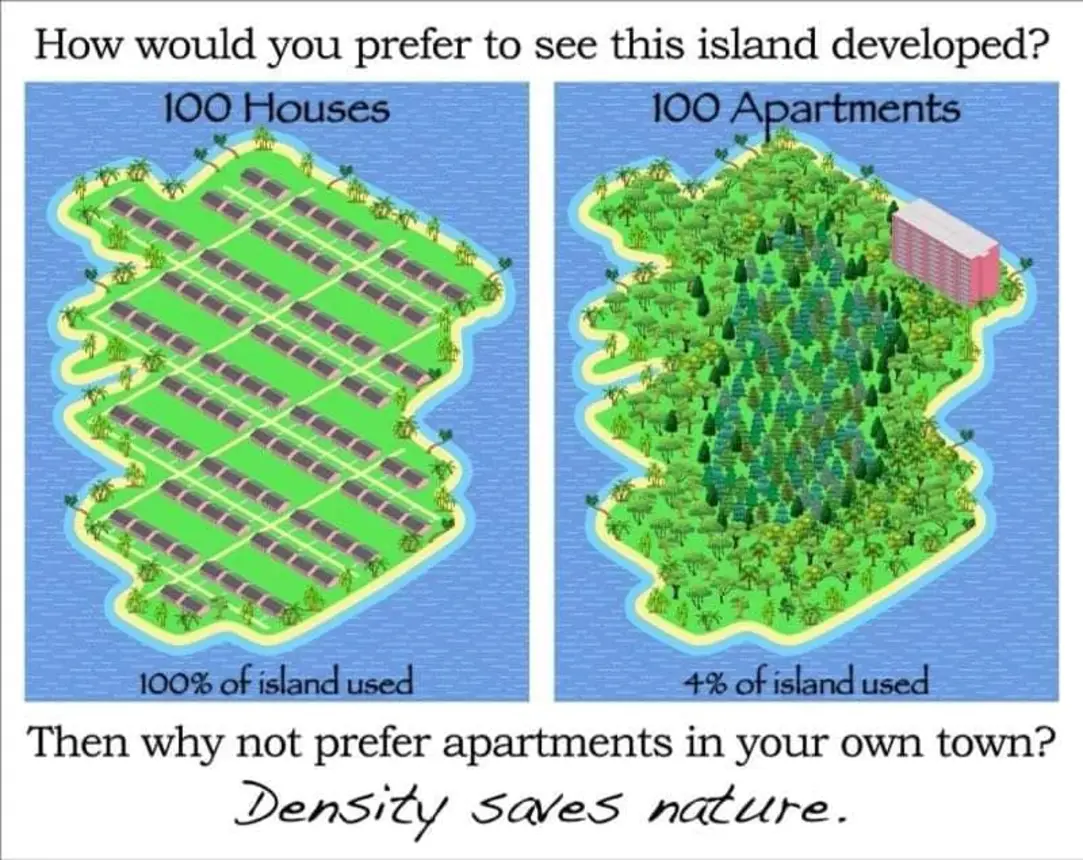
The meme is a humorous comparison between a city built with 100 houses and a city built with 100 apartments. The image shows a grid of 100 houses with 100% of the island used, and a forest with 100 apartments, with only 4% of the island used. The text at the bottom reads "Then why not prefer apartments in your own town? Density saves nature." This meme is a commentary on urban planning and the trade-off between density and green space, suggesting that building apartments can help preserve natural environments.
detailed-analysis (gemma3-27b-vision)
Okay, here's an analysis of the image, broken down into sections as requested. I'll only include sections where the theoretical framework has demonstrable relevance.
Visual Description
The image presents a comparative scenario of island development. It’s divided into two panels.
- Panel 1 (100 Houses): Displays a small, lush island completely covered in a grid-like arrangement of small, red-roofed houses. The entire landmass is utilized for housing, leaving no visible natural greenery. There is a label "100% of island used."
- Panel 2 (100 Apartments): Shows the same island, but instead of many small houses, it features a single, multi-story apartment building. A significantly larger portion of the island remains covered in green vegetation. The label reads “4% of island used”.
- Overarching Text: Below the two panels is the question "Then why not prefer apartments in your own town?" followed by the tagline “Density saves nature.” The overall visual impression is designed to contrast the environmental impact of sprawl (single-family homes) versus density (apartment buildings).
Critical Theory
The image lends itself well to Critical Theory, particularly concepts of spatial organization and its effects on both human experience and the environment.
- Spatial Justice: The image implicitly highlights issues of spatial justice. The 100 houses scenario depicts a prioritization of housing quantity at the expense of natural space and, arguably, environmental health. The apartment scenario suggests a possibility for co-existence between built environment and nature.
- The Built Environment as Ideology: Critical theorists (like Lefebvre) argue that the built environment isn’t neutral – it reflects and reinforces societal power structures. The image pushes us to question the default assumption that single-family homes are the ideal housing model. Is that preference a result of individual choice or a consequence of systemic factors like zoning laws, car-centric infrastructure, and culturally ingrained norms?
- Deconstructing Norms: The image actively challenges the normative assumption that single-family home ownership is the desired standard. It presents an alternative and implicitly questions the desirability of suburban sprawl. It's a visual argument for re-evaluating the ways we organize space and the environmental consequences of those choices.
Marxist Conflict Theory
While not explicit, elements of conflict theory can be inferred.
- Resource Control: The image subtly touches on the theme of resource control. The "100 Houses" scenario represents a complete domination of natural resources (land) for private (housing) gain. The apartment scenario demonstrates a more limited consumption of resources.
- Class & Housing: Historically, single-family homes have been associated with middle and upper-class aspirations. The image suggests that the pursuit of this housing model (sprawl) comes at an environmental cost that is disproportionately borne by all, while potentially benefiting a specific class.
- Power Dynamics: The control over land development (who decides how an island is built) is a reflection of power dynamics. The image could be seen as a call for a different power structure where environmental sustainability is prioritized over maximizing housing units (and potential profit).
Postmodernism
The image contains a degree of Postmodern messaging in its attempt to deconstruct the idea of a “normal” housing structure.
- Deconstruction of the "Ideal": The image is a deliberate attempt to challenge our expectations of what a developed island or town should look like. It's a rejection of the idea that there is a single, correct way to organize space.
- Framing and Narrative: The image doesn't present objective "facts", but rather frames a particular narrative about density and conservation. The tagline “Density saves nature” is a simplified message designed to sway the viewer towards a specific perspective.
- Rejection of Grand Narratives: The image pushes back against the “grand narrative” of endless suburban expansion and the “American Dream” of owning a single-family home. It suggests that there are alternative ways of living that can be more sustainable and environmentally conscious.
Note: I did not apply Foucauldian Genealogical Discourse Analysis or Queer Feminist Intersectional Analysis because the image does not strongly resonate with these theoretical frameworks. While you could potentially find tangential connections (e.g., examining the historical power dynamics involved in zoning laws), the image's primary message is about spatial organization, environmental impact, and challenging dominant norms, making the other frameworks more applicable.
Let me know if you’d like me to expand on any of these sections or explore a different theoretical angle!
simple-description (llama3.2-vision)
This meme is a humorous comparison between two hypothetical islands. The first island is a utopian community where every house is occupied by a single person, with a caption "100% of houses are occupied". The second island is a dystopian community where every house is occupied by 100 people, with a caption "100% of houses are occupied... by 100 people". The meme pokes fun at the idea of a community where every house is occupied, implying that it's not as ideal as it seems.
tesseract-ocr
How would you prefer to see this island developed? lla | Cee A PERI > Bac <> ae ag 5 See nate A 5 Pe eg a Mae Gb 4 og eae te a &, -: ', ‘2 £ ae = he D ae 4 es eae vy, a he rn ie, -, Ve, > : ae ee < >. $ 4 r "Se "te." Then why not prefer apartments in your own town? Density saves natttre.