
First Seen
2023-12-01T21:22:15+00:00
gemma3-27b-vision
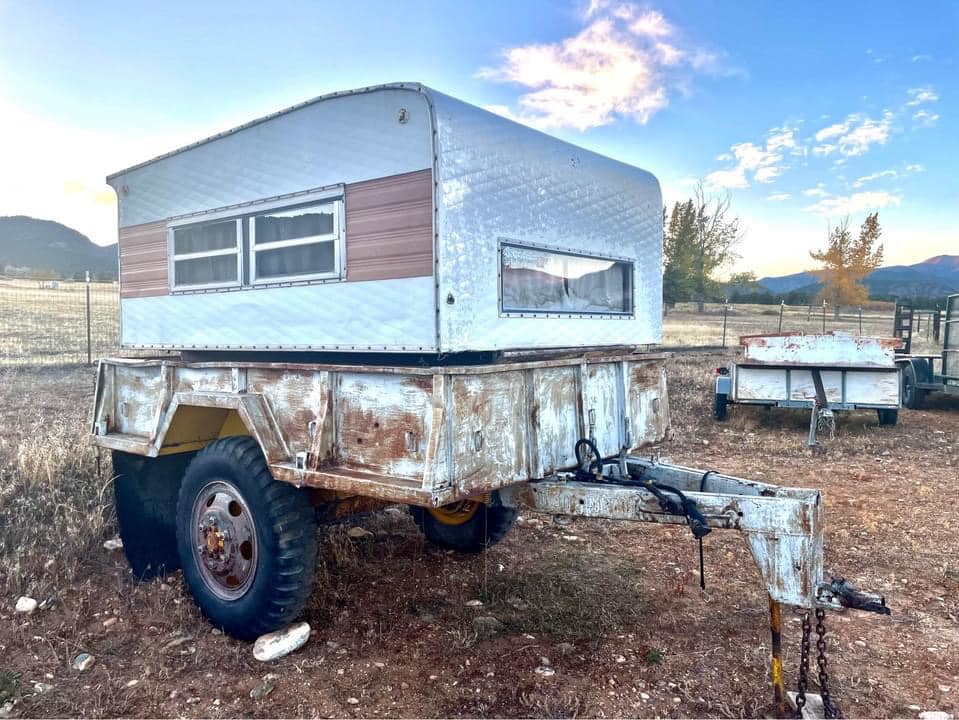
Okay, here's an analysis of the image, broken down into the sections you requested, *only* applying the theories where relevant and with a focus on interpretation from the image itself. Some sections will be brief or absent if the theory doesn't particularly apply. ## Visual Description The image depicts a vintage, weathered camper trailer. It is a boxy, rectangular structure mounted on a single axle with a rugged, off-road tire. The exterior is painted a faded white with significant rust and peeling paint, indicating age and exposure to the elements. Two small rectangular windows are visible, along with a larger window, all framed in faded brown. The trailer is connected to a towing mechanism with a chain, suggesting a history of use. The setting appears to be a dry, rural landscape, with dry grasses and distant hills. Two other trailers are partially visible in the background. The sky is a bright blue with scattered clouds. The overall impression is one of age, utility, and a life spent outdoors. ## Foucauldian Genealogical Discourse Analysis This trailer *can* be read through a Foucauldian lens as an artifact reflecting the *discourse* of mobility and leisure within a specific historical moment. The trailer's design suggests a period where self-sufficiency and a connection to nature were valued (perhaps the mid-20th century). The *genealogy* of the trailer - tracing its origins and evolution - would reveal shifts in how people perceived travel and recreation. * **Power/Knowledge:** The trailer embodies a power/knowledge relationship. It *allows* for a specific type of freedom and access to landscapes, but that freedom is *conditioned* by access to resources (a vehicle to tow it, land to travel to), and shaped by societal norms about leisure and the "great outdoors." * **Disciplinary Practices:** The trailer *disciplines* the body within a constrained space. It necessitates a certain type of organization, planning, and limitation of belongings to be functional. It dictates a mode of movement and limits where and how one can "live" while traveling. * **Archaeology of Knowledge:** Examining the trailer's design (materials, features, construction) would reveal how ideas about "camping" or "road tripping" were conceptualized at the time of its creation. It represents a concrete example of how those concepts manifested into an object, shaping the experience of travel. ## Marxist Conflict Theory The trailer represents a contradiction inherent in a capitalist system. While appearing to embody a form of "freedom" (the freedom of the open road), its very existence relies on a hierarchy of ownership and access. * **Means of Production:** The trailer itself is a product of labor, and embodies a portion of the surplus value extracted from that labor. It’s a commodity. * **Class Struggle:** While anyone *can* theoretically buy such a trailer, access is limited by economic means. It signifies a form of leisure and exploration available to those with disposable income. Its weathered state suggests it could have originated with a different class and is now possibly in transition. * **Alienation:** The trailer represents a form of escape *from* the alienation of industrial work, but ironically, relies on the products of that same system (materials, manufacturing processes). The trailer also physically *isolates* the occupant, creating a different form of alienation. ## Postmodernism The trailer, in its decayed state, is a perfect example of the postmodern concept of “the death of the original.” It is no longer a pristine representation of its original purpose. * **Pastiche/Irony:** The combination of an industrial object (the trailer) with the idealized notion of "getting back to nature" creates a sense of ironic juxtaposition. * **Fragmentation/Deconstruction:** The peeling paint, rust, and wear & tear visually represent fragmentation and the breakdown of a coherent narrative. The trailer is no longer a unified symbol but a collection of fragmented elements. * **Rejection of Grand Narratives:** The trailer rejects the idea of a linear progression towards a perfect camping experience. It acknowledges the inherent imperfections and ephemerality of travel. The trailer is in a state of entropy, a symbol of the instability of meaning. ## Queer Feminist Intersectional Analysis This analysis is the most challenging to apply *directly* from the image, but it’s possible to extrapolate. * **Space and Belonging:** Historically, access to outdoor recreation and "the wilderness" has been largely dominated by specific demographics (white, male, heterosexual). A trailer *could* be seen as a way to *reclaim* that space, but it simultaneously raises questions about who feels safe and welcome in those environments. * **Domesticity & Mobility:** The trailer combines elements of domestic space (a place to sleep, eat, and live) with mobility. This challenges traditional notions of "home" and the roles assigned to women within domestic space. However, the ruggedness and potential isolation of the trailer also present safety concerns, particularly for women traveling alone. * **Labor & Resource Allocation:** Consider the labor that went into building the trailer, and the resources extracted from the earth to create it. Who benefited from that labor and resource allocation? Was it equitable? Intersectionality would explore how gender, race, class, and other factors influenced those processes. **Important Note:** Many of these interpretations are speculative and rely on bringing theoretical frameworks to bear on a visual object. The image itself is open to multiple readings. Let me know if you'd like me to expand on any particular section or explore different interpretations.
tesseract-ocr
oe) . =a — ——— ib a — Fa HEL: v4 = = oC ey a j —— ‘ | int’ = aN a sea. ey = : - Fit Teeny aie a ae ea, — Za de wee th j set Wiiacae koe | aes ban me ge sj} NE /Mlecmeae fieigc Vt f Gre ane (al Oa er dee | | Sh eee eee ees Bonen 24 R = e ere ~ ae eee ee as fade, al ee en = 4 peg re a he as ee fet cee itt . Be Sn) |, ee iY vee +. a So. eo ete ee oa ’ o Pn Sey hi 2 ear ee é a FF. ee Soh ae See eS NER Re Be es ee ee ae ee ne A Pe Bee eee ala Masa eR ee en
llama3.2-vision
This meme features an image of a small, rusty, and old camper or trailer, with a faded and worn-out exterior. The text "I can see right through you" is written in a bold, red font, implying that the camper's exterior is being used as a metaphor for someone's ability to see through someone else's deception or lies.